Sitting at the top of the Premier League table on Christmas Day has long been viewed as a powerful omen. English football folklore often suggests that leading the league at this point of the season places a team firmly on course for the title.
However, history tells a more nuanced story. While many Christmas leaders do go on to lift the trophy, others have watched their advantage evaporate after the festive period. As Arsenal find themselves at the summit this Christmas, the familiar question returns: does being top on December 25 truly guarantee Premier League glory?
What History Says About Christmas Leaders
Since the Premier League era began in 1992, a clear pattern has emerged between Christmas leaders and eventual champions. Out of 33 Premier League seasons, the team leading the table on December 25 has gone on to win the title 17 times.
More strikingly, in 11 of the last 15 seasons, the Christmas leaders ultimately finished as champions. This trend highlights how modern title races often reward early consistency, squad depth, and the ability to manage the intense winter schedule.
Since the year 2000, dominant clubs such as Manchester United, Chelsea, Manchester City, and Liverpool have repeatedly demonstrated their ability to hold onto a Christmas advantage. These teams often possessed not only quality starting line-ups but also the depth and experience needed to survive injuries, fixture congestion, and pressure.
Yet, despite these numbers, being top at Christmas remains far from a guarantee.
When Christmas Leaders Fall Short
For every success story, there is a cautionary tale. Several Premier League seasons have ended with dramatic twists, reminding fans that the title race remains open well into the spring.
Among the most notable examples is Liverpool, a club that has experienced both the joy and heartbreak associated with Christmas leadership. Over the past 11 seasons, five Christmas leaders failed to win the title—and Liverpool accounted for three of those collapses.
The 2008/09 and 2013/14 campaigns remain particularly painful for Liverpool supporters. In 2014, a home defeat to Chelsea followed by a stunning 3–3 draw against Crystal Palace—after leading by three goals—proved decisive moments that allowed Manchester City to seize the title.
These seasons reinforced the idea that momentum, not just position, determines champions.
Liverpool’s Recent Redemption
History, however, does not always repeat itself. Liverpool finally reversed their Christmas curse in the 2024/25 season, leading the table on December 25 and successfully converting that advantage into a Premier League title.
That triumph served as a reminder that past failures do not dictate future outcomes. With the right balance of mentality, fitness, and tactical clarity, teams can learn from history rather than be haunted by it.
Liverpool’s success also reinforced the importance of experience—both within the squad and the coaching staff—when navigating the pressures of a title run-in.
Manchester City: Masters of the Chase
If Liverpool represent the dangers of losing a Christmas lead, Manchester City exemplify the art of hunting from behind. More than half of City’s nine Premier League titles were won in seasons where they were not top at Christmas.
City are, remarkably, the only team to have won the Premier League after being as low as eighth place on Christmas Day. That extraordinary comeback came during the 2020/21 season, when Pep Guardiola’s side trailed by eight points before embarking on a relentless winning streak.
Their ability to sustain long runs of victories after Christmas has redefined modern title races, proving that consistency between January and April can outweigh early-season dominance.
Extreme Comebacks That Defy Logic
The Premier League has also produced some truly dramatic turnarounds. One of the most remarkable occurred in 1997/98, when Arsenal trailed by 13 points on Christmas Day yet still surged to the title.
That season remains one of the clearest examples that point gaps in December are not insurmountable. Tactical adjustments, squad rotation, and psychological resilience can rapidly reshape the title picture.
Such comebacks ensure that no team—whether leading or chasing—can afford complacency.
Arsenal’s Recent Painful Lesson
Arsenal themselves know better than most how fragile a Christmas advantage can be. During the 2022/23 season, the Gunners held a six-point lead over Manchester City at Christmas and remained top of the table for 248 days—the longest spell at the summit without winning the league in Premier League history.
Despite a five-point cushion entering April, Arsenal’s form dipped at a crucial moment. City capitalized ruthlessly, overtaking them and securing the title with games to spare.
That collapse left scars, but it also delivered invaluable lessons about squad depth, game management, and handling pressure at the elite level.
Is This Arsenal’s Defining Season?
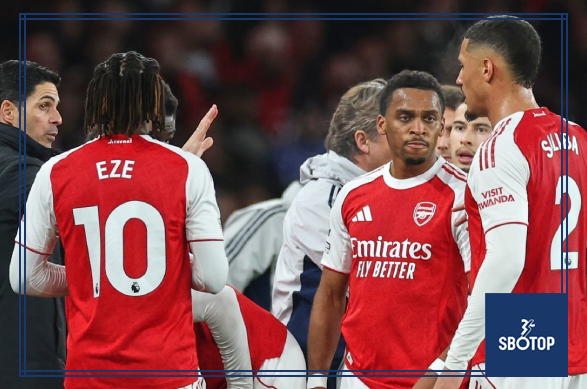
This season feels different for Arsenal. Their squad appears deeper, more experienced, and mentally tougher than in previous campaigns. Key players have matured, and the team looks better equipped to cope with injuries and fixture congestion.
Leading the Premier League at Christmas places Arsenal in a statistically strong position—but not a guaranteed one. History suggests they have roughly a 50–50 chance of turning that advantage into silverware, depending on performance after the festive period.
Christmas Is a Signal, Not a Verdict
Being top of the Premier League on Christmas Day is undeniably significant. It reflects consistency, quality, and momentum. But it is not a final verdict.
For Arsenal, the challenge now is to prove that this Christmas lead represents the start of a championship run—not another chapter in football’s long list of festive false dawns. The months ahead will decide whether history finally works in their favor.
ALSO READ :
- SBOTOP : Sir Alex Ferguson Warns Manchester United Are Caught in a Cycle Once Faced by Liverpool
- SBOTOP : Manchester United Demand Meeting with PGMOL Chief Howard Webb Over Two Controversial Incidents
- SBOTOP : Wayne Rooney Admits Alcohol Addiction During Playing Career, Highlights Football’s Ongoing Drinking Culture