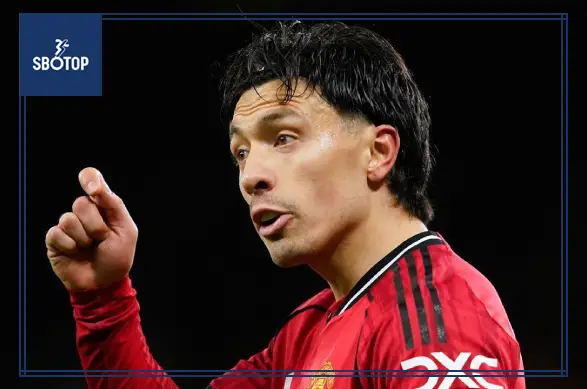
Manchester United defender Lisandro Martinez has opened up about the most vulnerable and challenging chapter of his professional career, revealing that a serious knee injury once pushed him to consider walking away from football entirely.
The Argentina international endured a brutal recovery process after suffering multiple injuries across the last two seasons, a difficult period that ultimately culminated in a torn anterior cruciate ligament (ACL). What followed was not only a physical battle, but a profound mental struggle that forced Martinez to confront his future in the sport.
Speaking in an emotional interview with AFA Estudio, the 27-year-old shared a deeply personal account of pain, doubt, and the psychological toll of long-term rehabilitation, offering rare insight into the human side of elite football.
A Career-Defining Setback for Manchester United’s Defender
Martinez’s ACL injury in February 2025 marked the lowest point of his career. The setback required surgery and sidelined him for an estimated ten months, effectively removing him from Manchester United’s plans during a crucial phase of the season.
For a player known for his intensity, aggression, and leadership at the back, the sudden loss of mobility was devastating. The injury did not occur in isolation either. Martinez had already struggled with recurring physical issues, including a broken foot earlier in his United career, which limited his consistency and availability.
During the previous Premier League campaign, he managed only 11 league appearances, a frustrating statistic for both club and player. The accumulation of setbacks left him physically drained and emotionally exhausted.
“I Didn’t Want to Play Football Anymore”
Martinez admitted that the early weeks following surgery were overwhelming. As the reality of another long recovery set in, his motivation collapsed.
“After the first two or three weeks, I didn’t want to play football anymore,” Martinez confessed. “I had already been through a broken foot, and then my knee happened. I said, ‘That’s enough. I don’t want to know anything anymore.’”
The defender explained that the constant cycle of injury and rehabilitation broke his mental resilience. Football, once the center of his identity, became a source of suffering rather than joy.
At that moment, his only desire was to return home to Argentina, be close to his family, and escape the pressure of professional sport.
Losing Balance Both Physically and Emotionally
Martinez described how pain disrupted not just his body, but his emotional stability as well. The intensity of the physical discomfort affected his mindset and decision-making.
“When I got injured, I completely lost my balance because the pain was unbearable,” he said. “My first reaction was to go home, be with my family, and stop suffering. I wanted to be healthy and enjoy life.”
He acknowledged that those thoughts did not reflect his true self, but rather a moment of emotional disconnection caused by trauma.
“When you’re unbalanced, you can say anything because you’re not connected to yourself. I allowed myself about three weeks of mourning, when I wasn’t really myself.”
Rebuilding Identity During Rehabilitation
As the weeks passed, Martinez slowly began the process of self-reconstruction. Rehabilitation forced him to redefine his identity beyond being a footballer, something he admitted was deeply uncomfortable.
“You have to recreate yourself in every way: physically, mentally, and personally,” he explained. “At times, you don’t even feel like a football player anymore.”
Fear became a constant companion. Doubts about whether he would return to his previous level, or whether his body would hold up again, lingered throughout his recovery.
However, Martinez emphasized that this period also revealed the importance of mental strength and personal character.
“That’s when you truly discover who you are as a person,” he said.
The Role of Family, Support, and Mental Strength
One of the key factors that helped Martinez endure was the support system around him. His family, close friends, and psychological work played a vital role in stabilizing his mindset during the darkest moments.
Rather than rushing his return, Martinez learned patience and trust in the rehabilitation process. Manchester United’s medical team carefully managed his recovery, focusing on gradual progress rather than quick fixes.
This holistic approach allowed him to regain confidence step by step, both on and off the pitch.
Return to Action and Renewed Optimism
Martinez finally made his return on November 30 in a match against Crystal Palace, marking the end of a long and painful absence. Since then, he has steadily re-entered Manchester United’s rotation, showing signs of his old aggression and composure.
His comeback also earned him a return to the Argentina national team setup under Lionel Scaloni, a significant signal of trust ahead of the 2026 World Cup cycle.
“I feel really good,” Martinez said. “I was a bit surprised because I thought coming back would be harder, but we managed my minutes very well. Everything was progressive.”
He praised the club’s handling of his recovery, crediting their professionalism for his current condition.
“The club did an incredible job, and that helped me feel good again. Physically and mentally, I feel better than ever.”
A Stronger Lisandro Martinez Emerges
Martinez’s story is not just about injury and recovery, but about resilience, vulnerability, and personal growth. After nearly walking away from football, he has returned with renewed perspective and mental strength.
For Manchester United and Argentina, his comeback represents more than just a defensive reinforcement. It is the return of a player who has faced his darkest moment and emerged stronger, wiser, and more determined than ever.
As Martinez continues his journey back to peak performance, his story serves as a powerful reminder that even elite athletes are human, and sometimes, the toughest battles are fought away from the pitch.
ALSO READ :