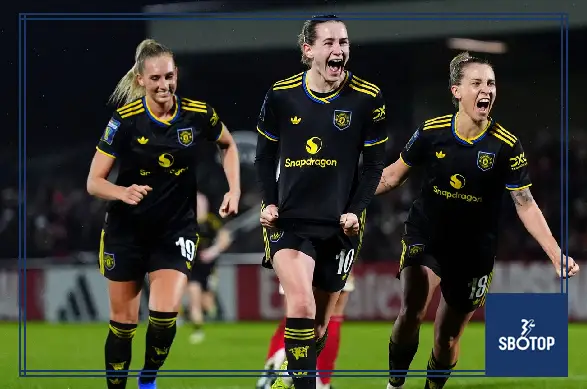
Manchester United Women etched a new chapter into their rapidly evolving history as Elisabeth Terland’s decisive goal secured a landmark 1–0 victory over Arsenal, sending the Red Devils through to their first-ever Women’s League Cup final. On a night defined by intensity, discipline, and belief, United delivered a performance that showcased how far the club has come—and how high its ambitions now reach.
For Arsenal, the defeat was a bitter blow. A side rich in experience and silverware entered the semi-final as favorites, yet they were undone by a moment of sharp attacking instinct and a United defense that refused to yield. This was not merely an upset; it was a statement.
A Semi-Final Charged with Expectation
The build-up to the clash carried a sense of anticipation rarely matched in domestic cup football. Arsenal, perennial contenders and serial winners, arrived with pedigree and pressure. Manchester United, meanwhile, carried the hunger of a club still building its trophy cabinet but steadily closing the gap on England’s elite.
From the opening whistle, it was clear this would not be a cautious affair. The tempo was fierce, challenges were robust, and both sides sought early dominance. Arsenal attempted to impose control through possession, while United looked to disrupt rhythm and strike with pace on the counter.
The atmosphere reflected the stakes. Every interception was celebrated, every duel contested like a final itself. This was knockout football in its purest form.
Manchester United’s Tactical Blueprint
United manager Marc Skinner approached the semi-final with a clear plan: compact defensive shape, aggressive pressing triggers, and rapid transitions into wide areas. Against an Arsenal side known for positional play and attacking depth, United focused on denying space between the lines.
The midfield pairing was crucial. They screened the back four intelligently, closing down passing lanes and forcing Arsenal into wider, less dangerous areas. Full-backs were disciplined, rarely overcommitting, ensuring Arsenal’s wingers were constantly faced with two defenders.
Crucially, United were not passive. When possession was won, they moved the ball forward decisively, refusing to settle for survival football.
Arsenal’s Early Control Without Reward
As expected, Arsenal dominated possession in the opening stages. Their build-up play was neat and composed, with defenders stepping into midfield and attackers rotating fluidly. However, despite the territorial advantage, clear-cut chances were hard to come by.
United’s defensive line remained compact, tracking runners diligently and clearing crosses with authority. Arsenal attempted to increase tempo, but United’s press forced hurried passes and disrupted rhythm just as attacks began to develop.
This inability to translate possession into penetration would ultimately define Arsenal’s night.
The Moment That Changed Everything
The breakthrough arrived midway through the first half—and it came from Elisabeth Terland, a forward whose work rate and intelligence have quickly made her indispensable.
The move began deep in United’s half. A well-timed interception triggered a swift transition, with the ball moved into space down the right flank. Arsenal’s defensive line scrambled to reset, but Terland read the situation perfectly.
Timing her run between defenders, she met a precise delivery with calm assurance, guiding the ball past the goalkeeper with a composed finish that silenced the home crowd and ignited celebrations among United supporters.
It was a goal born of anticipation, movement, and ruthless efficiency—everything United had prepared for.
Elisabeth Terland Rising to the Occasion
Terland’s goal will be remembered as a historic moment, but her overall performance was just as impressive. She led the line with intelligence, constantly pressing Arsenal’s defenders and offering an outlet under pressure.
Her movement caused problems throughout the match. Even when not in possession, she dragged defenders out of position, creating space for teammates to exploit. Defensively, she worked tirelessly, tracking back and contributing to United’s collective effort.
In big matches, moments define players. On this occasion, Terland delivered the defining moment—and did so with composure that belied the pressure of the occasion.
Arsenal’s Response Pressure Without Precision
Conceding the opening goal forced Arsenal to raise the intensity. The second half saw a more aggressive approach, with full-backs pushing higher and midfielders taking greater risks.
Crosses were delivered in volume, shots were taken from range, and United’s penalty area became a constant battleground. Yet, despite the pressure, Arsenal lacked the sharpness required to break through.
Time and again, United defenders made crucial blocks, clearances, and interceptions. Goalkeeper distribution was calm, decision-making was measured, and panic never set in.
Defensive Masterclass from Manchester United
If Terland’s goal provided the highlight, United’s defensive performance delivered the foundation. Every player understood their role and executed it with discipline.
- Center-backs won aerial duels and held the line.
- Full-backs timed tackles perfectly and denied space in wide areas.
- Midfielders tracked runners relentlessly.
- The goalkeeper commanded the box with authority.
This was not defensive desperation—it was organized resistance, the hallmark of a team with growing maturity.
The Psychological Battle
As the minutes ticked away, the psychological dimension of the contest became increasingly evident. Arsenal’s urgency grew, but so did frustration. Missed chances and blocked shots chipped away at confidence.
United, meanwhile, grew stronger. Each successful defensive action reinforced belief. Time management became intelligent rather than negative, with possession retained when possible and fouls drawn in safe areas.
The final ten minutes were played with the intensity of a final whistle waiting to be blown—and when it was, United’s bench erupted.
Historic First League Cup Final for United
The significance of the victory cannot be overstated. Manchester United Women had reached their first League Cup final, a milestone that signals the club’s evolution from newcomers to genuine contenders.
Since their formation, United’s rise has been steady rather than rushed. Investments in infrastructure, recruitment, and coaching have begun to bear fruit, and this semi-final victory felt like validation of that long-term vision.
For players and supporters alike, the final now represents an opportunity not just to compete—but to win silverware.
What This Means for Arsenal
For Arsenal, the defeat will prompt reflection. While the performance was not poor, the lack of cutting edge proved costly. Dominance without goals is a familiar frustration in knockout football.
The result does not diminish Arsenal’s quality or pedigree, but it does highlight areas for improvement—particularly in breaking down well-organized defensive sides.
Experienced teams are often judged by how they respond to setbacks. Arsenal will now shift focus to the league and other competitions, determined to ensure this disappointment does not linger.
Tactical Lessons from the Semi-Final
Several key lessons emerged from the contest:
- Efficiency Beats Volume
United required fewer chances but made them count. - Defensive Structure Wins Knockout Games
Organization and communication proved decisive. - Transitions Are Crucial
United’s goal came from swift, purposeful movement after regaining possession. - Mental Resilience Matters
United handled pressure with composure, while Arsenal struggled to convert urgency into clarity.
The Growing Gap—or Closing One
Matches like this suggest that the gap between England’s traditional powerhouses and emerging contenders is narrowing. United’s victory was not a fluke; it was the result of planning, belief, and execution.
As the women’s game continues to grow in quality and depth, results like this will become increasingly common—and increasingly celebrated.
Also Read:
- SBOTOP: Middlesbrough Climb Back to Second as Saints Overpower Sheffield United in Championship Showdown
- SBOTOP: Dominik Szoboszlai Emerges as Liverpool Superstar While Moises Caicedo Impresses for Chelsea – Champions League Hits and Misses
- SBOTOP: Mohamed Salah Remains on Saudi Pro League Radar Despite Liverpool’s Focus on Younger Signings