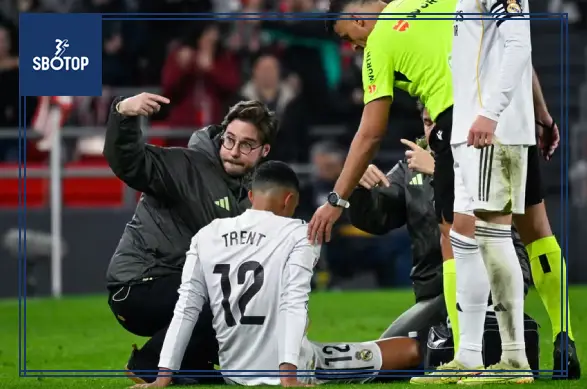
Real Madrid suffered a major blow on Thursday after confirming that England defender Trent Alexander-Arnold will be ruled out for approximately two months due to a thigh muscle injury. The full-back underwent an MRI scan earlier in the day, which revealed a significant strain in the rectus femoris of his left leg — an injury that immediately heightens concerns within the squad as Madrid enter one of the busiest phases of the season.
The 25-year-old was forced to leave the pitch during Real Madrid’s 3–0 LaLiga victory over Athletic Club on Wednesday night. What initially appeared to be a precautionary substitution was soon revealed to be a serious muscular issue, one that now sidelines the Englishman for up to 13 matches across all competitions.
Injury Confirmed After MRI Scan
In an official medical statement, Real Madrid outlined the results of the examination:
“Following tests carried out today on our player Trent Alexander-Arnold by Real Madrid’s medical services, he has been diagnosed with a muscle injury in the rectus femoris muscle of his left leg. His recovery will be monitored.”
This diagnosis not only confirms his absence for the remainder of the Champions League group stage but also places him out of contention for several key domestic encounters. Club insiders suggest that his return will not be expected before February, although recovery timelines may shift depending on his rehabilitation progress in the coming weeks.
Key Matches He Will Miss
The injury comes at a critical juncture for Real Madrid, with the team preparing for multiple high-stakes matches in both LaLiga and Europe. Alexander-Arnold is set to miss:
-
Champions League fixtures against Manchester City, AS Monaco, and Benfica
-
At least six LaLiga matchdays
-
The Spanish Super Cup in January
-
Several Copa del Rey rounds, depending on scheduling
This extended absence leaves head coach Xabi Alonso facing a tactical puzzle, especially given that Real Madrid were already dealing with shortages in the right-back position.
Real Madrid’s Right-Back Crisis Deepens
Complicating the situation further is that Dani Carvajal, the club’s long-serving right-back, remains unavailable as he continues recovery from arthroscopic knee surgery performed on October 28. Carvajal had suffered a ligament tear earlier in the year and briefly returned in late October before undergoing the latest procedure.
While the 33-year-old is targeting a comeback during the Spanish Super Cup, the club medical team remains cautious about fast-tracking his return, wary of causing long-term complications.
With both Alexander-Arnold and Carvajal sidelined, Madrid now find themselves without a natural right-back heading into a packed winter schedule. Alonso may be forced to experiment with makeshift solutions, such as:
-
Deploying versatile midfielder Federico Valverde as an emergency right-back
-
Using young centre-back Raúl Asencio, who has played the role earlier this season
-
Switching to a back-three system to reduce reliance on full-backs
Madrid have already relied on such adjustments earlier in the campaign, when injuries disrupted continuity in the defensive line.
Alexander-Arnold Still Searching for Peak Form in Spain
Alexander-Arnold joined Real Madrid in the summer transfer window with high expectations. Brought in to add creativity, precision crossing, and world-class distribution on the right flank, the England international was seen as a major upgrade to help modernize Madrid’s buildup play.
However, his adaptation to LaLiga has been uneven. While he has delivered moments of brilliance reminiscent of his Liverpool peak, recurring injuries and tactical adjustments have prevented him from finding consistency in his debut season in Spain.
This latest setback now interrupts his progress once again, leaving Madrid fans waiting to see the version of Alexander-Arnold that dominated English football for years.
Xabi Alonso Faces Major Selection Challenges
For Alonso, who is navigating his first full season in charge of Real Madrid, the timing of the injury could not be worse. The club must contend with top-tier opponents in the Champions League and maintain pressure in the LaLiga title race.
Losing Alexander-Arnold — especially while Carvajal is unavailable — forces him to rethink his approach entirely.
He may rely more heavily on Madrid’s midfield talent to compensate for the lack of width from the right side or emphasize inverted full-back roles when improvising defensively. Either way, squad rotation and tactical adaptability will be essential in the coming months.
Looking Ahead
Alexander-Arnold’s tentative return date of February 2026 offers some relief for Madrid, but the exact recovery timeline will depend on how quickly the muscle responds to treatment. Thigh injuries — particularly those involving the rectus femoris — can be unpredictable for players whose game relies heavily on sprinting and long-range passing.
Real Madrid will hope that one of their marquee summer signings can recover smoothly and return to peak form before the Champions League knockout stages begin.
For now, however, they must navigate a demanding schedule without both of their senior right-backs, turning this injury blow into one of the biggest challenges of Madrid’s season so far.