


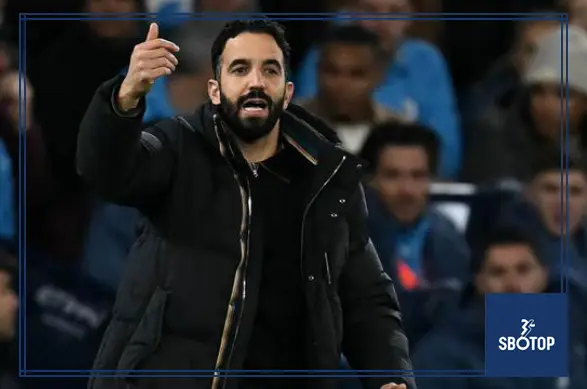
Manchester United head coach Ruben Amorim has finally opened up about his decision to persist with the much-debated 3-4-2-1 formation, a tactical setup that has divided opinion since his arrival at Old Trafford. According to Amorim, external pressure—particularly from the media—played a decisive role in convincing him not to abandon the system too early.
The Portuguese coach admitted that constant calls for change only reinforced his determination to stay the course, believing that reacting too quickly would undermine both his authority and the long-term project he is building at Manchester United.
A System Built on Past Success
Amorim’s commitment to the back-three formation is deeply rooted in his previous success. During his time at Sporting CP, the system delivered remarkable results, including Primeira Liga titles in the 2020/21 and 2023/24 seasons. Even after his departure, Sporting went on to reclaim the league crown in 2024/25, further validating the effectiveness of the approach.
However, what worked seamlessly in Portugal presented a far greater challenge in England. The Premier League’s intensity, combined with Manchester United’s existing squad profile, meant the transition required time, patience, and a significant period of adaptation.
Recruitment Aligned With Tactical Vision
Since Amorim’s appointment, United’s recruitment strategy has increasingly focused on players who fit the demands of a three-at-the-back system. The aim was not just to win matches in the short term, but to build a squad capable of executing Amorim’s philosophy consistently.
One notable beneficiary of the tactical shift has been Amad Diallo, who had struggled for prominence under former manager Erik ten Hag. Under Amorim, Diallo has been entrusted with a more influential role, highlighting the coach’s belief in reshaping individual responsibilities within his system.
Criticism and a Historic Low Point
Despite the long-term vision, criticism mounted rapidly. Many analysts and supporters pointed to tactical rigidity and a perceived lack of short-term compromise as major factors behind United’s disastrous 2024/25 campaign—widely regarded as the club’s worst season in 51 years.
Questions were raised about whether Amorim’s refusal to adapt was costing the team results. The scrutiny intensified even as the club began to show gradual improvement following more targeted recruitment and a full pre-season dedicated to embedding the new principles.
Still, Amorim remained under constant pressure, with every team selection and formation choice dissected by fans and media alike.
Experimentation Behind Closed Doors
Reports emerged suggesting Amorim had quietly tested alternative systems ahead of United’s dramatic 4–4 draw against AFC Bournemouth. The coach later confirmed the reports, admitting his surprise at how quickly such information became public.
Despite the experimentation, Amorim opted to stick with his original approach against Bournemouth and again six days later in a defeat to Aston Villa. For him, consistency remained essential, even in the face of mounting criticism.
Timing the Tactical Shift
The turning point came on Boxing Day, when Manchester United faced Newcastle United. On that occasion, Amorim switched to a 4-2-3-1 formation—a move that paid off with a crucial victory.
Amorim stressed that timing was everything. Making the change earlier, he argued, would have sent the wrong message to his players and weakened his position as head coach.
“When journalists keep talking about changing the system, I cannot change it immediately because players will think I am doing it because of pressure,” Amorim explained during a recent press conference. “In my opinion, that is the end of a manager.”
He went on to clarify that tactical changes should come from strength, not desperation.
“When we play well with our system, that is the right moment to change—if it helps us win the next match. That is what we did against Newcastle,” he added.
Injuries and External Challenges
Complicating matters further was United’s injury crisis, with eight players unavailable due to fitness issues and commitments at the 2025 Africa Cup of Nations. These absences limited Amorim’s options and reinforced his belief that stability was preferable to constant tactical upheaval.
Under such circumstances, maintaining a clear identity became a priority, even if results did not immediately reflect progress.
A Philosophy Now Taking Shape
According to Amorim, the situation has now evolved. He believes the foundations of his philosophy are firmly in place, allowing for greater tactical flexibility without appearing reactive to outside noise.
“Today, the moment is different,” he said. “We don’t have many players, so we need to adapt, but I know they understand why we are changing. This is not because of pressure from journalists or fans.”
He emphasized that while formations may vary, the underlying principles remain unchanged.
“Now we understand how we want to play. The principles are the same. We can change the system. I think we will be a better team because when everyone returns, we won’t always play with three at the back,” Amorim explained.
Looking Ahead
Amorim concluded by reiterating his belief that Manchester United are still evolving. Flexibility, he insists, will come naturally as the squad grows more familiar with his ideas.
“We will keep improving. That is what I have been talking about,” he said.
For now, Amorim’s message is clear: resisting media pressure was a deliberate choice, made to protect the integrity of his project. As Manchester United continue to develop under his guidance, the coming months will reveal whether patience—and persistence—will ultimately pay off.
ALSO READ :








