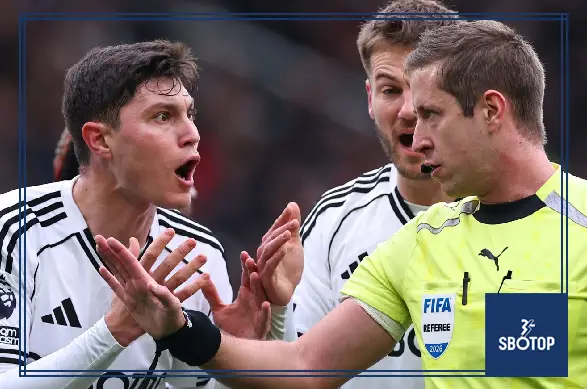
Manchester United’s dramatic 3–2 victory over Fulham delivered goals, momentum swings, and late drama—but it was not the football alone that dominated the post-match conversation. Instead, controversy took center stage as Fulham manager Marco Silva launched a fierce criticism of VAR, claiming the video review process intervened because the referee’s original decision was “so bad.”
Silva’s comments added fuel to an already volatile debate surrounding officiating standards, VAR consistency, and transparency in the Premier League. What unfolded at Old Trafford was not merely a thrilling contest between two competitive sides, but a flashpoint in football’s ongoing struggle to reconcile human judgment with technological oversight.
A Match That Had Everything—Including Controversy
From a neutral perspective, the match was a spectacle. Manchester United, buoyed by growing confidence, faced a Fulham side determined to challenge one of the league’s most storied clubs on their own turf.
The game featured:
- End-to-end attacking football
- Defensive lapses at critical moments
- Tactical adjustments from both benches
- A late decisive goal that swung the result
Yet despite all the footballing narratives available, the spotlight shifted sharply toward one VAR intervention that left Fulham feeling aggrieved and their manager incensed.
The Incident That Sparked the Storm
The controversial moment arrived during a critical phase of the match. Fulham believed they had earned a foul that would have halted United’s attacking momentum. Instead, play continued, eventually leading to a goal that proved decisive in the final outcome. VAR intervened—but not in the way Fulham expected. According to Silva, the video officials identified a different foul than the one initially called—or missed—by referee John Brooks. Silva argued that this reinterpretation undermined the credibility of the entire process, suggesting VAR was searching for justification rather than correcting a clear and obvious error.
“It’s not about interpretation anymore,” Silva implied post-match. “It’s about fixing something that should never have been missed.”
Marco Silva’s Frustration Boils Over
Silva’s post-match comments were among the strongest criticisms of VAR heard this season. He did not merely question the outcome—he challenged the reasoning behind it.
His central argument was clear:
- VAR should intervene only for clear and obvious errors
- The referee’s original decision was altered without conclusive evidence
- The explanation given lacked coherence and transparency
By stating that VAR stepped in because the on-field decision was “so bad,” Silva highlighted what he sees as a growing problem: subjective reinterpretation disguised as objective correction.
Referee John Brooks Under the Microscope
Referee John Brooks found himself at the center of the controversy. While refereeing is an inherently difficult task, this match raised uncomfortable questions about authority and accountability.
Silva’s comments implied that Brooks’ decision-making invited VAR intervention—not because of factual error, but because of perceived inadequacy. That distinction matters.
If VAR is correcting decisions because they are “bad” rather than incorrect, then the entire framework of officiating standards becomes unstable.
Officials are expected to interpret the game. VAR, in theory, exists to correct mistakes—not judgments.
Manchester United’s Perspective Play to the Whistle
From Manchester United’s standpoint, the reaction was more restrained. Their players emphasized a familiar footballing principle: play until the whistle.
United argued that they took advantage of a situation allowed by the officials and should not be penalized for doing so. The goal, in their view, was legitimate under the laws as applied in real time.
They also pointed to moments earlier in the match where decisions had gone against them, reinforcing the idea that refereeing errors—even controversial ones—tend to balance out over the course of a season.
VAR’s “Different Foul” Explanation Raises Eyebrows
Perhaps the most troubling aspect of the incident was the explanation that VAR identified a different foul than the one initially debated.
This raised immediate concerns:
- Was VAR searching for justification rather than evidence?
- Did the review exceed its remit?
- How many interpretations are allowed in a single review?
Critics argue that VAR should assess one specific incident, not reinterpret the entire phase of play. Expanding the scope of reviews risks turning VAR into a tool for narrative correction rather than factual accuracy.
Fans React Confusion and Anger
As expected, fan reaction was swift and polarized. Fulham supporters expressed outrage, pointing to what they perceived as systemic bias toward bigger clubs. Manchester United fans countered by highlighting the chaos and inconsistency of officiating across the league.
What united both sides, however, was confusion.
Many fans admitted they no longer understood:
- What constitutes a foul
- When VAR should intervene
- How decisions are ultimately reached
This erosion of clarity is arguably VAR’s greatest failure.
Pundits Weigh In A System Under Strain
Football analysts and pundits were quick to dissect the incident. While opinions differed on the decision itself, there was broad consensus on one point: the communication surrounding VAR remains inadequate.
Several experts argued that:
- Referees should explain decisions more clearly
- VAR audio should be made public
- Fans deserve transparency, not vague statements
Without clear explanations, even correct decisions risk appearing arbitrary.
Fulham’s Sense of Injustice
For Fulham, the sense of injustice was magnified by the context of the match. They had competed fiercely, matched United for long stretches, and felt they deserved something from the game.
To lose due to a controversial decision—not a defensive error or missed chance—was particularly painful.
Silva emphasized that his frustration was not about protecting his players emotionally, but about defending the integrity of the competition.
“When rules change depending on interpretation,” he suggested, “it becomes impossible to prepare.”
Manchester United’s Growing Momentum
Lost amid the controversy was the fact that Manchester United secured their third consecutive league win, continuing an upward trajectory.
United’s performance showed:
- Improved attacking cohesion
- Greater belief in late-game situations
- Increased contribution from squad players
Yet even for United, the victory felt slightly hollow under the weight of debate. When officiating dominates headlines, football itself becomes secondary.
The “Clear and Obvious” Standard Revisited
This match once again exposed the ambiguity of the “clear and obvious error” standard.
If:
- The foul required multiple replays
- The explanation involved reinterpretation
- Reasonable experts disagreed
Then was the error truly clear?
Silva’s comments struck at the heart of this issue. VAR, he argued, is drifting away from correction and toward justification.
Psychological Impact on Players
Controversial decisions do not affect managers alone. Players experience:
- Loss of focus
- Emotional frustration
- Reduced trust in officiating
For Fulham’s players, the sense of being wronged could linger into future matches. Managing that psychological fallout becomes part of Silva’s challenge.
For United’s players, learning to block out external noise is equally important.
A Broader Pattern in the Premier League
This incident is not isolated. Over recent seasons, similar VAR controversies have surfaced with alarming regularity.
Common themes include:
- Inconsistent application
- Subjective interpretations
- Poor communication
- Delayed decisions
Each new controversy compounds existing frustration, making it harder for officials to regain trust.
Calls for Reform Grow Louder
In the aftermath, calls for reform intensified. Suggestions include:
- Limiting VAR reviews to objective decisions
- Introducing time limits on reviews
- Publishing full explanations post-match
- Allowing referees to announce decisions in-stadium
Whether these changes will be implemented remains uncertain, but pressure continues to mount.
Marco Silva’s Leadership Moment
While Silva’s criticism was sharp, it also served a strategic purpose. By publicly defending his team, he:
- Shifted focus away from player mistakes
- Reinforced unity within the squad
- Sent a message to officials and authorities
In modern football, managers are not just tacticians—they are advocates.
What This Means Going Forward
For Fulham, the challenge is to respond constructively. Dwelling on controversy risks distraction. Turning frustration into motivation is essential.
For Manchester United, maintaining momentum while ignoring external debate will be key.
For the Premier League, however, the stakes are higher. Each VAR controversy chips away at confidence in the system.
Also Read:
- SBOTOP: VAR Controversy Sparks Debate as Aston Villa’s Late Equaliser Is Ruled Out Against Brentford
- SBOTOP: Livingston Reshuffle Leadership as David Martindale Moves Upstairs and Marvin Bartley Steps In as Manager
- SBOTOP: Kerolin’s Hat-Trick Powers Manchester City Women Past Chelsea in Statement WSL Victory