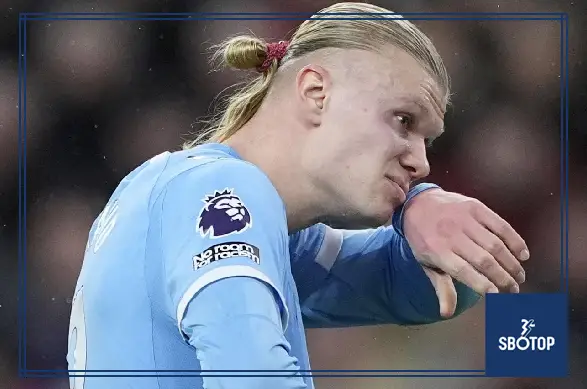
Manchester City’s title ambitions have been tempered by the ongoing injury concerns surrounding their talismanic striker, Erling Haaland. The Norwegian forward, whose goal-scoring exploits have been central to Manchester City F.C.’s domestic and European campaigns, remains sidelined, leaving head coach Pep Guardiola expressing uncertainty over his return and openly criticizing the Premier League fixture schedule. The situation highlights not only City’s reliance on Haaland but also the broader challenges faced by top-flight clubs managing congested schedules and the physical demands placed on elite athletes.
The Nature of Haaland’s Injury
Details about Haaland’s injury have been closely guarded by the club, but reports suggest a muscular issue sustained during training. Guardiola described it as “delicate,” emphasizing the need for caution:
“We cannot rush him back. We must protect him for the long term. He is a key player, and his health comes first.”
Haaland’s absence has immediate tactical implications. City’s high-intensity pressing and vertical attacking style have been built around the striker’s ability to exploit spaces, lead the press, and convert chances with clinical efficiency. Without him, Guardiola must adapt, relying on alternative forwards and creative midfielders to fill the void.
Tactical Adjustments in Haaland’s Absence
-
Rotating the Forward Line
City have explored several tactical adjustments. Julian Alvarez has assumed a central striking role in some matches, while Phil Foden and Jack Grealish have been deployed in false-nine or support striker positions.
These rotations attempt to replicate Haaland’s influence by emphasizing:
- Movement Behind Defenders – Exploiting gaps in opposition lines.
- Pressing from the Front – Maintaining City’s characteristic high press.
- Goal Threat Distribution – Ensuring scoring opportunities remain spread across multiple players.
While these adjustments have yielded some success, they cannot fully replicate Haaland’s unique combination of physicality, pace, and finishing instinct.
-
Midfield Support
Without Haaland, City’s midfield has had to become more inventive. Kevin De Bruyne now frequently drops deeper to orchestrate play and link with advancing forwards. This strategy has helped maintain possession dominance, though it shifts responsibilities, potentially leaving City vulnerable during transitional phases.
Guardiola’s Frustration with Fixture Congestion
Haaland’s injury has coincided with a period of intense fixture congestion. City are competing on multiple fronts: Premier League, UEFA Champions League, domestic cups, and international breaks. Guardiola voiced his frustration in post-match press conferences, pointing to the physical toll on players:
“The schedule is impossible. We play every three or four days, and top players are at risk. It is difficult to manage. Clubs, leagues, and organizers must consider the demands on these athletes.”
Fixture congestion has become a recurring debate in modern football. Elite teams, particularly those competing domestically and in Europe, must balance performance with player welfare. Overloaded schedules increase injury risk and reduce recovery time, affecting team consistency and long-term planning.
Impact on Manchester City’s Title Challenge
Haaland’s absence comes at a critical juncture. City are in a tight race with Arsenal F.C. and Liverpool F.C., where every point is vital. Losing a forward of Haaland’s caliber forces City to adjust strategically while maintaining results.
-
Scoring and Conversion
Without Haaland, City’s conversion rate has slightly dipped. Matches that might have been sealed quickly now require sustained possession and creativity from multiple sources. Guardiola has emphasized teamwork and collective responsibility, asking midfielders and wide players to share goal-scoring duties more aggressively.
-
Psychological Factor
Haaland’s presence also carries a psychological dimension. Opponents often adjust defensive strategies specifically for him. His absence may embolden rival defenses, but it also challenges City’s squad to elevate collective performance and compensate for the missing threat.
Case Study Recent Matches Without Haaland
City’s fixtures during Haaland’s recovery illustrate both strengths and vulnerabilities:
- Match Against Leeds United – City narrowly secured a 1-0 victory, highlighting the team’s ability to grind out results even without their star striker. Efficiency, patience, and tactical discipline were crucial.
- Champions League Tie – The team relied on midfield creativity and set-piece effectiveness to generate scoring chances, emphasizing adaptability under high-stakes conditions.
These examples underscore Guardiola’s capacity to innovate tactically, but they also reflect the difficulty of replicating Haaland’s unique contributions consistently.
Managing Player Fitness and Recovery
Guardiola has stressed that Haaland’s recovery will be meticulously managed. Modern sports science and monitoring technologies allow teams to track player workload, recovery metrics, and potential injury risks. For Haaland, this means:
- Controlled training sessions.
- Gradual reintegration into full team drills.
- Careful monitoring during match play to avoid relapse.
The goal is to ensure that when Haaland returns, he does so fully fit, preserving both his performance levels and City’s long-term ambitions.
Broader Implications for Squad Depth
Haaland’s injury highlights the importance of squad depth in elite football. City’s alternative forwards, midfielders, and wingers have been required to step up, demonstrating:
- Flexibility – Adapting to different roles and responsibilities.
- Resilience – Handling the pressure of performing without the team’s primary goal scorer.
- Tactical Understanding – Implementing Guardiola’s systems effectively in high-pressure situations.
Teams with well-rounded squads are better equipped to absorb the impact of key absences, while those relying heavily on individual stars face greater challenges.
Fixture Scheduling and Player Welfare Debate
Guardiola’s criticism of fixture congestion taps into a wider discussion about player welfare in modern football. Increased broadcast commitments, international tournaments, and domestic cup competitions compress the calendar, leading to:
- Higher risk of muscular and joint injuries.
- Reduced recovery time between high-intensity matches.
- Mental fatigue, affecting concentration and decision-making.
Several governing bodies, including the Premier League and UEFA, are under pressure to balance commercial interests with athlete safety, and Guardiola’s comments amplify calls for reform.
Tactical Innovation in Response to Key Absences
City’s approach to mitigating Haaland’s absence illustrates Guardiola’s tactical flexibility. Key adaptations include:
- Deploying a false-nine system to encourage fluid positional play.
- Utilizing overlapping fullbacks to generate width and crossing opportunities.
- Emphasizing set-piece routines as alternative avenues for goals.
These strategies maintain City’s attacking threat while compensating for the missing striker. The successful execution of these tactics reflects both player intelligence and the coaching staff’s meticulous preparation.
Psychological Dynamics in High-Stakes Competitions
Haaland’s injury also introduces psychological challenges. Teammates must adapt to increased responsibility, while opponents may adjust strategies knowing the absence of City’s main striker.
Guardiola has emphasized mental fortitude, encouraging players to focus on collective strength rather than individual deficits. This mindset is crucial in sustaining results and morale during periods of squad disruption.
Lessons for the Premier League
Several broader lessons emerge from Haaland’s injury and City’s response:
- Importance of Squad Depth – Elite teams must maintain versatile players capable of stepping up in critical moments.
- Player Welfare Considerations – Fixture congestion presents tangible risks; careful management is essential.
- Tactical Flexibility – Coaches must adjust systems and strategies to account for key absences.
- Psychological Resilience – Teams that maintain focus and confidence despite injuries are better positioned to succeed.
These lessons extend beyond City, offering insights into managing elite football squads under pressure.
Also Read: