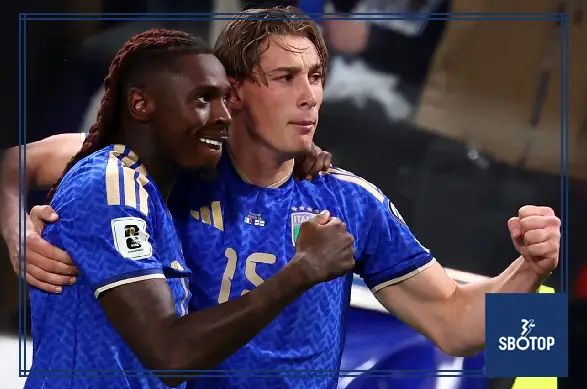
Italy delivered a composed and clinical performance as goals from Sandro Tonali and Moise Kean secured a 2-0 victory over Northern Ireland, a result that mathematically ended the visitors’ hopes of reaching the World Cup. The match showcased Italy’s growing balance between youthful energy and tactical maturity, while leaving Michael O’Neill’s side to reflect on missed opportunities in a qualifying campaign that promised more than it ultimately delivered.
For Italy, it was another step forward in their rebuilding process, with standout contributions from emerging stars and a disciplined structure that never allowed Northern Ireland to settle into rhythm. For Northern Ireland, the defeat was a painful confirmation of elimination, despite moments of resistance that hinted at what might have been with more consistency in key fixtures.
A Night That Defined Contrasting Fortunes
The atmosphere inside the stadium reflected the stakes. Italy entered the match knowing that victory would tighten their grip on qualification momentum, while Northern Ireland, managed by Michael O’Neill, needed nothing short of a miracle to keep their World Cup dream alive.
From the opening whistle, Italy controlled possession, dictating tempo with calm passing sequences and intelligent movement between the lines. Northern Ireland, as expected, sat deeper, looking to absorb pressure and strike on the counterattack. However, Italy’s technical superiority quickly became evident, especially in midfield where the hosts dominated second balls and transitions.
The match never fully drifted into chaos. Instead, it evolved into a controlled demonstration of Italy’s patience against a side fighting to stay alive in the competition.
Tonali Sets the Tone in Midfield Authority
The breakthrough moment arrived midway through the first half, when Italy’s midfield control finally translated into a decisive action. Sandro Tonali, operating with composure and intelligence, found space just outside the penalty area after a sustained spell of pressure.
Receiving the ball in rhythm, Tonali took a touch to settle before striking a precise effort beyond the Northern Ireland goalkeeper. The shot was not just about technique but timing—arriving at a moment when the visitors had begun to lose compactness between their defensive and midfield lines.
It was a goal that symbolized Tonali’s evolution as a complete midfielder. No longer just a deep-lying passer or defensive shield, he has become a player capable of influencing matches in the final third, especially in tightly contested qualifying fixtures.
Italy’s bench reacted with visible relief, while Northern Ireland were forced to abandon their cautious approach earlier than planned.
Northern Ireland’s Response and Missed Chances
Despite going behind, Northern Ireland showed brief signs of resistance. Their best moments came from set pieces and direct balls into advanced areas, where Italy’s defense occasionally looked stretched. A half-chance midway through the first half forced a routine save, offering a glimpse of what might have been if their attacking transitions had been sharper.
However, the lack of sustained pressure proved costly. Italy’s defensive organization, built on compact spacing and disciplined marking, ensured that Northern Ireland rarely generated clear openings.
As the half progressed, Italy reasserted control, slowing the tempo when needed and accelerating only when gaps appeared. It was a mature performance, particularly for a team still blending experienced leaders with younger talent.
Kean’s Impact Seals the Contest
If Tonali’s goal established control, the second strike effectively ended the contest. Early in the second half, Italy increased their attacking intensity, pushing Northern Ireland further back and forcing errors in buildup play.
The decisive moment came when Moise Kean capitalized on defensive hesitation inside the penalty area. Moise Kean reacted quickly to a loose ball, demonstrating sharp instincts and physical strength to finish past the goalkeeper with confidence.
It was a striker’s goal in every sense—quick reactions, positional awareness, and ruthless execution.
For Kean, the goal represented more than just a statistic. It reinforced his growing importance in Italy’s attacking rotation, especially in matches where breaking down compact defenses is essential. His ability to stretch defensive lines and exploit space complements Italy’s midfield creativity perfectly.
Italy’s Tactical Control and Game Management
Beyond the goals, Italy’s overall structure was the defining factor in the match. Their midfield triangle ensured numerical superiority in central areas, while full-backs provided width without compromising defensive balance.
After taking a two-goal lead, Italy shifted into a controlled possession phase. Rather than aggressively pursuing more goals, they focused on game management—circulating the ball, drawing fouls, and reducing Northern Ireland’s ability to transition forward.
This strategic maturity reflects a broader trend in Italy’s football identity. The team is no longer reliant solely on defensive resilience but has developed a more flexible attacking framework that allows them to adapt to different opponents.
The combination of Tonali’s intelligence, Kean’s directness, and a structured midfield allowed Italy to dominate without overextending themselves.
Northern Ireland’s Struggles in Final Third
For Northern Ireland, the match highlighted recurring issues that have plagued their qualifying campaign. While effort and discipline were never in question, the lack of cutting edge in the final third proved decisive across multiple fixtures.
Under Michael O’Neill, the team has often relied heavily on defensive organization and set-piece opportunities. However, against higher-quality opposition like Italy, those margins shrink significantly.
In this match, Northern Ireland struggled to maintain possession under pressure, often resorting to long passes that were comfortably dealt with by Italy’s defensive line. Their inability to connect midfield and attack consistently meant that any momentum was short-lived.
Even after conceding the second goal, their response lacked urgency in dangerous areas. While effort remained high, creativity and precision were missing.
The End of a World Cup Dream
As the final whistle blew, the reality became unavoidable: Northern Ireland’s World Cup hopes were officially over. Players remained on the pitch for several moments, absorbing the disappointment of a campaign that promised competitiveness but ultimately fell short.
There were flashes of potential throughout the qualifying journey, but inconsistency in key matches proved costly. Against top-tier opposition, the margins were unforgiving.
For fans, the frustration lies not only in elimination but in the sense that opportunities were there to be taken. Missed chances, narrow defeats, and moments of defensive lapses combined to form a narrative of near-success rather than breakthrough achievement.
Italy’s Rebuilding Journey Gains Momentum
For Italy, however, the victory represents another positive step in their long-term development. Blending experienced figures with emerging talents like Tonali and Kean has created a more dynamic and unpredictable team.
The midfield, in particular, has become a strength rather than a concern. Tonali’s influence continues to grow, offering both defensive stability and attacking contribution. His ability to control tempo is becoming central to Italy’s identity.
Kean’s resurgence adds another dimension. His pace, strength, and direct style provide Italy with a different attacking option compared to more traditional forwards.
Together, they symbolize a new generation of Italian football—less rigid, more fluid, and increasingly confident in taking control of matches.
Key Performances That Shaped the Match
Several individual performances stood out beyond the goal scorers:
- Italy’s midfield unit dominated possession and prevented Northern Ireland from building sustained attacks.
- The defensive line remained composed, handling aerial threats and direct play efficiently.
- The wide players provided consistent support in both attack and defense, maintaining balance throughout the match.
- Northern Ireland’s goalkeeper made several important saves to prevent a heavier defeat.
Despite the scoreline, Northern Ireland’s defensive discipline prevented the match from becoming a one-sided rout. However, the lack of attacking output remained the critical weakness.
Also Read:
- SBOTOP Arsenal Plot Summer Overhaul: Khvicha Kvaratskhelia and Anthony Gordon Emerge as Key Left-Wing Targets
- SBOTOP: Thomas Tuchel Explains Ben White Recall While Trent Alexander-Arnold Misses Out Again in England Squad Decisions
- SBOTOP Old Trafford Eyes Bold Move: Manchester United Target Myles Lewis-Skelly from Arsenal in Ambitious Summer Transfer Plans