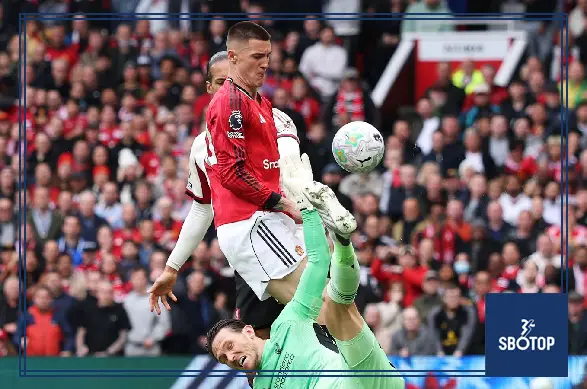
Few Premier League incidents ignite debate quite like those involving VAR, especially when they occur in high-stakes fixtures between historic rivals. The latest flashpoint centers around Manchester United forward Benjamin Šeško and an alleged handball incident during a match against Liverpool—an episode that has once again placed officiating, technology, and interpretation under the microscope.
What has intensified the discussion further is the acknowledgement from Howard Webb, the head of refereeing in English football, who reportedly believes Šeško did handle the ball. However, VAR officials were unable to overturn the on-field decision due to what has been described as insufficient conclusive evidence.
The situation has reopened a familiar and uncomfortable debate: even with advanced technology, why do some of football’s most decisive moments still end in disagreement?
The Incident That Sparked Debate
The controversy stems from a key moment in the match between Manchester United and Liverpool, where Benjamin Šeško was involved in an attacking phase inside a crowded area. During the sequence, the ball appeared to make contact with his arm, prompting immediate appeals from Liverpool players.
Referee on the pitch allowed play to continue, and VAR subsequently reviewed the incident. Despite visible suspicions from multiple angles, the decision ultimately stood due to the lack of definitive proof required under current VAR protocols.
This outcome triggered frustration among players, coaching staff, and supporters, many of whom felt the footage clearly suggested a handball offense.
Yet, as has become increasingly common in modern football, interpretation and protocol did not align with public perception.
Howard Webb’s Perspective on the Decision
Howard Webb’s involvement in discussing the incident added significant weight to the controversy. As the head of refereeing and a former elite referee himself, his perspective carries authority in matters of interpretation and officiating standards. Webb’s acknowledgment that Šeško may have handled the ball highlights an important distinction in modern VAR usage: belief is not enough. Even if officials suspect an infringement occurred, VAR intervention requires clear, irrefutable evidence that meets a strict threshold.
This is where the system often becomes controversial.
Webb’s stance essentially reinforces the idea that VAR is not designed to correct every questionable moment, but only those that meet the criteria of being “clear and obvious errors.”
The Core Issue Evidence Versus Interpretation
At the heart of the controversy lies a fundamental tension in football officiating: the difference between what appears likely and what can be proven conclusively.
In the Šeško incident, several factors complicated VAR’s decision-making:
- The ball moved rapidly in a congested area
- Multiple camera angles offered different perspectives
- Arm position and contact timing were open to interpretation
- No single replay provided definitive proof of intentional handling
As a result, VAR officials were left in a difficult position. While suspicion existed, certainty did not.
This gap between probability and proof is one of the biggest ongoing challenges in modern refereeing.
Why VAR Could Not Intervene
The VAR protocol is intentionally restrictive. It is designed not to re-referee matches but to correct only clear errors that the on-field referee could not reasonably have seen.
In cases of handball, VAR must determine:
- Whether there was contact
- Whether the contact was deliberate or accidental
- Whether the arm position made the player “unnaturally larger”
- Whether the incident clearly meets the threshold for a penalty or offense
If any of these elements remain uncertain, VAR is instructed not to overturn the original decision.
In the Šeško case, officials reportedly could not reach the level of certainty required to intervene.
This is not necessarily a failure of technology—it is a reflection of how VAR has been deliberately structured.
Manchester United’s Perspective
From Manchester United’s point of view, the incident is likely to be seen as a fortunate escape rather than a contentious injustice.
For attacking players, handball incidents are often scrutinized intensely, especially in key matches against top opposition like Liverpool. In this case, the decision allowed play to continue without punishment, potentially influencing the flow of the match.
However, United may also argue that ambiguity is part of football and that VAR consistency across similar incidents remains the broader issue rather than a single decision.
Clubs often experience both sides of VAR controversy over a season, and interpretations rarely remain consistent across all matches.
Liverpool’s Frustration and Familiar VAR Concerns
For Liverpool, the frustration is more familiar. The club and its supporters have frequently voiced concerns about VAR inconsistencies in high-profile matches over recent seasons.
In this instance, the feeling stems not only from the decision itself but from the perception that clear evidence existed for intervention.
Liverpool’s argument is likely centered on consistency:
- If similar incidents in other matches have resulted in penalties
- Why was this one treated differently?
This question continues to fuel broader dissatisfaction with VAR standards across the Premier League.
The Role of Subjectivity in Modern Officiating
One of the most significant challenges facing VAR is that football is not a purely objective sport. Unlike sports with clearly measurable infractions, football relies heavily on interpretation.
Handball decisions in particular are notoriously subjective. Factors such as:
- Natural arm movement
- Distance from the ball
- Reaction time
- Body positioning
- Intent
All influence whether an incident is considered a foul.
Even with multiple camera angles, different officials can interpret the same moment differently.
This subjectivity is where VAR struggles most.
The Pressure on VAR Officials
VAR officials operate under immense pressure. Every decision is scrutinized in real time by millions of viewers, with slow-motion replays often exaggerating the appearance of incidents.
What may seem obvious on television can look far less clear in real time within the VAR control room.
Officials must also work within strict time constraints. Prolonged delays are criticized for disrupting the flow of matches, while quick decisions risk missing key details.
This balancing act makes their role one of the most difficult in modern sport.
Howard Webb’s Broader Challenge
For Howard Webb, the incident highlights the ongoing challenge of improving consistency across the VAR system. Since taking a leadership role in refereeing administration, Webb has aimed to restore trust and clarity in decision-making.
However, cases like Šeško’s demonstrate how difficult that task remains.
Even with standardized guidelines and improved communication, football’s inherently subjective nature ensures that disagreement will always exist.
Webb’s acknowledgment of the incident may be seen as an attempt to provide transparency, even if it does not resolve the controversy itself.
The Fan Perspective Trust Versus Technology
Supporters remain deeply divided on VAR. Some believe it improves fairness by reducing obvious mistakes. Others argue it has introduced confusion, inconsistency, and emotional disruption.
In incidents like Šeško’s, fans often feel:
- Frustrated by lack of clarity
- Confused by differing interpretations
- Disconnected from refereeing logic
- Unsure what constitutes a foul anymore
This erosion of trust is one of VAR’s biggest unintended consequences.
Football fans value emotional continuity. When decisions interrupt that flow without clear explanation, dissatisfaction grows rapidly.
The Slow-Motion Problem
One of the most frequently criticized aspects of VAR is its reliance on slow-motion replays.
In real time, many incidents appear fluid and instinctive. However, slow motion can dramatically alter perception by:
- Exaggerating contact
- Making movements appear more deliberate
- Extending brief moments into long sequences
- Increasing perceived severity
This can lead to decisions that feel disconnected from natural gameplay.
Officials must constantly balance real-time interpretation with slowed analysis, a task that often produces conflicting conclusions.
Also Read:
- SBOTOP: Ben White Injury Blow for Arsenal and England as Knee Issue Ends Season and Casts Doubt Over World Cup Hopes
- SBOTOP : Real Madrid Face Major Roadblock in Bold Move for PSG Star Vitinha
- SBOTOP: Paul Merson Backs Arne Slot to Outperform Manchester United as Liverpool Project Expected to Rise Next Season