Manchester United’s thrilling 3-2 victory over Liverpool at Old Traffordon Sunday (May 3, 2026) delivered everything fans crave—goals, drama, and late-game heroics. But beyond the excitement, one moment continues to dominate the conversation: Benjamin Šeško’s controversial goal that survived a tense VAR review.
In a match that could have gone either way, this single decision became the focal point of debate, sparking reactions from fans, pundits, and analysts alike. So what really happened—and why did the goal stand?
A High-Stakes Clash Full of Turning Points
From kickoff, the intensity was unmistakable. Manchester United wasted no time asserting control, with Matheus Cunha opening the scoring early in the game. The home crowd had barely settled before Benjamin Šeško doubled the lead just eight minutes later.
However, what seemed like a routine goal quickly turned into a heated controversy.
As Šeško redirected the ball into the net, the referee immediately delayed the confirmation. There were suspicions that the ball might have made contact with his hand in the build-up—a potential handball offense that could nullify the goal.
Meanwhile, Liverpool regrouped impressively. Goals from Dominik Szoboszlai and Cody Gakpo brought the score level, setting up a dramatic finale. Eventually, Kobbie Mainoo emerged as the hero, scoring the decisive goal that secured all three points for United.
Still, despite the late winner, the spotlight remained firmly on Šeško’s earlier strike.
The Moment That Sparked the Debate
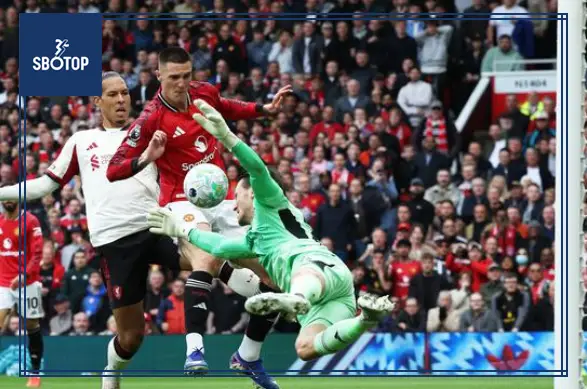
The controversial incident unfolded inside a crowded penalty area. Šeško was positioned between Liverpool’s third-choice goalkeeper Freddie Woodman and central defender Virgil van Dijk when the ball came toward him.
As he attempted to finish, his arms appeared slightly raised. The ball struck his body before crossing the goal line—but replays suggested there could have been slight contact with his arm.
Given the uncertainty, VAR stepped in to review the situation.
Multiple angles were analyzed, and for several tense moments, players and fans waited for a final decision. In matches of this magnitude, such reviews often carry enormous consequences.
Premier League’s Official Explanation
After reviewing the footage, VAR chose not to overturn the on-field decision. The goal was allowed to stand.
Shortly after, the Premier League issued an official explanation via its Match Centre account, clarifying the reasoning behind the call.
According to the statement, there was no conclusive evidence that the ball had made illegal contact with Šeško’s hand before entering the net.
This detail is crucial.
Under current VAR rules, a decision can only be reversed if there is a clear and obvious error. In this case, the available footage did not provide definitive proof of a handball offense.
As a result, the referee’s original decision was upheld.
Understanding the VAR Decision
To fully grasp the situation, it’s important to understand how VAR operates in these scenarios.
VAR is not designed to re-referee matches or reinterpret every close call. Instead, it acts as a safety net to correct clear mistakes.
In Šeško’s case, the contact—if any—was minimal and not clearly visible across all replay angles. Without undeniable evidence, VAR is instructed to support the referee’s initial judgment.
This approach prioritizes consistency, but it also leaves room for interpretation in borderline situations.
And that’s exactly why this decision has sparked such strong reactions.
Liverpool’s Frustration Is Understandable
From Liverpool’s perspective, the decision is understandably frustrating.
The ball appeared extremely close to Šeško’s arm, and in a match of this magnitude, even the smallest detail can change the outcome. Had the goal been disallowed, the entire flow of the game might have been different.
Instead, United gained a two-goal advantage early on—an edge that ultimately played a significant role in the final result.
For players, coaches, and fans, these moments are difficult to accept, especially when they fall into what many describe as football’s “gray area.”
The Never-Ending Handball Debate
This incident is just the latest chapter in the ongoing debate surrounding handball decisions in the Premier League.
Even before the introduction of VAR, handball calls were among the most controversial aspects of the game. The addition of technology was meant to bring clarity—but in many cases, it has simply shifted the debate.
Now, discussions revolve around interpretation, camera angles, and what qualifies as “clear and obvious.”
Situations like Šeško’s goal highlight the limitations of VAR. While it can eliminate blatant errors, it cannot remove subjectivity from football.
And in high-profile matches like Manchester United vs Liverpool, every controversial decision is magnified.
A Result That Will Be Remembered
Despite the controversy, the result stands: Manchester United 3, Liverpool 2.
Kobbie Mainoo’s late winner ensured the home side walked away with all three points, strengthening their position and adding another memorable chapter to this historic rivalry.
Yet, for many fans, the defining image of the match won’t be the winning goal—but the moment Šeško’s strike was reviewed, debated, and ultimately allowed.
What This Means Moving Forward
As the season progresses, decisions like this could have lasting implications—not just for the teams involved, but for the broader conversation around VAR and officiating standards.
For Manchester United, the focus will remain on momentum and results. For Liverpool, the challenge is to move past disappointment and stay competitive.
But for the Premier League as a whole, the debate continues.
Because in football, especially at the highest level, it’s not just about what happens—it’s about how those moments are judged.
And sometimes, even with technology, the answers aren’t as clear as everyone hopes.
ALSO READ :
- SBOTOP : Pep Guardiola Speaks Out Amid Exit Rumours “I Still Have Energy for Man City”
- SBOTOP : Old Trafford Erupts as New Mainoo Chant Steals the Spotlight vs Liverpool
- SBOTOP: Unai Emery Rages at VAR After Claiming ‘Huge Error’ Let Nottingham Forest’s Elliot Anderson Escape Red Card in Europa League Semi-Final