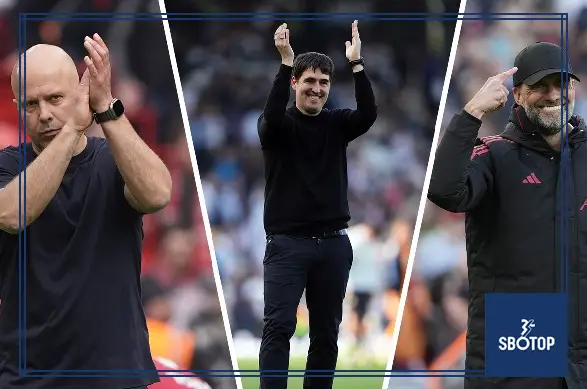
Modern football has entered an era where tactical identity is just as important as results. In the Premier League especially, managers are no longer judged only by trophies but also by how their teams play. Among the most fascinating tactical discussions in recent years is the comparison between Andoni Iraola, Jurgen Klopp, and Arne Slot.
All three managers represent a high-intensity, proactive style of football, yet each interprets it differently. Klopp built a legacy at Liverpool with “heavy metal football,” Slot refined structured attacking control at Feyenoord and later Liverpool, while Iraola has emerged in the Premier League as a coach who blends pressing aggression with compact tactical discipline.
This article explores how Iraola’s identity compares to Klopp and Slot, breaking down pressing systems, attacking structure, defensive organization, and in-game adaptability.
The Foundation Shared High-Intensity Philosophy
At the core, all three managers belong to the same broad tactical family: proactive, high-pressing football.
They believe in:
- Winning the ball high up the pitch
- Vertical attacking transitions
- High physical intensity
- Structured pressing triggers
- Collective movement over individual brilliance
However, the differences lie in execution.
Klopp’s system is emotionally explosive and chaotic in its energy. Slot’s approach is more controlled and positional. Iraola sits somewhere between the two but leans heavily into compact pressing structures with strong tactical discipline.
Jurgen Klopp Emotional Chaos and Vertical Power
Under Klopp, Liverpool became one of the most feared teams in world football. His system is built on emotional intensity and rapid transitions.
Key Tactical Features:
- Heavy counter-pressing (“gegenpressing”)
- Fast vertical attacks within seconds
- Full-backs acting as primary creators
- High defensive line with aggressive stepping
- Direct attacking patterns after ball recovery
Klopp’s philosophy thrives on chaos. The moment possession is won, Liverpool explode forward with speed and intent.
His teams are not always positionally rigid, but they are mentally and physically overwhelming.
The emotional identity of Klopp’s football is one of its defining features—players run, press, and attack with relentless energy.
Arne Slot Structured Control and Positional Precision
In contrast, Arne Slot represents a more controlled evolution of high-intensity football.
At Feyenoord and later in the Premier League, Slot has focused on:
- Structured positional play
- Controlled pressing rather than chaotic pressing
- Patient buildup through midfield
- Intelligent spacing between lines
- Tactical rotations to create overloads
Slot’s teams still press aggressively, but not in the same emotional, chaotic manner as Klopp’s sides.
Instead, pressing is more coordinated and triggered by specific positional cues. The structure is designed to maintain control even in high-intensity moments.
In many ways, Slot represents the modern evolution of pressing football—less chaos, more calculation.
Andoni Iraola Compact Aggression and Tactical Balance
Andoni Iraola has quickly become one of the most interesting tactical coaches in the Premier League due to his ability to blend intensity with structure.
Unlike Klopp’s emotional chaos or Slot’s positional control, Iraola builds systems that are:
- Compact and vertically disciplined
- Aggressive in pressing but structurally organized
- Highly responsive in transitions
- Focused on collective movement
- Strong in defensive compactness without the ball
His teams often operate with a clear balance between risk and control.
Pressing Systems Chaos vs Structure vs Compact Traps
-
Klopp: Relentless Aggression
Klopp’s pressing is immediate and emotional. When possession is lost, multiple players swarm the ball instantly. The goal is to force mistakes through pressure intensity.
-
Slot: Structured Pressing Lines
Slot uses coordinated pressing traps. Players move as units, maintaining shape while forcing opponents into predictable passing lanes.
-
Iraola: Compact Pressing Blocks
Iraola’s system is more compact than Klopp’s and more direct than Slot’s.
His pressing is:
- Zone-oriented rather than man-oriented
- Trigger-based but tightly spaced
- Designed to force turnovers in central areas
- Built on reducing opponent passing lanes
This makes Iraola’s teams extremely difficult to play through, especially for possession-heavy opponents.
Attacking Philosophy Directness vs Control
Klopp: Fast Vertical Chaos
Klopp’s attacking structure prioritizes speed over control. Once the ball is recovered, the objective is immediate vertical progression.
Key features:
- Early forward passes
- Wide overloads through full-backs
- Rapid transitions into final third
- High-risk, high-reward attacking patterns
Slot: Controlled Progression
Slot builds attacks more methodically. His teams:
- Maintain possession structure
- Use midfield rotations to break lines
- Create space through positional movement
- Wait for structural weaknesses in opposition shape
Iraola: Balanced Verticality
Iraola combines both approaches.
His teams:
- Transition quickly after winning the ball
- But maintain compact support structures
- Use wide players in aggressive one-on-one situations
- Prioritize efficiency over possession dominance
He does not rely purely on chaos or control but instead blends both depending on match context.
Defensive Structure The Hidden Strength
One of the most underrated aspects of Iraola’s system is his defensive organization.
While Klopp’s system often leaves space behind due to aggressive pressing and Slot prioritizes possession defense, Iraola focuses heavily on compact defensive shape.
Iraola’s Defensive Identity:
- Tight vertical spacing between lines
- Mid-block pressing as default structure
- Controlled aggression rather than full commitment pressing
- Strong protection of central zones
- Reduced exposure to counterattacks
This makes his teams extremely difficult to break down even when they are not in possession dominance.
Transition Play Where Iraola Excels
Transitions are the most important tactical battlefield in modern football.
-
Klopp:
Explosive attacking transitions driven by emotion and momentum.
-
Slot:
Structured transitions with positional clarity.
-
Iraola:
Highly efficient transitional system that combines:
- Immediate vertical progression
- Compact support positioning
- Quick exploitation of opponent disorganization
- Strong defensive recovery after attack
Iraola’s teams are especially dangerous in “second-phase transitions”—moments after initial counterattacks are defended but space remains open.
Tactical Adaptability Game Management Styles
-
Klopp:
Klopp relies on intensity to dominate matches but can struggle when tempo is forced into slow control games.
-
Slot:
Highly adaptable tactically due to structured positional flexibility.
-
Iraola:
Iraola is one of the most adaptable modern Premier League managers.
He can:
- Shift between mid-block and high press
- Adjust compactness depending on opponent
- Change attacking width dynamically
- Modify transition speed mid-game
This flexibility is key to his Premier League success.
Player Roles and Tactical Demands
Klopp’s Players:
- High stamina requirements
- Emotional intensity and aggression
- Full-backs as attacking weapons
- Forwards as pressing machines
Slot’s Players:
- Tactical intelligence
- Positional discipline
- Technical passing quality
- Structured movement patterns
Iraola’s Players:
- Tactical awareness and adaptability
- Physical resilience in compact systems
- Ability to press in coordinated units
- Strong transition decision-making
Iraola’s system requires players to think quickly in tight spaces rather than dominate possession.
The Key Tactical Difference Chaos vs Control vs Compact Efficiency
When comparing all three, the clearest distinction lies in philosophy:
- Klopp = Controlled chaos built on emotion
- Slot = Structured control built on positional discipline
- Iraola = Compact efficiency built on tactical balance
Each system works at the highest level, but they represent different interpretations of modern football intensity.
Why Iraola’s Style Is Gaining Attention
Iraola’s rise in the Premier League has attracted attention because his system:
- Competes effectively against possession-heavy teams
- Maintains defensive stability
- Creates dangerous transitions without excessive risk
- Balances intensity with structure
In many ways, he represents a hybrid evolution of both Klopp and Slot philosophies.
The Future of High-Intensity Football
Modern football is moving toward hybrid systems. Pure chaos pressing or rigid possession control is no longer enough on its own.
Coaches like Iraola are important because they represent the next stage:
- Structured pressing with flexibility
- Defensive compactness with attacking speed
- Tactical discipline with transitional aggression
This balance may define the next generation of Premier League football.
Also Read: