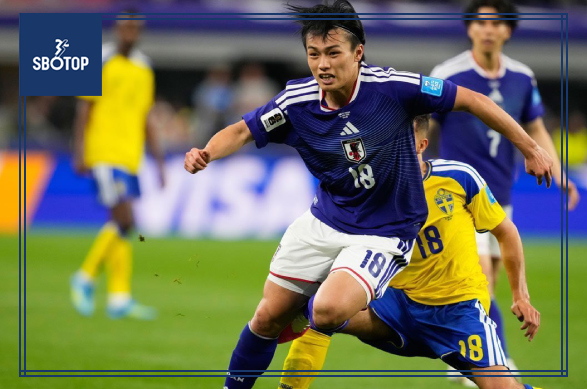
Japan and Sweden shared the points in a tightly contested 1-1 draw in their final Group F match at the 2026 FIFA World Cup. The result, played on June 26, 2026 (local time), was enough for Samurai Blue to secure progression to the Round of 32 as group runners-up, while Sweden also kept their tournament hopes alive through the best third-placed teams pathway.
Despite the draw, the match produced several interesting statistics and historical milestones for both nations, highlighting Japan’s growing consistency on the world stage and Sweden’s promising new generation.
Japan Take the Lead Before Sweden Strike Back
Japan started the match with confidence and quickly imposed their rhythm. Their breakthrough came through Daizen Kamada, who finished a well-worked move to put the Asian side ahead.
However, Sweden responded strongly and found an equalizer through Anthony Elanga, whose goal ensured the match ended level after 90 minutes of competitive football.
With both sides unable to find a winning goal, the match concluded 1-1, a result that shaped the final standings of Group F.
Japan finished second in the group with five points, while Sweden ended in third place with four points. Despite missing out on a top-two finish, Sweden still advanced to the knockout stage as one of the best third-placed teams at the tournament.
Five Key Facts from Japan vs Sweden
1. Japan Extend Remarkable Unbeaten Run Against European Teams
Japan continued their outstanding record against European opposition, extending their unbeaten streak to 11 consecutive matches.
Their record during this period now stands at:
- 8 wins
- 3 draws
- 0 defeats
This is officially Japan’s longest-ever unbeaten run against European nations, surpassing their previous best sequence of 10 matches recorded between May 2006 and May 2009.
The consistency reflects Japan’s evolution into one of the most tactically disciplined and competitive teams outside Europe and South America.
2. Anthony Elanga’s Long-Range Strike Makes History for Sweden
Sweden’s equalizer came from a spectacular effort by Anthony Elanga, who scored from a distance of 28.9 meters.
This goal becomes only the second-longest distance goal scored by a Swedish player at the World Cup since detailed records began in 1966.
The only Swedish player to score from a longer range is Anders Svensson, who netted from 30.2 meters against Argentina in the 2002 FIFA World Cup.
Elanga’s strike adds another memorable moment to Sweden’s World Cup history and highlights his growing influence in the national team setup.
3. Yuto Nagatomo Makes Asian Football History
Veteran defender Yuto Nagatomo achieved a historic milestone by becoming the first Asian player ever to appear in five different FIFA World Cup tournaments.
At 39 years old, Nagatomo continues to demonstrate remarkable longevity and professionalism at the highest level of international football.
His achievement underlines both his personal consistency and Japan’s ability to produce players capable of sustaining elite performance across multiple World Cup cycles.
4. Sweden Field One of Their Youngest World Cup Lineups in Decades
Sweden’s starting XI against Japan had an average age of 26 years and 273 days, making it one of their youngest World Cup lineups in recent history.
The only younger Swedish starting lineup in a World Cup match came during the 1994 third-place playoff against Bulgaria, when the average age was 25 years and 350 days.
This shift reflects Sweden’s ongoing squad rebuild, with a clear focus on developing younger talent for future international competitions.
5. Japan’s Tactical Discipline Continues to Pay Off
Beyond statistics, Japan once again demonstrated their trademark tactical discipline, structured defensive organization, and efficient ball movement.
Even when under pressure, Samurai Blue maintained composure and ensured qualification from a competitive group that included strong European opposition. Their ability to consistently avoid defeat against top-tier teams continues to strengthen their reputation as one of the most reliable national sides in modern World Cup history.
Japan Progress, Sweden Show Promise
The 1-1 draw was a fair reflection of a balanced contest between two well-organized teams. Japan’s unbeaten record against European sides continues to grow, reinforcing their status as a rising force in international football.
Meanwhile, Sweden may leave the group stage with mixed emotions, but their youthful squad and competitive performances suggest a strong foundation for the future.
Both teams now turn their attention to the knockout stage of the 2026 FIFA World Cup, where challenges will only become more demanding.
ALSO READ :