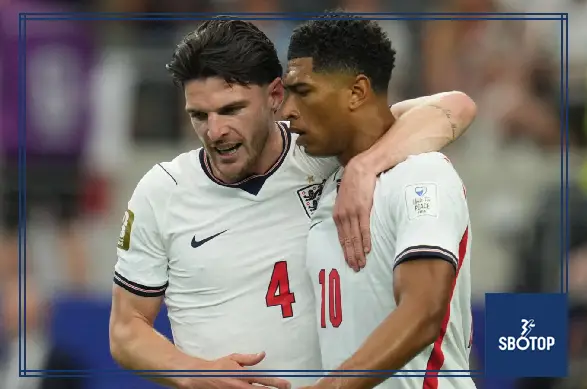
England’s 2-1 win over DR Congo was supposed to be remembered for Harry Kane’s late rescue act. The captain scored twice in the final 15 minutes, dragging Thomas Tuchel’s side from the edge of a World Cup disaster into the last 16. Yet beneath the drama of Kane’s finishing, another storyline emerged that could shape England’s knockout campaign: Declan Rice, one of the team’s most important midfielders, suddenly looked like a possible answer to the right-back problem.
It was not part of the original plan. England had started the game with Djed Spence at right-back, but the team’s structure never looked entirely comfortable. DR Congo struck early through Brian Cipenga, and England spent much of the match chasing a game they were expected to control. When Tuchel eventually reshuffled his side, Eberechi Eze replaced Spence, Rice moved across to right-back, and England’s rhythm changed almost immediately. The Guardian reported that Rice finished the match as a full-back and helped give England a better connection on the right side, with Kane equalising five minutes after the switch.
That does not mean Rice is suddenly a natural right-back. It does mean England have discovered an emergency solution that may be more credible than anyone expected.
A Right-Back Crisis Tuchel Cannot Ignore
Tuchel’s issue at right-back has become one of the strangest tactical subplots of England’s World Cup. Sky Sports noted that five different players have already occupied the position across England’s first four matches: Reece James, Jarell Quansah, Djed Spence, Declan Rice and Ezri Konsa. None of that screams stability.
The problem has been made worse by injuries and squad construction. Reece James has been dealing with a hamstring problem, while Quansah missed the DR Congo match with an ankle issue. By the time England began preparations for Mexico, James was still not involved in full training, although Quansah had returned and was available to start.
That leaves Tuchel with a difficult choice. Does he trust Quansah immediately after injury? Does he persist with Spence despite a shaky outing? Does he move Konsa across? Or does he take the bold option and use Rice as a makeshift full-back, even if that means removing one of England’s best midfielders from his strongest position?
The question is not simple. But Rice’s cameo against DR Congo made the debate unavoidable.
Spence’s Difficult Afternoon Opened the Door
Spence had the chance to make the position his own, but the DR Congo match exposed the risks of relying on him in such a demanding role. Sky Sports highlighted his difficult performance, noting that he was dragged out of position for Cipenga’s opening goal and later lost possession 17 times, more than any other England player in the match.
To be fair to Spence, the role was not easy. He has played a lot of football on the opposite flank at club level, and switching to right-back in a World Cup knockout game is a major challenge. DR Congo also targeted the space behind him with speed and directness, forcing him to defend while England were still searching for control.
But tournament football is cruel. There is little room for patience when every match can end a campaign. Tuchel did not wait. Spence was withdrawn, Eze came on, Rice shifted wide, and England suddenly looked more balanced.
That sequence matters because it tells us something about Tuchel’s mindset. He is not afraid to use unconventional solutions if the game demands it. He is also willing to sacrifice positional purity for tactical control.
Rice Changed the Energy on the Right
Rice’s move to right-back was surprising because of his importance in midfield. He is usually the player who gives England security, ball-winning power, and control between the lines. Yet against DR Congo, his spell at full-back gave England something they had been missing: thrust, composure and clean delivery from the right side.
Sky Sports reported that Rice made the driving run into the DR Congo box that led to England’s equaliser, adding momentum and attacking force after moving into the role. Tuchel also credited assistant Anthony Barry for suggesting the switch, saying that Barry proposed putting Rice there during the staff’s tactical discussion.
This was not just about filling a gap. Rice actively improved England’s attacking shape. His passing from deeper and wider areas gave England better angles. His physical power allowed him to carry the ball into space. His defensive instincts made him less vulnerable than a more attack-minded player might have been.
The most important thing was his decision-making. Rice did not play like a midfielder pretending to be a defender. He understood when to hold position, when to step forward, and when to deliver early. That calmness is exactly what England needed.
The Arsenal Connection Helped
One reason the experiment worked was chemistry. Rice’s move to the right side placed him near Bukayo Saka and Eberechi Eze, two players who could benefit from his timing and passing range. Tuchel suggested after the game that Rice’s quality from that side made England more dangerous with crosses and gave support to Saka and Eze.
That connection is important because England’s attack had looked disjointed before the reshuffle. The team had possession, but too much of it was slow and predictable. Once Rice moved wide, the right side had clearer relationships. Eze could drift, Saka could stay aggressive, and Rice could choose when to overlap, underlap, or deliver from deeper positions.
A makeshift full-back is often expected only to survive defensively. Rice did more than that. He helped England attack with greater purpose.
This is why his cameo has become more than a footnote. It gave Tuchel a live example of how England might solve a structural problem without waiting for a natural right-back to be fully fit.
Kane Took the Headlines but Rice Helped Change the Match
Harry Kane deserved the attention after scoring both England goals. The official England match report recorded that Kane equalised in the 75th minute and then scored the winner four minutes from time, completing the comeback after Cipenga had given DR Congo a seventh-minute lead.
But goals rarely happen in isolation. England’s first goal came after good work down the right, with Rice finding Anthony Gordon before Gordon chipped in the cross for Kane. The official report specifically noted that Rice finished the match playing as a right-back and was involved in the build-up to the equaliser.
That detail matters. Rice did not merely occupy the position while others won the game. He played a direct role in the comeback.
Kane’s movement, Gordon’s delivery and England’s renewed urgency were all essential. But Rice’s positional switch gave the team a better platform to apply pressure. In that sense, Tuchel’s tactical adjustment and Kane’s finishing were part of the same story.
The Big Risk: Losing Rice in Midfield
The argument against using Rice at right-back is obvious: England may solve one problem by creating another. Rice is arguably England’s most important midfielder. Removing him from the centre could weaken the very area where tournament matches are often won and lost.
Sky Sports made that point by comparing Tuchel’s dilemma to Mikel Arteta’s experience at Arsenal. Rice has played at right-back only a handful of times, and even when he has handled the role well, the bigger issue is what the team loses in midfield.
England already have questions in central areas. Elliot Anderson has impressed in possession and duels, but expecting him to hold the midfield alone against stronger opposition is risky. Jude Bellingham’s best role is still a major talking point, while England’s balance can shift dramatically depending on whether Tuchel uses two No. 8s, a No. 10, or a more conservative double pivot.
Moving Rice away from midfield may help the right side, but it could expose the centre. Against Mexico, with the altitude of the Azteca and the intensity of the home crowd, that would be a significant gamble.
Mexico Makes the Decision Even Harder
England’s next test is not just another knockout match. It is Mexico at the Estadio Azteca, one of the most demanding venues in world football. The Guardian reported that England must play at 2,240 metres above sea level, with Tuchel admitting full physical adaptation is impossible in such a short time.
That matters for the right-back debate. At altitude, recovery runs are harder. Concentration can dip. Players can tire faster than usual. A full-back has to defend wide spaces, track runners, support attacks, and recover quickly when possession is lost. It is one of the most physically demanding roles on the pitch.
Rice has the engine and intelligence to cope with that. But using him there would also mean asking another midfielder to handle Mexico’s central pressure. Tuchel expects Mexico to start with intensity and heat, and he has warned that England will need answers to whatever problems the hosts pose.
That is the heart of the dilemma. Rice at right-back might be safer defensively than Spence. But Rice in midfield might be more important to controlling the game.
Also Read: