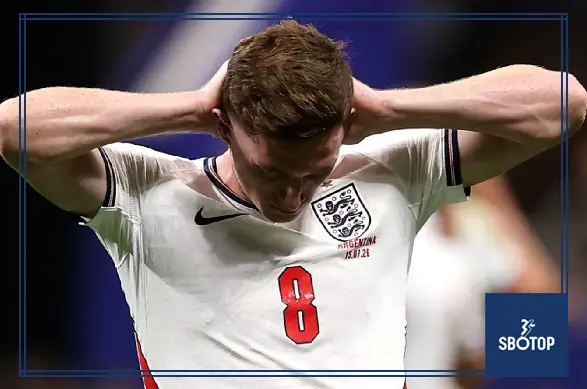
England’s World Cup campaign ended in devastating fashion as Argentina transformed a looming semi-final defeat into a dramatic 2-1 victory during the closing minutes in Atlanta. Anthony Gordon had placed the Three Lions ahead in the 55th minute, finishing Morgan Rogers’ delivery at the far post. England then retreated, surrendered control and attempted to protect their advantage against the defending champions.
That approach eventually collapsed.
Enzo Fernández equalised in the 85th minute before substitute Lautaro Martínez headed home the winning goal in stoppage time. Lionel Messi played a decisive role in Argentina’s late recovery, contributing to both goals and sending his country into another World Cup final against Spain.
For England, the defeat produced sharply contrasting individual performances. Djed Spence delivered one of his finest displays in an international shirt, combining pace, aggression and intelligent defending in a demanding role on the left side.
Jordan Pickford, John Stones, Marc Guéhi and Elliot Anderson also performed with courage. Gordon justified his selection by scoring the goal that briefly placed England within sight of their first World Cup final since 1966.
Yet several of the players expected to lead England through the most important moments struggled to influence the match. Harry Kane became isolated, Jude Bellingham could not impose himself on Argentina’s midfield, and Declan Rice never reached his commanding best.
England’s elimination was not the responsibility of one player. Thomas Tuchel’s defensive substitutions and the collective retreat after taking the lead shaped the result more significantly than any individual mistake.
Nevertheless, a semi-final demands decisive performances from a team’s biggest personalities. England’s leading figures were unable to provide them when Argentina increased the pressure.
Djed Spence Emerges from the Defeat with His Reputation Enhanced
Djed Spence — 8/10
Spence was a surprise inclusion at left-back, but he quickly demonstrated why Thomas Tuchel trusted him in such a significant fixture.
He defended assertively from the opening stages, refusing to allow Argentina’s wide players to settle. His speed enabled him to recover whenever the South Americans attempted to attack the space behind England’s defensive line.
Spence’s most memorable contribution came early in the second half. Giuliano Simeone appeared ready to break into a dangerous shooting position, but Spence produced an outstanding last-man challenge to stop the attack without conceding a foul.
It was a moment requiring perfect timing. A fraction too early and Simeone could have avoided him. A fraction too late and England might have conceded a penalty or lost a defender to a red card.
Spence judged the situation correctly.
He also made an important block following a quickly taken Messi free-kick and repeatedly matched Argentina’s attackers physically. Sky Sports awarded him England’s highest mark of eight, while other British outlets similarly identified him as one of the Three Lions’ strongest performers.
His performance was particularly impressive because England spent long periods without possession. Spence could not rely on sustained control from the midfield and was frequently asked to defend repeated attacks.
He remained composed for most of the contest. Even when England’s structure began to collapse, he continued competing rather than becoming overwhelmed by the occasion.
The defeat will dominate the immediate reaction, but Spence should leave the tournament with greater status inside the national team. He proved he could handle a World Cup semi-final against elite opposition while playing in a position that demanded concentration, pace and tactical discipline.
England entered the evening expecting their established stars to lead them into the final. Instead, one of the less celebrated names became their most convincing performer.
Pickford Keeps England Alive Until the Pressure Becomes Overwhelming
Jordan Pickford — 7/10
Pickford had very little to do during the first half, when England’s compact shape restricted Argentina’s opportunities. His workload increased substantially after the interval. He denied Julián Álvarez at the near post and later reacted sharply to keep out a low Nicolás González header. Pickford also tipped a long-range Fernández effort over the crossbar as Argentina’s pressure intensified.
Those interventions allowed England to preserve their advantage longer than their overall control justified.
Pickford could do little about either goal. Fernández’s equaliser was struck powerfully from distance after England failed to clear the danger properly. Martínez’s winning header arrived from close range after Messi was allowed enough time to provide the decisive delivery.
TNT Sports and Sky Sports both awarded Pickford a seven, recognising the importance of his saves despite England’s eventual defeat.
The goalkeeper displayed authority and remained vocal as the defensive line dropped increasingly close to his goal. However, no goalkeeper can indefinitely resist the level of pressure England invited during the closing stages.
Pickford performed his role. The problem was that England required him to do too much of it.
England’s Central Defenders Battle Until the Final Minutes
John Stones — 7/10
Stones justified his return to the starting line-up with a resilient and intelligent display.
He produced several important clearances, including a flying header that prevented Nicolás Tagliafico from reaching a dangerous delivery. Stones also headed a Rice free-kick narrowly wide during England’s first meaningful attacking moment.
His reading of the game remained strong as Argentina increased their numbers in advanced positions. Late in the contest, he intercepted another threatening Messi cross with an excellent defensive header.
Unfortunately for England, he could not repeat the intervention when Messi delivered for Martínez in stoppage time.
Stones was not personally responsible for the defeat. He competed bravely and generally made sensible decisions. Like the other defenders, however, he eventually suffered from England’s inability to move the ball away from their own penalty area.
Marc Guéhi — 7/10
Guéhi offered another composed performance on a major stage.
He defended aggressively when necessary but avoided being drawn unnecessarily out of position. His partnership with Stones gave England a solid central foundation during the first hour.
Guéhi’s recovery pace was useful whenever Argentina attempted to move beyond England’s back line. He remained calm in possession during the periods when the Three Lions were willing to play through the defence.
Once England retreated, however, his role became almost entirely reactive. He was asked to defend crosses, second balls and shots without sufficient protection from sustained possession.
The centre-back did little wrong individually, but the volume of Argentina attacks eventually became impossible to contain.
Reece James Provides Security but Limited Attacking Influence
Reece James — 6/10
James delivered a steady defensive performance on the right side.
He overlapped when opportunities appeared during the first half, but England rarely managed to find him in positions where his crossing could become influential. His primary responsibility became controlling Argentina’s width and supporting Stones against runners.
James handled those duties competently.
He was replaced during the final stages as Tuchel introduced Dan Burn and moved England into an even more defensive structure. By that point, James appeared physically exhausted after spending much of the second half chasing the ball.
His performance contained few obvious errors, but England needed greater attacking support from both full-back positions once they moved ahead.
Spence still offered the possibility of carrying possession through speed. James was increasingly pinned back and could not become an effective route out of pressure.
Elliot Anderson Accepts the Difficult Messi Assignment
Elliot Anderson — 7/10
Anderson was assigned one of the hardest jobs in international football: reducing Messi’s influence between England’s midfield and defence.
For much of the game, he performed it impressively.
The midfielder remained close to Messi, competed forcefully and disrupted Argentina’s rhythm. He was booked before half-time but continued defending with discipline rather than allowing the caution to make him passive.
Anderson also showed personality in an emotionally charged midfield battle. Argentina attempted to draw England’s players into confrontations, but he generally remained focused on his tactical responsibilities.
Messi ultimately influenced the two decisive goals, but that does not mean Anderson’s earlier work was unsuccessful. England restricted the Argentine captain for long periods before their increasingly deep structure offered him more time and space.
Sky and TNT both awarded Anderson a seven for a performance that demonstrated maturity against world-class opposition.
He was one of England’s most reliable midfielders on the night. The concern was that his disciplined work was not matched by sufficient control or creativity from the more established figures alongside him.
Declan Rice Works Hard but Cannot Control the Midfield
Declan Rice — 5/10
Rice entered the match after recovering from illness, and his physical condition may have affected his ability to dominate as he usually does.
He delivered a dangerous first-half free-kick towards Stones and worked tirelessly without possession. His effort could not be questioned.
However, England needed more than industry from Rice.
They required a midfielder capable of calming the game after Gordon’s goal, receiving possession under pressure and helping the team move away from its own penalty area. Rice was unable to provide that control consistently.
His passing became increasingly cautious as Argentina advanced. Rather than breaking the pressure, England often returned the ball towards their defenders or cleared it without direction.
Rice was replaced by Nico O’Reilly as Tuchel attempted to strengthen the team physically. By then, Argentina had established almost complete territorial control.
Sky Sports gave Rice a five, arguing that he had not shown the powerful, progressive influence expected of him during the tournament. TNT was more generous with a seven, reflecting the subjective nature of player ratings and the amount of defensive work he completed.
A balanced assessment lies between those positions. Rice was not poor in effort, discipline or defensive responsibility. Yet he did not shape the semi-final in the manner expected from one of England’s senior midfield leaders.
When the match demanded control, he could not provide it.
Jude Bellingham Fails to Produce Another Defining Moment
Jude Bellingham — 6/10
Bellingham had delivered several important performances during England’s journey to the semi-final. Against Argentina, expectations were understandably high.
The Argentine midfield recognised his importance and targeted him physically from the opening minutes. Leandro Paredes, Fernández and Simeone challenged him aggressively, attempting to disrupt both his rhythm and temperament.
Bellingham deserves credit for avoiding unnecessary retaliation. He remained controlled despite receiving several heavy challenges.
What England did not receive was the decisive attacking influence they needed.
Bellingham struggled to find space between Argentina’s lines. When he dropped deeper, he became too far removed from Kane and Gordon. When he moved forward, England often lacked the possession required to find him.
He never fully imposed his personality on the contest.
Sky Sports awarded him a six, noting that he failed to reproduce the influence shown earlier in the tournament. TNT reached the same conclusion, describing it as less than the major performance many had expected from the midfielder.
Bellingham was not anonymous, and his work rate remained strong. Yet great players are judged more severely in semi-finals because these are the occasions on which their authority is supposed to become most visible.
Messi struggled to dominate for long periods but still helped decide the match. Bellingham never found an equivalent moment.
That contrast will form part of England’s disappointment.
Morgan Rogers Creates the Goal but Fades After the Tactical Shift
Morgan Rogers — 7/10
Rogers was selected on the right ahead of several more established attacking options.
The decision was rewarded in the 55th minute. Rogers found space and delivered an accurate cross towards the far post, where Gordon completed the move.
It was England’s best attacking combination of the match.
Rogers also drew a booking from Lisandro Martínez during the first half through his strength and direct running. He gave England a physical presence capable of carrying the ball into Argentina’s half.
His influence decreased sharply once the Three Lions adopted a defensive approach.
Rogers was pushed deeper, leaving him with fewer opportunities to run at defenders or combine with Kane. He became another body in England’s low block rather than an attacking outlet.
He deserves credit for creating the goal, but his fading influence illustrated the consequences of England’s tactical retreat. The players most capable of threatening Argentina were asked to spend the final stages defending close to their own area.
Anthony Gordon Delivers Before England Sacrifices Its Threat
Anthony Gordon — 7/10
Gordon’s goal appeared ready to become one of the most important in England’s modern history.
He read Rogers’ delivery well, moved beyond his marker and finished confidently past Emiliano Martínez. The goal rewarded a lively performance in which Gordon repeatedly attempted to attack Argentina’s defence through direct running.
He did not receive many opportunities, but he remained alert and made the most important one count.
Tuchel removed him in the 73rd minute, replacing an attacking player with Ezri Konsa as England shifted towards a back five.
That substitution altered the balance of the match.
Without Gordon’s speed, Argentina’s defenders could advance with less fear. England lost their strongest counter-attacking option and became increasingly unable to move possession beyond the halfway line.
Gordon cannot be blamed for what followed. He had completed his primary task and left England leading.
The decision to remove him will remain one of the central debates surrounding the defeat.
Harry Kane Endures a Painfully Quiet Semi-Final
Harry Kane — 5/10
Kane’s tournament had contained important goals and influential performances. Against Argentina, England’s captain was unable to provide either.
He dropped into midfield during the first half to search for possession but rarely connected effectively with Bellingham or the wide players. Inside the penalty area, he received almost no service.
As England retreated, Kane became completely isolated.
He was expected to function as the team’s outlet, holding up long clearances and allowing the defence to move forward. Instead, Argentina recovered possession quickly and launched another attack.
Sky Sports described his performance as having no meaningful impact and awarded him a five. TNT reached the same score, calling it an anonymous display from the England captain.
The tactical approach undoubtedly made Kane’s task difficult. A striker cannot retain every desperate clearance while surrounded by several defenders and separated from his team-mates.
Nevertheless, elite captains are expected to find a way to influence major matches.
Kane did not register the defining shot, pass or physical intervention England needed. He could not slow the game by winning fouls, carry the ball into safer areas or bring Bellingham and Rogers into play.
His lack of influence became increasingly damaging as England lost control.
Also Read: