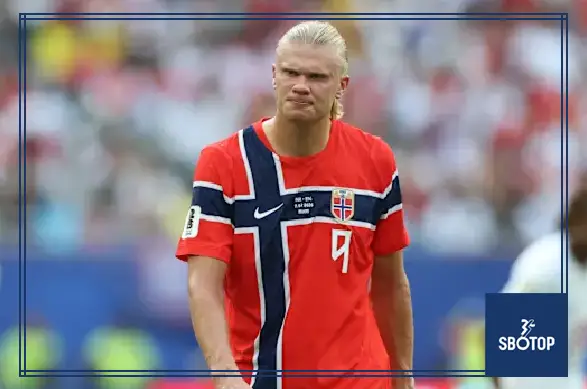
Erling Haaland’s first World Cup ended in a way few could have predicted. After emerging as one of the tournament’s biggest personalities and most dangerous goalscorers, Norway’s superstar striker finished his quarter-final against England watching from the bench as his country fought desperately to remain in the competition.
Haaland was substituted halfway through extra time with Norway trailing 2-1 in Miami. At first, the decision appeared almost impossible to understand. Norway needed a goal, only 15 minutes remained, and their coach had removed one of football’s most feared finishers.
The explanation that emerged after the match painted a more complicated picture.
Norway manager Stale Solbakken said Haaland was physically “finished” after battling through exhausting conditions and suffering a dead leg during the second half. Former Premier League striker Tony Cascarino later claimed he had received information during the game suggesting that Haaland had also been unwell before kickoff. The illness report was not issued as an official medical diagnosis by Norway, but it offered a possible explanation for the striker’s unusual lack of energy.
Haaland managed only two attempts against England, with one testing the goalkeeper, and struggled to impose himself after the interval. England eventually secured a 2-1 extra-time victory through two goals from Jude Bellingham, bringing Norway’s remarkable World Cup journey to an end.
The striker’s performance therefore should not be judged only as a failure to deliver in a major game. It was shaped by illness concerns, extreme heat, physical contact, limited service and the accumulated demands of a historic tournament run.
A Surprisingly Quiet Performance
Haaland entered the quarter-final as England’s most obvious defensive problem. He had scored seven goals during Norway’s run to the last eight, including both goals in the stunning 2-1 victory over Brazil. His pace, strength and ruthless finishing had helped transform Norway from an exciting outsider into a genuine threat to reach the semi-finals.
England therefore built much of their defensive preparation around restricting him.
Marc Guehi and John Stones remained aware of his movement behind the defensive line, while England attempted to prevent Martin Odegaard from receiving the ball comfortably and supplying early passes into the striker’s path.
For much of the match, the plan worked.
Haaland was not completely uninvolved. His positioning still occupied England’s central defenders and created spaces that Norway’s other attackers could target. However, he rarely produced the explosive movement normally associated with his game.
The difference was visible whenever Norway recovered possession. In earlier tournament matches, Haaland had immediately accelerated toward goal, forcing opponents to retreat. Against England, those movements appeared less frequent and less powerful.
Former striker Cascarino said the Norwegian looked physically wrong and appeared to lack his normal energy. He attributed that condition to an illness reportedly affecting Haaland before the game, although Norway did not publicly confirm the precise nature of any sickness.
The official explanation was broader. Solbakken pointed to exhaustion, a second-half dead leg and the enormous amount of energy Haaland had already used throughout the tournament.
Taken together, those factors help explain why the striker looked more subdued than usual.
The Sickness Report Requires Careful Context
The suggestion that Erling Haaland was unwell came from Cascarino, who said he received a message at half-time from someone he considered well informed.
According to the former Republic of Ireland international, the message indicated that Haaland had been suffering from sickness. Cascarino said the information matched what he was watching because the Manchester City forward lacked his usual physical drive.
That claim attracted attention because Norway had dealt with reports of illness in the camp before the match.
Several players had reportedly experienced symptoms during the build-up, although earlier accounts suggested the impact of the sickness bug had been exaggerated and that the squad was healthy enough to face England.
It is possible for both accounts to contain some truth. A player can recover sufficiently to start while still feeling the effects of illness during a demanding match. Reduced energy, dehydration or interrupted preparation may not become obvious until physical intensity increases.
However, the illness claim should remain attributed to Cascarino rather than presented as a confirmed statement from the Norwegian medical team.
Solbakken did not publicly identify sickness as the primary reason for the substitution. He said Haaland had run out of energy and was also managing the effects of a dead leg.
The distinction matters. There is evidence that Haaland was not physically at his best, but the precise contribution made by illness remains uncertain.
Miami’s Heat Increased the Physical Demands
The quarter-final was played in punishing conditions, with reports placing the heat index at approximately 38 degrees Celsius.
That environment placed an additional burden on every player, especially during a match that lasted 120 minutes. Solbakken specifically referred to the taxing conditions when explaining why Haaland could not continue.
Heat affects far more than a player’s ability to run.
It can reduce concentration, slow recovery between high-intensity efforts and increase the physical cost of pressing. Players also lose fluid rapidly, and even carefully managed hydration cannot completely remove the effects of prolonged exposure.
For a striker such as Haaland, effectiveness depends on repeated explosive movements. He must sprint behind defenders, challenge physically for possession, press from the front and react immediately when a chance develops.
Those actions are difficult enough under normal circumstances. Performing them while possibly recovering from sickness, carrying a dead leg and playing in extreme heat made the task significantly harder.
Norway’s tournament schedule may also have contributed. Their victories over Ivory Coast and Brazil demanded enormous physical and emotional effort. Reuters reported that the strain eventually became visible against England, with the demands placed on Haaland and Odegaard proving increasingly difficult to sustain.
Haaland did not suddenly lose his ability. His body appeared unable to produce the level of intensity usually expected from him.
England Cut Off the Supply Line
Physical problems alone do not explain the entire performance.
England also defended intelligently.
Stopping Haaland is rarely achieved by asking one centre-back to defeat him repeatedly in direct duels. The more effective approach is to prevent the passes that allow him to attack at full speed.
England attempted to pressure Norway’s midfield and restrict Odegaard’s influence. Without accurate, early service, Haaland was forced to wait between defenders or move away from goal in search of involvement.
That situation suited England.
Haaland is capable of linking play, but his greatest threat comes near the penalty area. Every time he moves deeper to receive possession, the opposing defence gains time to reorganise.
England’s defenders also avoided following him unnecessarily when he dropped away from the forward line. They protected the central space, communicated well and ensured that Norway could not consistently create direct routes toward goal.
Haaland still occupied both Stones and Guehi, helping open areas for teammates. One tactical analysis observed that his movement dragged England’s defenders around and contributed to opportunities elsewhere, even though he did not score.
That contribution should not be ignored. A striker can influence a match without recording numerous touches.
Yet Norway needed more than space creation from Haaland. They needed the decisive finishing that had driven their tournament, and England prevented him from receiving enough high-quality opportunities.
A Major Chance Passed Norway By
One of the most frustrating moments arrived when Alexander Sorloth chose to shoot rather than pass to Haaland during a promising Norwegian attack.
Haaland appeared available in a dangerous central position, but the ball never reached him. The incident became one of the main examples used to show how close Norway came to creating the chance their leading striker needed.
Such moments are particularly important for players like Haaland.
He does not require constant involvement to decide a game. A single accurate pass can be enough. When that pass does not arrive, his statistical contribution may appear extremely limited despite his positioning being correct.
The situation also illustrates why evaluating Haaland purely through touches can be misleading. His role is not to dominate possession. It is to stretch the defence, attack spaces and finish moves.
Nevertheless, Norway could not repeatedly afford to overlook him. England’s defenders had already succeeded in limiting his opportunities, meaning every rare opening needed to be used efficiently.
The failure to find Haaland during that attack was not the only reason Norway lost, but it represented an opportunity they would later regret.
The Disallowed Goal Added to Haaland’s Frustration
Haaland was also involved in one of the match’s most important decisions.
Norway thought they had scored during the second half through Torbjorn Heggem, but the goal was disallowed after a video review. Officials ruled that Haaland had fouled Elliot Anderson during the buildup.
The decision meant that even one of Haaland’s most significant involvements ended negatively for Norway.
It was a difficult moment for a striker already struggling to find rhythm. Instead of contributing to a potentially decisive goal, his physical challenge became the reason it was removed.
Norway also remained unhappy about the circumstances surrounding Bellingham’s first goal, believing that the ball may have struck an overhead camera cable earlier in the sequence. FIFA said sensor information from the match ball did not support that claim.
Those controversies contributed to Norway’s frustration, but they should not distract from the physical reality facing Haaland.
By extra time, the striker was no longer capable of producing the intensity required to influence the match consistently.
Why Solbakken Removed His Best Goalscorer
The substitution looked extraordinary because Norway were losing.
Bellingham’s second goal had put England ahead, leaving Solbakken’s team with only 15 minutes to find an equaliser. Under normal circumstances, removing Haaland in that situation would appear almost indefensible.
Solbakken insisted it was not a difficult decision.
The Norway coach said Haaland was exhausted and suggested he might have waited too long before replacing him. He explained that the striker had suffered a dead leg in the second half, adding to the accumulated fatigue from his tournament workload.
Jorgen Strand Larsen entered for the final period.
The decision was not an attempt to protect a lead or accept defeat. Solbakken believed a fresher striker offered Norway a better chance than a physically depleted Haaland.
That calculation is difficult for supporters to accept because Haaland can score even when he appears uninvolved. His presence alone creates fear, and many would have preferred him to remain on the field in case one final chance arrived.
But an exhausted player can also become a liability.
If Haaland could no longer press, contest duels or accelerate into space, England’s defenders would have been able to manage him more comfortably. A fresh replacement could at least provide movement and physical energy during the closing stages.
Norway did not score, but that does not automatically make the decision incorrect.
Haaland’s Frustration Was Visible
Television cameras repeatedly showed Haaland watching from the bench as Norway searched for an equaliser.
His frustration was understandable.
He had spent years waiting to represent his country at a World Cup. Norway had not appeared at the tournament since 1998, and their return had developed into one of the competition’s most memorable stories.
Haaland had been central to everything.
He scored decisive goals, embraced Norway’s “Viking Row” celebrations and became one of the most popular figures among neutral supporters. Norway’s victories over Ivory Coast and Brazil allowed the country to imagine a place in the final four.
For that journey to end while he was sitting beside the pitch was inevitably painful.
Yet Haaland’s body had already given everything available. Solbakken said the striker had repeatedly used his energy and power throughout the tournament and praised his contribution despite the disappointing final performance.
The image of Haaland on the bench should therefore not define his World Cup. It was the final scene of a tournament in which he had already transformed Norway’s expectations.
Also Read:
- SBOTOP: Harry Kane Backs Thomas Tuchel While Admitting England Have Yet to Reach Their Peak at World Cup 2026
- SBOTOP: Kylian Mbappe Eases Injury Fears as France Star Laughs with Thierry Henry and Michael Olise Before Spain Semi-Final
- SBOTOP: Jude Bellingham Sparks Fresh Injury Fears After Cameras Capture England Star Managing Persistent Shoulder Problem