Argentina’s preparations for the 2026 World Cup final have acquired an unexpected disciplinary complication after FIFA began assessing reports concerning a politically charged banner displayed during the team’s celebrations following their semi-final victory over England.
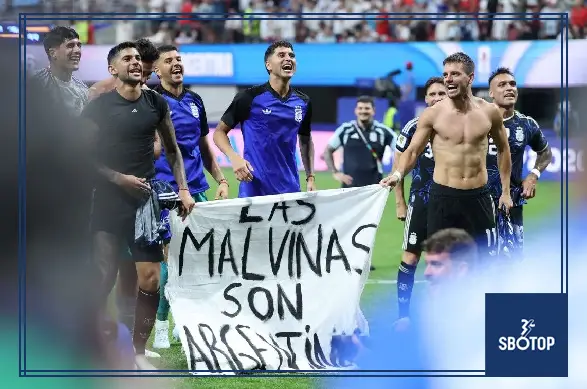
Several Argentina players were photographed with a handmade sign carrying the message “Las Malvinas Son Argentinas,” translated as “The Malvinas are Argentine.” The banner appeared on the pitch after Argentina completed a dramatic 2-1 comeback win in Atlanta and secured a place in the final against Spain. Reuters reported that it had initially been held by supporters in the front row before Giovani Lo Celso approached them and asked to borrow it. Lo Celso and Lisandro Martínez were later pictured displaying it while the squad celebrated with fans.
FIFA has not yet announced a punishment. Its independent disciplinary committee said it was assessing the official match reports and considering the relevant circumstances before deciding whether further steps were required under the governing body’s disciplinary code. That distinction matters. Argentina have not been found guilty, and the review does not automatically mean players will be suspended from the final.
The episode has nevertheless placed football, national identity and a sensitive sovereignty dispute into the same international spotlight. It also leaves FIFA facing a difficult question: how should rules against political messaging be applied when an emotional post-match celebration becomes connected to a dispute that has shaped relations between two countries for generations?
What Happened After the Semi-Final
Argentina’s players had just completed one of the most emotional victories of the tournament. England led through Anthony Gordon, but Enzo Fernández equalised before Lautaro Martínez scored the late winner that sent the defending champions into another World Cup final.
During the celebrations, supporters produced the banner near the front of the stand. Photographs showed players carrying it in front of Argentina’s travelling fans. The wording referred to the Falkland Islands, known in Argentina as the Islas Malvinas, whose sovereignty remains disputed between Argentina and the United Kingdom.
The banner was not part of Argentina’s match kit, and available reporting indicates that it came from spectators rather than the Argentine Football Association. That detail may form part of FIFA’s assessment, but it does not necessarily remove responsibility. The governing body can consider the conduct of players and officials once a message is brought onto the playing area or becomes part of an official match celebration.
FIFA’s Stadium Code of Conduct prohibits political, offensive or discriminatory banners, flags, clothing and other material inside tournament venues. Its disciplinary rules also allow action against messages considered inappropriate for a sporting event, including statements of a political or ideological nature.
Investigators must now establish who handled the sign, how long it was displayed, whether team officials were involved and whether the conduct meets the threshold for a disciplinary offence.
Why the Message Is So Sensitive
The islands sit in the South Atlantic, roughly 300 miles from Argentina. Britain administers them as a British overseas territory, while Argentina maintains a sovereignty claim and refers to them as the Malvinas.
The dispute became a war in 1982 after Argentina’s military dictatorship invaded the islands. Britain sent a military task force and regained control after a conflict lasting more than two months. The fighting killed 649 Argentine service personnel, 255 British personnel and three islanders.
For many people in Argentina, the sovereignty claim is deeply connected to national identity, history and the memory of those who died. For residents of the islands and many people in Britain, the banner represents a rejection of the islanders’ expressed wish to remain linked to the United Kingdom and recalls the trauma of the invasion.
Supporters interviewed in Buenos Aires defended the players, arguing that the gesture reflected history and national sentiment rather than an attempt to provoke England. The Falkland Islands government described the display as insensitive and urged FIFA to apply its rules.
Britain Calls for a Thorough Investigation
The British government quickly supported calls for FIFA to examine the incident.
Business Secretary Peter Kyle described the banner as inappropriate and argued that politics should remain separate from football. A spokesperson for Prime Minister Keir Starmer said the government’s commitment to the islands and the principle of self-determination had not changed, while stressing that any sporting action was a matter for FIFA.
Liberal Democrat leader Ed Davey went further by calling for players involved in the display to be prevented from taking part in the final. Such a sanction would be highly significant, particularly if it affected established internationals, but there is no indication that FIFA has accepted that demand.
Political pressure can increase attention around a disciplinary case, yet the committee is expected to base its decision on match reports, visual evidence and the applicable code. The governing body must avoid appearing either to ignore its own regulations or to impose a disproportionate penalty because of external demands.
Argentina Defends the Sentiment
President Javier Milei described the players’ gesture as understandable and said the message reflected a sentiment shared by Argentines, although he also suggested that a financial penalty was a likely consequence. Vice-President Victoria Villarruel offered even stronger public support for the sovereignty message.
The political response demonstrates why FIFA treats such displays cautiously. A message that one country regards as a legitimate national position may be considered inflammatory or offensive by another.
Lisandro Martínez said Argentina could not let its people down when asked about the banner. Leandro Paredes spoke about the pain associated with the conflict and suggested the players understood that they were representing people affected by that history.
Those explanations may help clarify motivation, but intent is only one part of a disciplinary assessment. A player may believe a message expresses solidarity or identity while still breaching a regulation designed to prevent political claims from becoming part of official football events.
What Sanctions Could FIFA Impose
FIFA could fine the Argentine Football Association, sanction individual players, issue formal reprimands or impose match suspensions if the committee considers the conduct sufficiently serious. Reported fine levels for political messaging generally fall in the thousands or tens of thousands of dollars, although every case depends on the rules applied and the circumstances.
A suspension before the World Cup final would be the most dramatic possibility, but it should not be treated as inevitable. FIFA must establish individual responsibility and determine whether a ban would be proportionate. The fact that the banner came from supporters, appeared after the final whistle and was displayed during celebrations may influence the decision.
The committee may also consider whether the message was planned, whether it was repeatedly shown, whether officials attempted to remove it and whether any player has a relevant disciplinary history.
A collective fine is easier to administer than identifying different levels of responsibility among several players. However, critics would argue that a modest financial penalty might have little deterrent effect during the world’s largest football tournament.
Previous Cases Offer Guidance Not Certainty
Argentina have faced action over the same slogan before.
In 2014, FIFA fined the Argentine Football Association £20,000 after players displayed a “Las Malvinas son Argentinas” banner before a friendly against Slovenia. FIFA concluded that the act breached rules concerning political action and team misconduct.
That precedent strengthens the argument that the latest incident falls within FIFA’s jurisdiction. It may also raise the possibility of a stronger response because the association was previously punished for similar conduct.
Other cases illustrate that suspensions are possible. A South Korean player was banned for two World Cup qualifying matches after holding a banner asserting a territorial claim over islands disputed with Japan during celebrations at the 2012 Olympics. UEFA also suspended Spain players Rodri and Álvaro Morata for one match after they sang “Gibraltar is Spanish” during the country’s Euro 2024 celebrations.
Could the Final Be Affected
Argentina are scheduled to face Spain in the World Cup final, making the timing of the review especially sensitive.
Any suspension announced before the match could alter Argentina’s team selection and create accusations that a political controversy had influenced the tournament’s sporting conclusion. Delaying a decision until after the final, however, could lead to criticism that FIFA avoided enforcing its rules when the stakes were highest.
The committee therefore faces both legal and practical pressure.
If the available reports are clear, FIFA may act quickly. If investigators need statements from players, team officials, stadium staff or security personnel, a final decision could take longer. A provisional measure is theoretically possible, but such action would require a strong justification because it could prevent a player from appearing in the biggest match of his career before the case is fully resolved.
FIFA’s Neutrality Is Under Scrutiny
Absolute separation is difficult. World Cups are hosted by governments, opened by political leaders and shaped by diplomatic decisions. National teams naturally carry flags, anthems and historical identities.
FIFA’s rules do not remove politics from football entirely. Instead, they attempt to prevent players, teams and supporters from using official events to promote political claims, ideological campaigns or messages capable of causing conflict.
Consistency is therefore essential.
If FIFA has punished comparable statements in the past, ignoring the Argentina banner could create accusations of selective enforcement. An excessive punishment could produce a different criticism: that the governing body is criminalising a national belief rather than regulating match conduct.
The Incident Should Not Define the Match
The controversy risks overshadowing an exceptional semi-final.
Argentina showed resilience to recover after falling behind, while England came within minutes of reaching their first World Cup final since 1966. Lionel Messi’s team survived a physical and emotionally charged contest before earning the right to defend their title against Spain.
The players’ actions after the whistle deserve scrutiny, but they should remain separate from the sporting merit of the victory.
There is currently no suggestion that the banner affected the result, influenced the officials or provided Argentina with a competitive advantage. Any sanction should address conduct rather than rewrite the match.
That distinction is important because disciplinary controversy can quickly produce exaggerated demands. Disqualification from the tournament would be an extraordinary response unsupported by the punishments commonly discussed in comparable political-messaging cases.
Also Read: