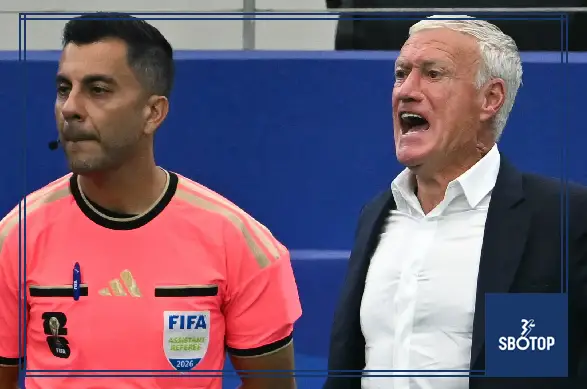
FIFA refereeing chief Pierluigi Collina has publicly defended the officials appointed for France’s World Cup semi-final defeat to Spain after Didier Deschamps questioned whether referee Ivan Barton was qualified to handle a match of such magnitude.
The dispute followed Spain’s 2-0 victory at Dallas Stadium, where Mikel Oyarzabal opened the scoring from the penalty spot before Pedro Porro added a second-half goal. Spain’s victory secured their place in the World Cup final, while France were left preparing for the third-place play-off rather than competing for another global title. FIFA’s official report characterised Spain as deserving winners after they controlled the contest and restricted France’s highly rated attack.
For Deschamps, however, the quality of France’s performance did not remove concerns about the officiating.
The long-serving coach admitted that Spain had been technically superior, but he also questioned whether Barton possessed the required level for a World Cup semi-final. His comments focused on the penalty awarded after Lucas Digne caught Lamine Yamal while attempting to clear the ball, although Deschamps suggested that his frustration came from an accumulation of decisions rather than one incident alone.
Collina’s response was firm. FIFA, he said, had no doubts about Barton’s suitability and considered the tournament’s referees to be world-class officials selected through a rigorous process.
The exchange has created another major refereeing debate at a World Cup already filled with discussions about VAR, disciplinary decisions and the enormous pressure placed on officials.
Deschamps Questions the Standard of Officiating
Deschamps attempted to frame his criticism carefully. He knew that attacking the referee immediately after elimination could appear to be an attempt to distract from France’s shortcomings. He therefore began by acknowledging that Spain had performed better and that responsibility for the defeat belonged primarily to his team.
France had not passed the ball with its normal accuracy, struggled to create meaningful opportunities and allowed Spain to dominate midfield. The French forwards, despite their individual quality, were unable to establish a consistent threat.
Only after accepting those failures did Deschamps turn towards Barton.
Rather than directly claiming that the referee had decided the match, the France coach raised a question about whether the Salvadoran official had been ready for the demands of a World Cup semi-final.
That distinction allowed Deschamps to express dissatisfaction without formally alleging bias or corruption. He did not accuse Barton of favouring Spain. He questioned the referee’s experience, judgement and management of key moments.
His strongest frustration concerned the first-half penalty.
Yamal moved towards a bouncing ball inside the French penalty area as Digne attempted to clear it. The defender made contact with the Spanish winger, and Barton immediately pointed to the spot. The decision survived a video review, allowing Oyarzabal to give Spain the lead.
Deschamps believed there was a possible handball by Yamal before the contact and felt the sequence deserved a different interpretation. He also complained about other decisions, including the reversal of a dangerous French free kick shortly before half-time and what he considered insufficient punishment for several Spanish challenges.
Collina Delivers an Unequivocal Response
FIFA did not allow Deschamps’ comments to remain unanswered. Collina, one of the most respected referees in football history and now the leading authority within FIFA’s refereeing structure, publicly supported Barton and his team.
Asked about Deschamps’ suggestion that Barton might not have been at the necessary level, Collina’s answer was unambiguous: “Yes, definitely.” He added that FIFA regarded its referees as world class.
The brevity of that response was significant.
Collina did not publicly analyse every disputed challenge or attempt to persuade critics through a detailed technical presentation. His primary objective was to protect the credibility of the appointment and reject the idea that FIFA had placed an unprepared official in charge of one of the tournament’s most important matches.
That institutional defence was predictable but still important.
Referees cannot respond to managers in post-match press conferences. They do not normally explain each decision publicly, and their performances are assessed through internal channels. Without support from the governing body, an official can become an easy target after a high-profile defeat.
Collina’s intervention made FIFA’s position clear: whatever Deschamps thought about individual incidents, the organisation remained confident in Barton’s ability and preparation.
Barton Was Not an Inexperienced Appointment
Deschamps’ comments could create the impression that Barton had been unexpectedly promoted into a match beyond his experience.
The available background presents a more complicated picture.
Barton was officiating at his second World Cup and had already taken charge of three matches earlier in the 2026 tournament. The France–Spain semi-final was therefore his fourth assignment at the competition. He also had experience officiating major matches within Concacaf before receiving the semi-final appointment.
FIFA officially selected Barton as the lead referee several days before the game. His appointment came during a tournament in which the governing body had faced criticism over several previous decisions and had moved part of its VAR operation on-site before the semi-finals.
This background does not prove that every decision Barton made was correct. Experience alone does not guarantee a flawless performance.
It does, however, weaken the argument that he lacked the qualifications to oversee the occasion.
FIFA did not choose an official making his debut at elite international level. It appointed a referee who had already handled World Cup matches and had progressed through the organisation’s evaluation system.
The more reasonable debate is therefore not whether Barton belonged at the tournament, but whether his decisions during this particular match met the expected standard.
Was the Penalty Decision Correct
The penalty remains the central incident because it changed the scoreline and forced France to chase the match.
From the referee’s position, the sequence involved Digne attempting to play the ball while Yamal entered the same space. Digne’s action caught the Spanish winger inside the penalty area, and Barton interpreted the contact as a foul.
Video officials checked the decision but found no clear reason to overturn it.
Former referees’ chief Keith Hackett later argued that Barton had made the correct call. According to his analysis, the referee had a strong viewing angle and properly punished the defender’s contact on Yamal.
That assessment does not mean every viewer must agree.
Football’s most controversial penalty decisions often involve genuine contact combined with questions about intention, force and whether the attacker could have remained on his feet. Slow-motion replays can make contact appear more dramatic, while full-speed footage may create a different impression.
Digne was clearly trying to clear the ball rather than deliberately kick Yamal. Yet intention is not the only consideration. A mistimed attempt to play the ball can still constitute a foul when it catches an opponent.
The possible handball before the challenge further complicated the debate. Deschamps believed Yamal may have controlled the ball illegally, while the officials concluded that the available images did not justify cancelling the penalty.
Ultimately, the decision fell within an area where the on-field referee’s interpretation carries considerable weight. VAR is not designed to replace every subjective judgement with a different one. It intervenes when officials identify a clear error according to the review threshold.
In this case, Barton’s original decision remained.
The Reversed Free Kick Added to French Frustration
Deschamps’ complaints extended beyond the penalty.
Late in the first half, France initially appeared to have won a free kick just outside Spain’s penalty area after a challenge involving Fabián Ruiz and Ousmane Dembélé. Barton first awarded the set piece before changing the decision after consulting his assistant.
From the French perspective, the reversal was especially frustrating because the position could have produced one of their best attacking opportunities of the half.
Managers and players generally accept that referees can receive information from assistants before restarting play. However, a changed decision often creates anger because supporters have already reacted to the original whistle and the attacking team has begun preparing for the set piece.
Deschamps reportedly considered the incident unusual, particularly because he believed other members of the officiating team had originally supported the foul call.
For FIFA, consultation between officials is normally a sign that the team is working collectively rather than evidence of weakness. The referee remains responsible for the final decision but can use information from assistants who may have had a clearer view.
The problem is one of perception.
When a referee reverses himself, one team sees healthy communication while the other sees uncertainty. In a World Cup semi-final, that uncertainty becomes magnified.
France’s Complaints Cannot Explain the Entire Defeat
Even while challenging Barton’s performance, Deschamps admitted that France had not reached the required standard.
Spain controlled midfield, moved the ball more confidently and defended with discipline. France’s attacking players struggled to find space, while technical mistakes repeatedly interrupted attempts to build pressure.
This matters when assessing the refereeing controversy.
A disputed penalty can change a match, especially when the two teams are evenly balanced. But France still had substantial time to respond after Oyarzabal’s goal. They were unable to create enough danger before Porro doubled Spain’s advantage.
France’s elimination was not caused by one whistle alone.
Their pressing lacked coordination, their midfield could not control possession and their forwards were frequently disconnected. Spain’s collective organisation prevented Kylian Mbappé and his attacking teammates from receiving the ball in their most dangerous areas.
French player Rayan Cherki also directed attention towards the team’s own performance rather than presenting the officiating as the primary reason for defeat. Reports from the aftermath indicated that some members of the squad accepted that France had simply fallen below the level required in a semi-final.
Deschamps’ criticism can therefore be valid as a separate issue without becoming a complete explanation for the result.
Why Managers Criticise Referees After Major Defeats
The period immediately after elimination is emotionally difficult for any coach.
Managers must speak publicly before they have had time to watch every incident again or process the disappointment. Their players are devastated, supporters demand explanations and journalists naturally focus on the decisions that appeared to shape the match.
Refereeing becomes an attractive subject because it offers a visible turning point.
Tactical failures are complex. They require discussion of positioning, pressing, passing angles and player selection. A penalty decision can be replayed in seconds and debated by millions of viewers.
Deschamps was also approaching the end of his long France tenure. Missing the opportunity to reach another World Cup final intensified the emotion surrounding his response.
His comments may have served several purposes at once.
They expressed genuine frustration, defended his players from carrying all the criticism and forced FIFA to address the standard of officiating.
At the same time, his acknowledgement of Spain’s superiority showed that he understood the danger of placing every responsibility on the referee.
FIFA Must Defend Officials Without Avoiding Transparency
Collina was right to defend Barton against the suggestion that he was fundamentally unqualified.
Public confidence in referees would collapse if FIFA abandoned its officials whenever a high-profile manager complained. Match appointments are based on assessments, experience, fitness and performance throughout the tournament.
However, institutional support should not become automatic refusal to discuss controversial moments.
Supporters increasingly expect governing bodies to explain how major decisions were reached. VAR has given officials access to more information, but it has also raised expectations of accuracy and transparency.
When viewers can watch multiple replays from several angles, a simple statement that the referees are world class may feel insufficient.
A stronger communication model could include post-match technical explanations for major interventions. FIFA would not need to criticise an official publicly. It could clarify what the referee saw, what VAR checked and why the decision met or failed to meet the intervention threshold.
Such explanations would not eliminate disagreement.
Football decisions often remain subjective even after review. But transparency could reduce speculation and help supporters distinguish between a controversial judgement and a genuine procedural error.
The Pressure on World Cup Referees Is Enormous
World Cup officials work under a level of scrutiny unmatched in most domestic competitions.
Every decision is broadcast globally. Social media distributes slow-motion clips before the referee has restarted the game, while former players, pundits and supporters immediately publish competing interpretations.
The pressure becomes even greater during knockout matches.
One penalty, red card or overturned goal can influence a nation’s entire tournament. Coaches may lose their jobs, players can carry the disappointment for years and referees may become permanently associated with a single incident.
Barton entered the semi-final during a tournament that had already experienced multiple officiating disputes. FIFA had faced criticism over previous VAR and disciplinary decisions, making every later appointment more sensitive.
This context helps explain Collina’s forceful defence.
FIFA needed to show confidence in the officials selected for the closing stages. Allowing Deschamps’ question to remain unanswered could have created additional doubt before the final.
Also Read: