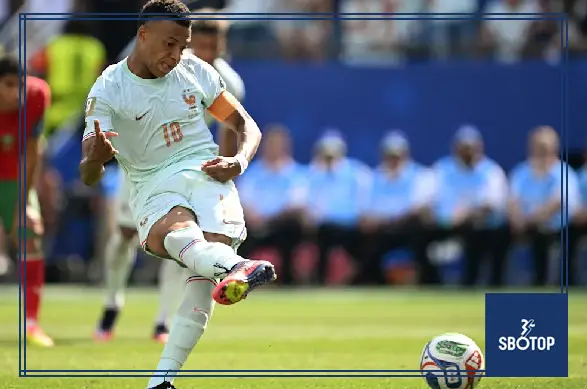
Kylian Mbappé has accepted responsibility for his missed penalty against Morocco while explaining that an unusual delay and confusion involving the referee disrupted his normal preparation.
The France captain was denied by Yassine Bounou during the first half of their World Cup quarter-final, but recovered impressively to score after the break and help Les Bleus secure a 2-0 victory. Ousmane Dembélé added the second goal six minutes later as Didier Deschamps’ team advanced to the semi-finals for the third consecutive World Cup.
Mbappé’s eventful evening did not end with the goal.
He later suffered a knock to his right ankle and was substituted with more than 15 minutes remaining. The sight of the forward receiving treatment and sitting on the bench with ice around the joint created immediate concern, but both Mbappé and Deschamps indicated that the problem was not serious.
France therefore left Foxborough with almost everything they wanted: a place in the final four, another clean sheet and an encouraging update concerning their most important attacker.
The only major imperfection was Mbappé’s penalty miss.
His explanation revealed how even the world’s most composed players can be affected when the familiar routine surrounding a major moment is suddenly interrupted.
Confusion Interrupted Mbappé’s Preparation
Mbappé did not attempt to avoid personal responsibility. He acknowledged that the penalty was poorly taken before explaining that the sequence leading up to it had become confusing. According to the France captain, the referee initially informed him that a penalty had been awarded, allowing him to begin his normal mental preparation. The official then returned and indicated that the decision might not stand, creating uncertainty before the kick was eventually confirmed.
Mbappé admitted that he allowed the situation to distract him.
The striker said he had not previously encountered that precise scenario, in which he prepared to take a penalty, was told it could be withdrawn and then had to restart the process moments later. He still accepted that the execution was his responsibility.
That balance was significant.
He did not blame the referee, the video review or the surrounding confusion for the miss. Instead, he offered context while admitting that his concentration and technique were not good enough.
For a captain, that distinction matters.
Teammates expect leaders to explain difficult moments honestly, but they also expect them to accept responsibility. Mbappé managed to do both without turning the incident into a complaint about officiating.
Why Penalty Routines Matter
A penalty may appear simple because the ball is stationary and the goalkeeper must remain on the line until the kick is taken.
In reality, the pressure can be extraordinary.
The taker must choose a target, control breathing, assess the goalkeeper’s movement and execute a precise strike while thousands of supporters and millions of viewers wait for the outcome.
Elite penalty takers often develop fixed routines to manage that pressure.
They position the ball in a particular way, take a specific number of steps and focus on a limited set of cues. The purpose of the routine is not superstition. It creates familiarity in an emotionally unstable situation.
Mbappé’s preparation was interrupted.
He moved from certainty to doubt and then back to certainty. Instead of focusing only on Bounou and the placement of the kick, he had to process whether the penalty would be taken at all.
That does not remove his responsibility, but it helps explain why the effort lacked the confidence and accuracy associated with one of football’s most reliable finishers.
Bounou remained patient, read the direction and smothered Mbappé’s low attempt in the 28th minute. Reuters reported that it was the forward’s first penalty miss for France since Euro 2020.
Bounou Deserves Credit for the Save
The discussion surrounding Mbappé’s preparation should not reduce Bounou’s contribution.
The Morocco goalkeeper has built a reputation as an outstanding performer in high-pressure situations. He did not commit too early and gave himself enough time to react to the direction of the shot.
His calmness placed additional pressure on Mbappé.
Some goalkeepers attempt to distract a penalty taker through movement, conversation or exaggerated gestures. Bounou’s approach was more controlled. He remained balanced and trusted his reading of the strike.
The save temporarily preserved Morocco’s hopes.
France had started aggressively and created early opportunities, but the penalty offered the clearest chance to establish control. When Bounou stopped the effort, the Atlas Lions gained an emotional lift and remained level through the rest of the first half. France also struck the crossbar through Lucas Digne before the interval, while Morocco failed to register an attempt during the opening 45 minutes.
The match remained goalless, and Mbappé entered half-time knowing his miss had prevented France from turning their superiority into a lead.
The Response Revealed Mbappé’s Mental Strength
The defining feature of Mbappé’s performance was not the missed penalty.
It was the way he reacted.
Some players become cautious after failing from the spot. They stop demanding possession, avoid difficult shots or allow frustration to influence their decision-making.
Mbappé did the opposite.
He continued moving aggressively, receiving the ball around Morocco’s penalty area and searching for an opportunity to attack the defensive line.
The breakthrough arrived on the hour.
Mbappé collected possession near the edge of the box, looked up and curled a precise finish beyond Bounou. The goal opened the match and rewarded France for the patience they had shown against Morocco’s deep defensive structure.
Deschamps praised the captain’s reaction, noting that Mbappé recovered from the disappointment of the missed penalty and delivered when France still needed him.
That ability to reset is one of the qualities separating exceptional players from merely talented ones.
Mistakes are unavoidable. The response determines whether a mistake becomes a defining failure or a temporary interruption.
Mbappé’s Goal Changed the Quarter-Final
Before Mbappé scored, Morocco could continue following a conservative plan.
They defended compactly, restricted central space and waited for France to become frustrated. Although the Atlas Lions created very little themselves, the scoreline allowed them to believe one counterattack or set piece could transform the match.
The opening goal destroyed that balance.
Morocco could no longer remain entirely passive. They had to move players forward, creating additional space behind their midfield and defensive lines.
France punished that change almost immediately.
Six minutes after Mbappé’s goal, Dembélé drove a low finish beyond Bounou to make it 2-0. France had struck twice in a short period, turning a tense quarter-final into a controlled victory.
Mbappé’s movement contributed to the space that allowed Dembélé to score.
Even when he does not provide the final pass, his presence attracts defenders and changes their positioning. Opponents know that giving him room can be decisive, so they often narrow their shape or commit additional cover toward his side.
That attention can create openings for France’s other attackers.
France’s Attack Is No Longer One-Dimensional
Mbappé remains France’s leading figure, but Deschamps has assembled an attack capable of producing danger from several positions.
Dembélé entered the semi-finals with five tournament goals, while Michael Olise, Désiré Doué and other attacking options have contributed at different stages of the competition. France had scored 16 goals by the end of the Morocco match, the highest total at that point of the tournament.
That depth gives opponents an impossible calculation.
They must protect against Mbappé’s pace and finishing without leaving too much room for Dembélé, Olise or advancing midfielders.
Morocco’s cautious setup reflected that fear.
Their defensive structure was designed primarily to avoid giving France space to accelerate. Deschamps later suggested that the quality of his attacking players may have influenced Morocco’s decision to defend so deeply.
The approach delayed France, but it did not stop them.
Once Mbappé scored, the strength of the surrounding attack ensured Morocco had no realistic opportunity to recover.
Another Historic World Cup Milestone
The goal carried major statistical significance.
Mbappé became the youngest player to reach 20 World Cup appearances and scored his 20th goal at the competition. At 27, he also matched Hugo Lloris’ record for the most World Cup appearances by a French player.
His eighth goal of the 2026 tournament moved him level with Lionel Messi in the Golden Boot race at that stage, while his total World Cup tally left him one behind the Argentine captain.
The numbers are extraordinary because Mbappé remains in what should be the middle of his international career.
He has already played in three consecutive World Cup semi-finals and remains central to France’s attempt to reach a third straight final.
The penalty miss against Morocco will barely register when his tournament record is reviewed.
The recovery, goal and victory will matter far more.
The Ankle Knock Created a New Concern
Shortly after helping France take control, Mbappé experienced another difficult moment.
Morocco defender Issa Diop stepped on his right ankle during a challenge. Mbappé attempted to continue but later went down, received treatment and signalled that he could not operate comfortably. Deschamps eventually replaced him, and the forward watched the closing stages with ice around the ankle.
The image immediately raised questions.
France are only one match from the World Cup final, and any problem affecting Mbappé’s acceleration or ability to change direction could alter their chances.
Ankle injuries are particularly concerning for explosive attackers.
Even a minor issue can reduce confidence when sprinting, dribbling or striking through the ball. A player may be medically available but still lack the freedom required to perform at maximum intensity.
Deschamps therefore had little reason to take a risk.
France were already two goals ahead, Morocco had offered minimal attacking threat and the match appeared secure.
Removing Mbappé was the sensible decision.
Mbappé Quickly Played Down the Fear
The initial update was reassuring.
Mbappé said that he had taken a knock to the ankle but was fine, while Deschamps described the pain as slight and not serious. The France coach also expressed confidence that players who ended the quarter-final with physical issues would be available for the next match.
That does not mean France will ignore the problem.
Medical staff will monitor swelling, mobility and Mbappé’s reaction during recovery sessions. He may train separately or complete a reduced workload before returning fully to the squad.
The important point is that neither player nor coach spoke as though the injury threatened his tournament.
Mbappé’s calm response also helped prevent unnecessary panic.
Fitness concerns surrounding superstar players can dominate tournament camps. Every photograph, training absence or protective bandage becomes the subject of speculation.
By describing the problem as a simple knock, the captain attempted to shift attention back toward the team’s preparation.
France Must Still Manage Him Carefully
Even with a positive diagnosis, Deschamps must avoid becoming careless.
Mbappé has completed a demanding club season and carried a heavy workload throughout the World Cup. He has also received aggressive physical treatment from opponents, including during France’s narrow knockout victory over Paraguay.
Accumulated contact matters.
One challenge may not produce a serious injury, but repeated blows can leave a player vulnerable as the tournament progresses.
France have several days before the semi-final, providing time for treatment and controlled recovery. There is no need for Mbappé to participate fully in every session.
Deschamps can prioritise tactical meetings, light technical work and individual conditioning until the ankle responds normally.
The objective is not simply making him available.
It is ensuring he can perform without hesitation.
The Semi-Final Will Be France’s Toughest Test
France are scheduled to face the winner of Spain and Belgium in Dallas on July 14.
Either opponent would present a significant tactical challenge.
Spain’s possession game could force France to defend for extended periods, while their movement and technical quality would test the balance between Deschamps’ midfield and defensive lines.
Belgium would offer a different threat, combining experience, individual creativity and attacking power.
France cannot expect the semi-final to follow the same pattern as the Morocco match.
Morocco defended deeply and created almost nothing until the closing stages. Reuters reported that their first shot on target did not arrive until the 84th minute. France are unlikely to receive the same level of control against their next opponent.
Mbappé’s fitness will therefore matter even more.
France may require him to lead counterattacks, press defenders and produce decisive actions in a match containing fewer opportunities.
Also Read: