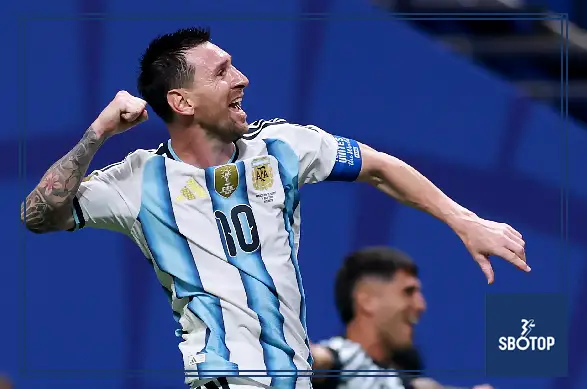
Lionel Messi has never needed a dramatic speech to convince teammates that an important match has arrived. Those who played beside him at Inter Miami say the transformation is quieter, almost invisible at first. His expression becomes more focused, his movements more deliberate and his competitive intensity begins to shape everyone around him.
Former Inter Miami players Kamal Miller and Fafa Picault have offered rare insight into the mentality behind Messi’s greatest performances. Their descriptions reveal that the Argentina captain does not suddenly become louder before a decisive match. Instead, he enters what Picault called a “different mode,” raising his own level so clearly that teammates feel compelled to follow.
That mentality became especially relevant before Argentina’s World Cup semi-final against England. At 39, Messi entered the match already carrying the pressure of a nation, the weight of football history and the knowledge that every appearance could be his final one on the tournament’s biggest stage.
England contained him for long periods. Argentina struggled to create clear chances, and Anthony Gordon’s second-half goal appeared capable of ending Messi’s pursuit of another World Cup. Yet as the match entered its decisive phase, the version of Messi described by his former teammates gradually appeared.
Argentina equalised through Enzo Fernández in the 85th minute. Messi then supplied the cross for Lautaro Martínez’s stoppage-time winner, completing a 2-1 comeback and sending the defending champions into the final against Spain. He finished the semi-final with involvement in both goals and demonstrated precisely why those who know him believe his mentality changes when elimination is near.
The Quiet Arrival That Changed Inter Miami
Kamal Miller remembered the first signs that something extraordinary was happening at Inter Miami in 2023. Security around the training facility increased. Players required new access codes, and anyone asking for the number 10 shirt was told it was unavailable. Rumours about Messi’s arrival had been circulating, but the reality became clear when the players entered the building and discovered that the seven-time Ballon d’Or winner was already there.
Miller said Messi had arrived before everyone else, forcing his new teammates to behave normally despite suddenly sharing a dressing room with one of football’s greatest players.
The initial challenge was adjusting to his fame. Messi’s presence changed the scale of attention surrounding Inter Miami almost immediately. Training sessions, travel arrangements and ordinary league matches were treated like global events.
Over time, however, Miller learned that celebrity was not the most important part of Messi’s influence. What separated him was the way he changed the emotional temperature of high-pressure matches.
Messi did not dominate team meetings with long speeches. He rarely needed to shout at others or publicly demand more effort. Miller explained that the pressure largely came from within the group because Messi was not especially verbal. His standards communicated the message.
That form of leadership is difficult to manufacture. A teammate can ignore a motivational slogan, but it is much harder to ignore a player whose concentration and performance visibly increase when the stakes rise.
Picault Saw Messi Enter Playoff Mode
Fafa Picault joined Inter Miami before the 2025 season and was recruited partly because his pace and direct running suited Lionel Messi’s passing.
Playing alongside the Argentine required movement. Messi could identify spaces before they fully opened, but the players around him had to trust that the ball would arrive. For runners such as Picault, the task was to accelerate at the correct moment, even when the passing lane did not yet appear obvious.
Picault also witnessed the psychological transformation that occurred during knockout football. He described different versions of Messi emerging in playoff matches and at the Club World Cup.
The change did not involve a completely different personality. It was an increase in intensity. Messi’s desire to win became more visible, particularly when defeat would mean elimination.
According to Picault, this version of Messi became sharper and more competitive. The normally composed playmaker showed another side of himself—one defined by an obvious refusal to accept defeat.
This is the “different mode” that opponents fear.
It does not guarantee that Messi will score a spectacular goal or dominate every minute. It means he continues studying the contest until he understands where it can be decided.
Messi’s Big-Game Mentality Is Often Misunderstood
Football frequently associates leadership with noise.
Captains are expected to deliver emotional speeches, confront opponents and constantly direct teammates. Messi has never consistently matched that traditional image. His personality is more reserved, and his influence is often expressed through actions rather than declarations.
That quietness can be mistaken for passivity.
During matches, Messi sometimes walks while others sprint. He can appear detached from the action, particularly when his team does not have possession. Critics may interpret those moments as fatigue or a lack of urgency.
In reality, he is frequently observing.
He watches the position of the defensive midfielders. He identifies which full-back is stepping too far forward. He studies whether a centre-back follows him into midfield or remains close to the penalty area.
That information becomes valuable later.
Messi’s major-match mentality is not based only on emotional intensity. It combines competitiveness with patience. He does not need to force himself into every attack because he trusts his ability to recognise the moment when his intervention will matter most.
Against England, that moment arrived late.
England’s Plan Initially Limited Him
Thomas Tuchel’s England approached the World Cup semi-final with a clear intention to reduce Messi’s influence.
The match became physical almost immediately. England crowded the central areas, prevented Argentina from developing smooth combinations and challenged aggressively whenever Messi received possession.
The opening half produced 19 fouls, two yellow cards and no shots on target. Messi struggled to create clear opportunities, while England captain Harry Kane was similarly isolated at the opposite end.
England’s structure forced Messi to move farther from goal. Djed Spence remained disciplined on the left side of the defence, and England’s midfield attempted to close the passing routes into Argentina’s forwards.
For much of the contest, the strategy worked.
Messi was present, but he was not yet decisive. Argentina controlled periods of possession without turning that control into major chances.
When Gordon scored in the 55th minute, England appeared to have gained the advantage its disciplined approach deserved. Declan Rice helped begin the move, Morgan Rogers delivered across the goal and Gordon converted at the far side.
At that stage, Messi’s tournament was under genuine threat.
Pressure Activated the Different Mode
England’s goal changed the tactical and emotional direction of the match.
Argentina no longer had the option of waiting. Lionel Scaloni introduced more attacking players, pushed his team higher and encouraged the full-backs to support attacks.
England responded by retreating.
Gordon was removed for defender Ezri Konsa, while later changes added further defensive protection. The Three Lions attempted to construct a wall around Jordan Pickford’s penalty area.
That decision removed much of England’s counterattacking danger. Argentina’s defenders could advance without worrying about Gordon’s pace, and Messi began receiving possession closer to the areas where he could decide the game.
This was the environment in which his former teammates’ description became visible.
His movements grew more purposeful. He began drifting towards the right, where he could escape the congestion in central midfield and face England’s defensive block from a different angle.
He did not panic. He did not begin shooting from impossible positions or attempting to dribble through the entire defence.
He continued searching.
The Guardian’s match analysis described how the energy gradually began revolving around Messi as England withdrew. By the closing stages, the Argentine was controlling the spaces and rhythm of the game despite having struggled to impose himself earlier.
Messi Creates the Equaliser
Argentina’s equaliser arrived in the 85th minute, and Messi was involved in creating the opening.
After a quickly taken corner, he received the ball on the right and moved towards the penalty area. England’s defence had become so focused on protecting the six-yard box that space appeared outside it.
Messi recognised Fernández’s position and played the ball into the midfielder’s path. Fernández struck powerfully from distance, beating Pickford and restoring parity.
The goal was officially significant for Fernández, but the buildup reflected Messi’s reading of the moment.
He had drawn England’s attention towards the right side before selecting the correct pass. He did not attempt the final shot himself. He understood that the better option belonged to a teammate.
That decision is central to Messi’s big-game mentality.
The desire to be decisive does not necessarily become a desire to do everything alone. He wants the outcome, not simply the personal highlight.
With the score level, Argentina could have prepared for extra time. Instead, the defending champions continued attacking.
Messi sensed that England were emotionally and physically vulnerable.
One Final Cross Ends England’s Dream
The winner came in the second minute of stoppage time.
Messi collected possession on the right, took several touches and examined the defensive line. England had multiple players near him, but their shape had become narrow and disorganised.
He created enough room to deliver with his right foot.
The cross was not driven hopefully into a crowd. It was carefully placed into the area between Pickford and the retreating defenders. Martínez attacked the space and powered a close-range header into the net.
Argentina led 2-1.
The assist was Messi’s fourth of the tournament and completed his involvement in both goals of the comeback. He had not controlled the entire semi-final, but he controlled its decisive minutes.
That is the difference former teammates were attempting to explain.
Messi’s major-match transformation is not always a 90-minute exhibition. Sometimes it is the ability to remain mentally engaged through frustration, physical contact and tactical resistance before determining the result with one pass.
England stopped him for most of the night.
They could not stop him when it mattered most.
His Intensity Raises Argentina’s Collective Belief
Messi’s effect extends beyond his own performance.
When teammates see him remain calm under pressure, they are less likely to lose belief. Argentina can survive difficult periods because the players trust that their captain will eventually discover an opening.
That belief has become a defining part of Scaloni’s team.
Argentina’s players run for Messi, protect him defensively and create the space that allows him to conserve energy. In return, he gives them the confidence that a match is never beyond recovery.
Fernández’s equaliser and Martínez’s winner demonstrated that relationship. Messi provided the creative influence, but his teammates still needed the courage and technique to complete the opportunities.
Martínez had entered the match only minutes before scoring. He could have remained cautious while adjusting to the pace of the contest. Instead, he attacked Messi’s cross with total commitment.
The striker expected the delivery to arrive.
That expectation is one of Messi’s greatest gifts to teammates. Runs that might appear speculative become logical because the passer has repeatedly demonstrated that he can see them.
Also Read:
- SBOTOP: Zlatan Ibrahimovic Declares ‘Football Won’ as Rodri Inspires Spain Past France and Into World Cup Final
- SBOTOP: Thomas Tuchel Commits to England Through Euro 2028 Despite Argentina Semi-Final Heartbreak
- SBOTOP: England’s World Cup Dream Ends as Harry Kane Admits Defensive Approach Failed Against Argentina