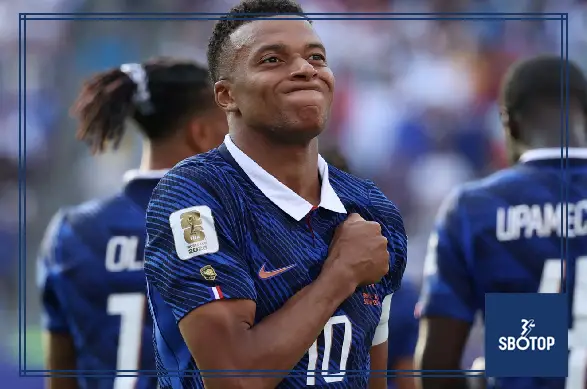
France did not simply beat Sweden. They overwhelmed them, stretched them, exhausted them, and reminded the rest of the World Cup that their attack may be the most frightening unit left in the competition. In a 3-0 round-of-32 victory at New York New Jersey Stadium, Kylian Mbappe scored twice, Michael Olise dictated the rhythm of France’s forward play, and Bradley Barcola added the second goal as Didier Deschamps’ side moved into the last 16 with authority.
The result maintained France’s perfect World Cup record so far: four wins from four, 13 goals scored, and only two conceded. Reuters reported that Mbappe’s double took him to six goals at the tournament and 18 career World Cup goals, one behind Lionel Messi on the all-time list. France’s next challenge is Paraguay, who stunned Germany on penalties to earn their own place in the last 16.
For Sweden, the final whistle must have felt like mercy. France hit the woodwork, created chance after chance, and produced a level of attacking fluency that made the 3-0 scoreline feel almost modest. Reuters described the performance as one full of attacking precision and noted that the scoreline arguably flattered the Swedes, given how many times France came close to adding more.
This was not a narrow knockout win built on caution. It was a warning.
Mbappe Sets the Tone With Ruthless Authority
Every great World Cup campaign needs a player who can make the tournament feel like his own. For France, that player is once again Kylian Mbappe. He entered the Sweden tie already carrying the weight of expectation, but what separates him from most forwards is how naturally he seems to live with that pressure.
Sweden had warnings long before the opening goal. Mbappe forced a save from range early on, later had a goal ruled out for offside, and then struck the post after half an hour. The breakthrough finally arrived in the 45th minute, when he cut in from the left and drove a right-footed shot beyond Jacob Widell Zetterstrom. Reuters reported that the goal came after Ousmane Dembele found him, continuing a devastating partnership that has now produced more combined World Cup goals than any duo in tournament history.
That first goal was important not only because it broke Sweden’s resistance, but because it confirmed France’s emotional control of the match. Sweden had defended, chased, recovered, and survived for almost an entire half. Then Mbappe arrived with the kind of individual certainty that makes defensive plans feel temporary.
The celebration also carried meaning. Mbappe and the French players ran toward Deschamps after the opener, embracing their coach after he had returned to the United States following his mother’s funeral. It was a human moment inside a ruthless performance, and it underlined the unity inside a squad that looks increasingly dangerous.
Olise Becomes France’s Creative Brain
If Mbappe was the finisher, Olise was the architect. His influence is becoming impossible to ignore. France have many explosive players, but Olise gives the attack its intelligence, its timing, and its ability to unlock teams without relying only on speed.
Against Sweden, he repeatedly found pockets between midfield and defence. He drifted inside, slowed the tempo when needed, and then accelerated attacks with disguised passes. Al Jazeera reported that Olise provided the pass for Barcola’s second-half goal and then assisted Mbappe’s second with another incisive delivery behind the Swedish line.
Olise’s numbers now place him among the defining players of the tournament. Reuters reported that he has five assists, one short of Pele’s World Cup record of six in 1970, while France’s main attacking group has produced a remarkable share of the team’s goals.
That record chase matters, but the eye test may be even more convincing. Olise does not play like a player forcing highlight moments. He plays like a footballer who understands how to make the entire attack breathe. Mbappe’s pace terrifies opponents, Dembele’s unpredictability destabilizes them, and Barcola’s movement stretches defensive lines. Olise connects all of it.
France are not just fast. They are coordinated. That is what makes them frightening.
Barcola Shows France’s Depth of Weapons
Bradley Barcola’s goal in the 53rd minute was another reminder of France’s ridiculous attacking depth. He is not always guaranteed to start, but in this team, even a player fighting for a regular place can look like a decisive tournament weapon.
His finish against Sweden came at the perfect moment. France had ended the first half on top, but knockout matches can shift if a leading team becomes careless after the break. Barcola made sure there would be no Swedish revival. His goal doubled the lead, gave France control of the match, and allowed Deschamps’ side to attack with even more freedom.
Al Jazeera reported that Barcola fired into the top corner after Olise’s pass eight minutes into the second half. Reuters also highlighted Barcola’s production in the wider tournament picture, noting that he has added goals and an assist despite not being a guaranteed starter.
That is the difference between France and many other contenders. Some teams have one elite attacker. Some have a strong front three. France have waves. If one player is quiet, another takes over. If a defender adjusts to Mbappe, Olise finds the passing lane. If opponents track Dembele, Barcola attacks space. If Deschamps turns to the bench, Rayan Cherki, Desire Doue, Jean-Philippe Mateta, or Marcus Thuram can change the match.
It is not only star power. It is relentless pressure from every angle.
Sweden Could Not Live With the Speed
Sweden did not lose because of a lack of effort. They lost because the gap in speed, sharpness, and attacking quality became too large. France forced them into constant emergency defending. Every turnover became dangerous. Every mistimed step risked putting Mbappe or Barcola behind the line.
Reuters wrote that Sweden looked visibly drained by the pace of France’s passing and attacking movement, with conditions in East Rutherford adding to the physical difficulty. The official temperature was 32 degrees Celsius, but France’s tempo made the match feel even hotter for the Swedes.
That matters because Sweden entered the game with a defensive plan, but tournament football punishes teams that spend too long without possession or relief. Sweden’s back line could survive one attack, then another, then another. Eventually, the pressure became cumulative.
The first half was about resistance. The second half was about survival. Once Barcola scored, Sweden’s belief dropped. Once Mbappe added the third in the 74th minute, the match was finished.
France did not merely defeat Sweden tactically. They wore them down physically and mentally.
Mbappe’s Record Chase Adds Another Layer
Mbappe’s World Cup story is entering historic territory. His two goals against Sweden moved him to 18 goals in 18 World Cup appearances, leaving him just one behind Messi’s all-time total, according to Reuters and Al Jazeera. Al Jazeera also reported that Mbappe’s fifth and sixth goals of the 2026 tournament moved him level with Messi in the Golden Boot race.
Those numbers are extraordinary because Mbappe is still building the prime years of his international career. He is not compiling records slowly. He is attacking them at terrifying speed.
Al Jazeera also reported that Mbappe now has 10 goals in World Cup knockout-stage matches, moving clear of Brazilian legends Leonidas and Ronaldo, who had eight each. That detail matters because knockout goals carry a different weight. Group-stage scoring can build momentum, but knockout goals shape legacies.
Against Sweden, Mbappe did both. He opened the match, then killed it. He scored when France needed release and then scored again when France needed finality. That is why the Messi chase, the Golden Boot race, and the knockout records feel like more than statistical noise. They are the natural consequence of a player deciding the biggest games.
Deschamps Has Built a Monster
For years, France under Deschamps have been associated with control, pragmatism, tournament management, and the ability to win even without playing beautifully. This version looks different. France still have structure, but their attack has become so explosive that it changes the entire identity of the team.
Reuters reported that France’s four main forwards have scored 12 of the team’s 13 goals through four matches, while Mbappe, Dembele, and Olise have combined for 11 goals and nine assists. It is the kind of attacking concentration rarely seen at a World Cup and has already invited comparisons with some of the greatest forward lines in tournament history.
That does not mean France have won anything yet. History only remembers attacking greatness if it leads deep into the tournament. But the signs are obvious. France can hurt teams in transition, in settled possession, from wide positions, through central combinations, and from the bench.
Deschamps has often been accused of caution. This time, he has a team that can be cautious when necessary but devastating when space appears. That balance is what makes France so dangerous. They are not reckless. They are selective. When they accelerate, opponents struggle to breathe.
Paraguay Present a Different Challenge
France’s next opponent will not approach the match like Sweden. Paraguay earned their place in the last 16 by eliminating Germany on penalties after a 1-1 draw, and Deschamps has already warned that their progress is no accident. Reuters reported that France expect a low block, a physically intense South American opponent, and difficult conditions in Philadelphia.
That makes the Paraguay tie fascinating. France will likely dominate the ball. Paraguay will likely defend deep, slow the rhythm, fight for duels, and wait for counterattacking or set-piece moments. Against Sweden, France had space to attack once the match opened. Against Paraguay, patience may become just as important as speed.
There is also history. Paraguay’s 1998 World Cup run ended against France in the last 16, when Laurent Blanc scored a golden goal in extra time. Deschamps captained France that day, and Paraguay arrive with both pride and revenge in the background. Reuters noted that Paraguay’s past elimination by France gives this meeting an old emotional edge.
France are favourites, but this tournament has already punished favourites who assumed control would be enough. Germany learned that against Paraguay. France will have no excuse for ignoring the warning.
Olise May Be the Key Against a Low Block
If Paraguay sit deep, Olise could become even more important than he was against Sweden. Mbappe is devastating when he has space to attack, but compact defences can reduce sprinting lanes. That is where France need a player who can pass through traffic, manipulate defenders, and find the half-second before a block closes.
Olise has become exactly that player. Reuters described him as the creative hub of France’s forward line, linking Mbappe, Dembele, and the rest of the attack with vision and touch. His five assists show end product, but his real value may be in how he changes defensive shapes before the final pass even arrives.
Against Paraguay, he will need patience. He may not have as much room as he enjoyed when Sweden began to tire. He may have to work in tighter pockets, recycle possession, and wait for the perfect angle. That kind of game suits him.
France have enough power to overwhelm teams. Olise gives them enough craft to unlock teams that refuse to open up.
Also Read: