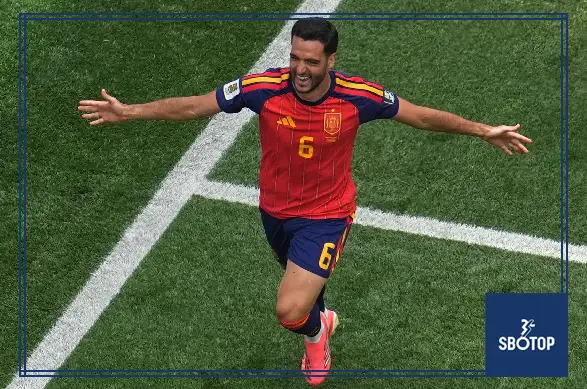
Mikel Merino has developed an extraordinary habit of arriving precisely when Spain need him most. With their World Cup quarter-final against Belgium drifting towards extra time, Spain appeared to be running out of ways to convert control into victory. They had dominated possession, created far more attempts and repeatedly pushed Belgium towards their own penalty area. Yet the score remained level, the clock was approaching 90 minutes, and the possibility of another exhausting knockout battle was growing.
Luis de la Fuente turned to Merino in the 86th minute.
Two minutes later, Spain were ahead.
Pau Cubarsí drove a low effort towards goal, replacement goalkeeper Senne Lammens failed to hold it, and Merino reacted before every Belgian defender. The midfielder reached the loose ball and fired it into the net, completing a dramatic 2-1 victory that sent Spain into their first World Cup semi-final since winning the competition in 2010.
It was not simply another late goal. It was the latest chapter in a remarkable sequence of decisive interventions from a player who has become Spain’s specialist for the most pressurised moments.
Merino had already come off the bench to score the stoppage-time winner against Portugal in the round of 16. Before this World Cup, his most famous international contribution had been the 119th-minute header that defeated Germany in the Euro 2024 quarter-finals. Spain went on to win that tournament, and now the same midfielder has again emerged as a symbol of their resilience.
His latest strike ended Belgium’s resistance and created one of the most anticipated fixtures of the tournament: Spain against France for a place in the World Cup final.
Spain Started with Purpose
Spain entered the quarter-final as favourites, but Belgium possessed enough attacking quality and tournament experience to make the contest dangerous. De la Fuente’s side attempted to establish control immediately. Their midfield pushed forward, the full-backs offered width and the front line pressed Belgium’s attempts to build from the back. Spain’s intention was clear: they wanted to make the match take place almost entirely inside the Belgian half.
The pressure eventually produced the opening goal in the 30th minute.
Thibaut Courtois initially made an excellent diving save, but Fabián Ruiz reacted to the rebound and drove the ball through a crowded penalty area. His finish travelled between Timothy Castagne’s legs before reaching the net.
The goal justified De la Fuente’s surprise decision to select Fabián ahead of Pedri. Pedri had been expected to start because of his ability to control possession and escape pressure, but the coach wanted a different physical and attacking presence in midfield. Fabián rewarded that decision by scoring the goal that gave Spain early control.
Spain appeared capable of building on the advantage. Lamine Yamal stretched Belgium from the right, while the movement around him created passing lanes inside. Belgium were often forced into a compact defensive structure, relying on Courtois to handle the shots that reached his goal.
However, the match changed before half-time.
Belgium Strike Back
Belgium had spent much of the opening period defending, but their attacking players remained dangerous whenever Spain’s shape became stretched.
Eleven minutes after Fabián’s opener, Castagne moved into space and delivered an accurate cross. Charles De Ketelaere timed his movement perfectly, attacking the gap between defenders before directing a header past Unai Simón.
The equaliser carried historical significance within Spain’s tournament. It was the first goal La Roja had conceded at the 2026 World Cup. Until that moment, their defence had resisted every opponent, combining aggressive pressing with calm possession and disciplined positioning.
Belgium’s goal demonstrated that Spain’s control was not absolute.
De Ketelaere’s movement exposed the risk created when Spain pushed players forward. Castagne was given time to deliver, the defensive line failed to track the run, and Simón had little chance of stopping the header.
The equaliser also changed the emotional balance of the contest. Belgium, who had looked vulnerable during Spain’s strongest period, suddenly carried greater belief. Kevin De Bruyne began finding more opportunities to influence possession, while Romelu Lukaku offered a physical target against the Spanish centre-backs.
Spain still had more of the ball, but Belgium had reminded them that one efficient attack could undo long periods of dominance.
The teams entered half-time level at 1-1, leaving the quarter-final finely balanced.
Spain Regain Control
Spain emerged for the second half with greater urgency.
Rather than abandoning their approach, they intensified it. Rodri continued to organise possession from midfield, while Spain moved the ball from side to side in an effort to pull Belgium’s structure apart.
Lamine remained one of the most dangerous players on the pitch. His ability to receive near the touchline, change direction and move into central areas forced Belgium to constantly adjust their defensive spacing.
Spain also introduced Pedri for Fabián early in the second half. The substitution gave them a player capable of receiving possession in tighter spaces and accelerating combinations around the penalty area.
The pattern increasingly resembled an attack-versus-defence exercise.
Spain finished the match with 17 shots compared with Belgium’s five. That difference illustrated the territorial control they established, although it also revealed their difficulty in turning dominance into a decisive goal.
Belgium defended deep and competed for every loose ball. Courtois continued making important saves, preserving the level score as Spain’s pressure grew.
Then another turning point arrived—one that would ultimately have a major influence on the outcome.
Courtois’ Injury Changes the Match
Courtois began experiencing discomfort in his leg during the second half.
The Real Madrid goalkeeper felt the problem while taking a long kick. He initially attempted to continue and remained capable of making saves, but another clearance increased the pain. Belgium coach Rudi Garcia eventually decided that continuing with a goalkeeper who was not fully fit presented too much risk.
Courtois left the pitch visibly emotional and was replaced by Lammens in the 71st minute.
The change was especially painful for Belgium because Courtois had been one of their strongest performers. He had made four significant saves and repeatedly prevented Spain from turning pressure into goals. His height, positioning and experience had brought calm to a defence operating under intense pressure.
Lammens entered in difficult circumstances. He had little time to settle before Spain resumed their attacks, and every pass, cross and shot carried enormous consequences.
Belgium’s problems were not limited to their goalkeeper.
Captain Youri Tielemans had been withdrawn from the starting line-up after suffering an injury during the warm-up. Amadou Onana was also unavailable after sustaining a serious knee injury in the round-of-16 victory over the United States. Belgium therefore faced Spain without important midfield strength and then lost their most experienced goalkeeper during the contest.
Garcia’s side continued to resist, but the physical and psychological pressure was increasing.
Spain still needed someone to make the final action count.
Merino Answers the Call Again
De la Fuente introduced Merino in the 86th minute, replacing Dani Olmo and adding a different threat to Spain’s attack.
Merino is technically comfortable enough to participate in Spain’s passing game, but his greatest late-match value comes from his movement and physical presence. He is strong in the air, intelligent when attacking second balls and particularly effective at arriving inside the penalty area after defenders have become focused on other threats.
Those qualities made him the ideal player for the final minutes.
He needed only two minutes to influence the result.
Cubarsí advanced and sent a low strike towards goal. The shot bounced in front of Lammens, who could not secure it. Merino had already moved into the correct area and reacted immediately, reaching the rebound before Belgium could recover.
His finish was simple compared with the drama surrounding it, but that simplicity was created by preparation. Merino had anticipated the possibility of a spill and positioned himself to attack it.
The goal triggered enormous celebrations among the Spain players and their largely supportive crowd at Los Angeles Stadium. After controlling so much of the contest, La Roja finally had the lead their pressure deserved.
Merino later rejected the suggestion that his repeated late interventions were merely fortunate. He explained that he prepares for limited opportunities and trusts that his moment will arrive. That mentality has transformed him into one of the most valuable substitutes in international football.
A Unique World Cup Achievement
Merino’s winner established an exceptional record.
He became the first player in World Cup history to score the decisive goal in two different knockout matches as a substitute. His stoppage-time strike had eliminated Portugal in the previous round, while his 88th-minute finish ended Belgium’s campaign.
The achievement reflects the changing importance of substitutes in modern football.
A player who begins on the bench is no longer viewed simply as a reserve. With five substitutions available, coaches can use the second half to alter the speed, physicality and structure of a match.
Merino has become De la Fuente’s ideal finisher.
He enters after opponents have spent more than an hour chasing Spain’s passing combinations. By that stage, defenders are tired, midfield gaps are larger and concentration begins to decline. Merino then brings fresh energy, intelligent movement and a willingness to attack the penalty area.
His role requires patience and confidence.
A player of his quality could reasonably expect to start for many national teams. Instead, he has accepted that Spain’s strongest use of his abilities may come during the final phase of matches.
De la Fuente praised him as a player who perfectly represents Spain’s collective character. The coach emphasised that Merino could contribute to almost any elite team but remains fully committed to whatever role Spain require.
That attitude has become central to La Roja’s tournament.
Belgium’s Painful Exit
Belgium’s elimination was particularly cruel because they had remained competitive despite a difficult series of setbacks.
They lost Tielemans before kick-off, entered the match without Onana and then watched Courtois leave in tears. Despite those problems, they recovered from falling behind and stayed level until the closing minutes.
De Ketelaere’s equaliser gave Belgium hope, while De Bruyne and Lukaku continued searching for opportunities during the second half. After Merino scored, the veterans attempted to force another response, but Spain’s defence managed the final moments effectively.
Lammens was left devastated by the mistake that preceded the winning goal.
For a replacement goalkeeper, the circumstances could hardly have been more demanding. He entered a World Cup quarter-final with little preparation, faced sustained pressure and then failed to control a difficult low shot.
Courtois publicly supported him after the match, offering an embrace and insisting that the experience would eventually make the younger goalkeeper stronger.
The gesture reflected the emotional difficulty of goalkeeping. A striker can miss several opportunities and still become the hero with one finish. A goalkeeper can make important saves but remain associated with a single mistake.
Belgium will inevitably consider how different the result might have been had Courtois remained on the pitch. Yet their defeat cannot be reduced to one error.
Spain had created the greater pressure, produced far more attempts and continually forced Belgium to defend close to their own goal. Lammens’ mistake provided the opening, but Merino still needed the anticipation and composure to exploit it.
Also Read: