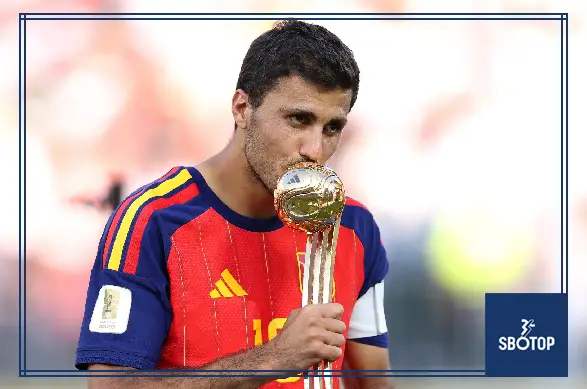
Rodri completed one of the greatest individual and collective achievements in modern international football by winning the 2026 World Cup Golden Ball after captaining Spain to victory over Argentina.
The influential midfielder was selected as the tournament’s best player following Spain’s 1-0 extra-time triumph in the final at New York New Jersey Stadium. Lionel Messi, who inspired Argentina to a second consecutive final at the age of 39, received the Silver Ball, while France captain Kylian Mbappé finished third in the voting and collected the Bronze Ball.
Rodri’s victory prevented Messi from claiming the Golden Ball for a record-extending third time. The Argentine had previously received the award in 2014 and 2022, making him the only player to win it more than once since its introduction in 1978. However, Spain’s success and Rodri’s commanding influence across eight matches ultimately made the difference.
The award also completed a remarkable Spanish sweep of the tournament’s major individual honours. Unai Simón won the Golden Glove after leading a historically strong defence, while teenage centre-back Pau Cubarsí was named the Best Young Player. Only the Golden Boot escaped Spain, with Mbappé taking the scoring award after producing 10 goals for France.
For Rodri, the Golden Ball was recognition of a type of excellence that is often less visible than goals, assists or spectacular individual moments. He did not score during the tournament and was not credited with an assist, but almost everything Spain did passed through him.
He determined the rhythm, protected the defence, resisted pressure and ensured that Luis de la Fuente’s side could dominate matches without losing its balance.
Spain lifted the trophy because Ferran Torres scored the decisive goal in the 106th minute. They controlled the competition because Rodri controlled its most important spaces.
The Heart of Spain’s World Cup Victory
Spain arrived in North America as one of the favourites after winning the European Championship in 2024 and building an extended unbeaten run under De la Fuente.
Their identity was clear. Spain wanted possession, territorial control and the confidence to press immediately after losing the ball. Those principles required a midfielder capable of understanding when to accelerate, when to slow the game and when to protect the team from counterattacks.
Rodri performed that role throughout the tournament.
He completed 753 passes at an accuracy rate of 94 percent, both exceptional numbers at the highest level of international football. He was also involved in 1,803 passages of play, almost 200 more than any other player at the competition. Those statistics demonstrated how central he was to every phase of Spain’s football.
When Spain built from the back, Rodri provided the safest passing option. When opponents attempted to press, he positioned himself behind the first line and opened new angles. When La Roja entered the attacking half, he remained available to recycle possession and stop dangerous transitions.
His contribution was not simply the number of passes he completed. It was the security and purpose behind them.
Spain’s attackers could take risks because Rodri protected them. The full-backs could advance because he recognised danger early. The centre-backs could spread across the pitch because they trusted him to receive the ball under pressure.
That influence made him the tactical foundation of the champions.
A Golden Ball Without Goals or Assists
Individual awards are often associated with players who dominate highlight reels. Lionel Messi finished the tournament with eight goals and four assists. Mbappé recorded 10 goals and four assists. Both produced unforgettable attacking performances and carried enormous responsibility for their countries.
Rodri’s contribution was different.
He did not need to score to control the match. He did not need to deliver the final pass to create the conditions from which chances developed.
Every successful attack begins before the assist. Someone must receive possession, escape pressure, identify the correct side of the pitch and place teammates in advantageous positions. Rodri repeatedly performed those tasks.
His football was based on judgement rather than unnecessary movement. He rarely appeared hurried, even when opponents attempted to surround him. A small change of body position could remove a defender from the play. A simple pass could force an entire midfield to shift.
Those decisions did not always attract immediate applause, but they shaped Spain’s matches.
The Golden Ball therefore represented an appreciation of control rather than spectacle. It recognised the player who allowed the tournament’s best team to function at its highest level.
Rodri Wins the Final Battle with Messi
The Golden Ball race created one final individual contest between Rodri and Messi.
Messi had built an extremely strong case before the final. At 39, he had scored eight goals, supplied four assists and led Argentina through another difficult knockout run. His late creativity was particularly important during the semi-final victory over England, where Argentina recovered to reach the final.
Another Golden Ball would have extended Messi’s extraordinary World Cup legacy. He had already won the award in 2014 despite Argentina losing the final to Germany, and again in 2022 after lifting the trophy in Qatar.
This time, however, Spain denied him both the championship and the individual prize.
Rodri controlled the midfield areas Messi usually seeks to influence. Spain prevented Argentina’s captain from receiving possession near the penalty area and forced him to operate far from goal. Messi finished the final without a goal or an assist for the first time in his previous 12 World Cup appearances. His most threatening effort came late in extra time, when a curling shot landed on top of Unai Simón’s net.
Messi remained one of the tournament’s outstanding players and deservedly collected the Silver Ball. Yet the final offered a direct demonstration of why Rodri won the top award.
Messi attempted to find space within the match.
Rodri controlled the match itself.
Spain’s Dominance Reflected in the Awards
Spain’s clean sweep of the principal player awards reflected the complete nature of their championship campaign.
Rodri represented control in midfield. Simón represented security in goal. Cubarsí represented a new generation capable of defending with maturity far beyond its age.
Together, they illustrated the structure behind Spain’s success.
Simón kept seven clean sheets in eight games and conceded only one goal during the entire tournament. Spain set a new record for the fewest goals allowed by a World Cup champion, surpassing the defensive standards established by previous winners.
His Golden Glove was therefore based on remarkable consistency. Spain’s possession reduced the number of chances opponents created, but Simón remained composed whenever he was required.
He organised the defence, dealt confidently with crosses and contributed to Spain’s build-up play. Modern goalkeepers must do more than stop shots, and Simón’s ability with the ball allowed La Roja to retain their identity from the first pass.
Cubarsí’s Best Young Player award offered another indication that Spain’s success may continue for years.
The Barcelona defender helped anchor the tournament’s strongest defence and completed more passes than any other player in the final. Alongside Lamine Yamal, he also became one of the first teenagers to start for a World Cup-winning team since Mbappé did so for France in 2018.
Yamal had also been considered a major candidate for the young-player prize, but Cubarsí’s defensive consistency gave him the advantage.
The decision demonstrated that Spain’s victory was not based solely on attacking flair. Their young centre-back was as important to the system as the exciting winger operating further forward.
Unai Simón’s Quietly Historic Tournament
Goalkeeping awards can be difficult to judge when the winning team dominates possession.
Some may argue that Simón faced fewer shots than Emiliano Martínez, whose 12 saves in the final set a record for the match. Argentina’s goalkeeper produced the more dramatic individual display in New Jersey, repeatedly preventing Spain from scoring during normal time.
The Golden Glove, however, rewards performance across the entire tournament rather than one match.
Simón maintained concentration through long periods without action. He made the saves Spain needed, contributed with his feet and remained dependable under pressure.
Seven clean sheets across eight matches represented a level of consistency no goalkeeper had previously achieved at one World Cup. Spain’s only concession did not prevent them from completing an almost flawless defensive campaign.
His recognition also highlighted the relationship between defence and possession.
Spain did not protect Simón by defending deep with ten players behind the ball. They protected him by controlling territory, pressing aggressively and denying opponents extended possession.
Simón was the final part of that system, but his calm presence allowed every player ahead of him to perform with confidence.
Pau Cubarsí Announces Himself to the World
Cubarsí entered the tournament as one of Spain’s most promising young defenders. He left as a world champion and the competition’s leading young player.
Playing centre-back at a World Cup demands more than physical ability. Defenders must read movement, manage space and remain composed when one mistake can eliminate an entire nation.
Cubarsí displayed those qualities throughout Spain’s run.
His passing allowed Spain to build confidently from deep, while his positioning helped prevent opponents from attacking the spaces behind the midfield. Despite being only 19, he rarely appeared overwhelmed by the occasion.
The final presented his greatest test.
Argentina attempted to use the movement of Messi and Julián Álvarez to create uncertainty between Spain’s defensive and midfield lines. Cubarsí maintained his discipline, stepped forward when necessary and avoided being pulled into areas that would expose his teammates.
His contribution helped Argentina complete the opening 90 minutes without registering a shot. Spain produced the first 20 attempts of the final before the defending champions finally managed one during extra time.
Cubarsí’s award did not merely celebrate future potential. It rewarded a player who had already performed at a championship level.
Mbappé Prevents a Complete Spanish Sweep
Spain claimed almost every major honour, but Mbappé ensured the Golden Boot belonged to France.
The French captain scored 10 goals in eight matches, becoming the first player since Gerd Müller in 1970 to reach double figures at a single World Cup. He finished two goals ahead of Messi and became the first player to win the Golden Boot twice.
Mbappé also received the Bronze Ball, recognising his overall influence despite France finishing fourth.
His goals carried Les Bleus into the semi-finals, where Spain defeated them 2-0. Mbappé then scored twice and provided an assist in France’s extraordinary 6-4 defeat to England in the third-place match.
That performance moved him to 22 career World Cup goals, one ahead of Messi in the competition’s historical scoring chart.
Yet his individual numbers were not enough to defeat Rodri in the Golden Ball voting.
The award’s final ranking reflected three different forms of excellence: Rodri’s control, Messi’s creativity and Mbappé’s finishing.
Rodri finished first because his performance was inseparable from the tournament’s ultimate outcome.
The Perfect Ending to Rodri’s Recovery
Rodri’s achievement carried additional emotional significance because of the difficult path he followed before the tournament.
The Manchester City midfielder suffered a major knee injury and spent eight months away before returning in May 2025. His early performances after coming back generated questions about whether he could regain the level that had made him one of the world’s finest midfielders.
By the summer of 2026, those doubts had disappeared.
Rodri arrived at the World Cup prepared to lead Spain and left with both the trophy and the award for its best player.
He described his journey as an example for younger players, explaining that football can take someone from the highest point of success into an extremely difficult period before offering the opportunity to rise again.
That message gave the Golden Ball meaning beyond technical performance.
Rodri had already won the Champions League with Manchester City and the Ballon d’Or in 2024. Adding the World Cup placed him among a small group of players to have won football’s most prestigious club, international and individual honours.
The recovery was complete.
Also Read:
- SBOTOP: Tearful Lionel Scaloni Weighs Argentina Future as He Calls for Time to Make a Fair Decision
- SBOTOP: Kylian Mbappé Makes World Cup History with Second Golden Boot After Record-Shattering 2026 Run
- SBOTOP: Argentina’s World Cup Final Shame as Paredes Ignites Post-Match Brawl and Is Sent Off After Spain Triumph