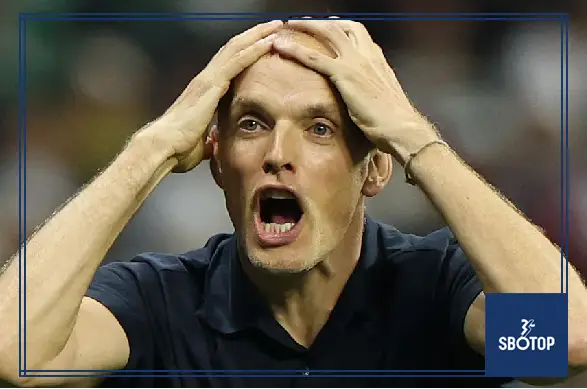
Thomas Tuchel expected Jarell Quansah to miss one match after the England defender was sent off against Mexico. Instead, the automatic suspension was increased to two games, removing Quansah from both the quarter-final against Norway and England’s subsequent semi-final meeting with Argentina.
The additional punishment created an immediate defensive problem, but Tuchel’s frustration extended beyond losing a player. England’s head coach said the Football Association had not received a satisfactory explanation from FIFA about why the original one-match suspension had been doubled.
For a manager preparing his team for the most important stage of the World Cup, the silence was almost as troubling as the punishment itself.
Quansah was dismissed following a VAR review early in the second half of England’s dramatic 3-2 last-16 victory over Mexico. His challenge on Jesús Gallardo was high, with his studs making contact around the Mexican player’s shin. FIFA’s disciplinary panel later classified the incident as serious foul play, triggering a two-match suspension under Article 14 of its disciplinary rules.
England accepted that Quansah would be suspended, but questions remained about the process, the severity of the sanction and the lack of direct communication.
Tuchel wanted clarity. FIFA, according to the England manager, had not provided it.
From One Match to Two
A straight red card normally carries an automatic suspension for the next match, although the relevant disciplinary body can increase the punishment after reviewing the offence. That is what happened in Quansah’s case. The initial expectation was that he would sit out England’s quarter-final against Norway. FIFA’s disciplinary committee then determined that the tackle met the threshold for serious foul play and imposed a second match. The ruling meant Quansah could not return unless England reached the final.
For the player, the difference was enormous.
Missing a quarter-final is already a significant consequence. Missing a semi-final removes the opportunity to participate in one of the biggest matches of an international career. England’s victory over Norway confirmed that the second game of the suspension would be the semi-final against Argentina.
Quansah therefore had to watch England’s campaign continue while remaining unavailable for selection.
The decision also damaged Tuchel’s defensive planning. Quansah had started at right-back against Mexico, even though he is more naturally associated with central defence. His physical strength, height and versatility had given England another solution across the back line.
With the ban increased, Tuchel lost that option for two consecutive knockout matches.
Tuchel’s Anger Began with the Red Card
The England coach’s dissatisfaction did not begin when the two-match punishment was announced. He had already criticised the officiating immediately after the victory over Mexico.
Tuchel questioned the standard and consistency of the match officials, arguing that England had been forced to operate without knowing how incidents would be interpreted. He was particularly unhappy with the way VAR intervened in several major decisions during the game.
The Quansah incident became the clearest example.
The referee did not initially award a foul. After being called to the monitor, however, he was reportedly shown an image highlighting the moment Quansah’s studs connected with Gallardo’s leg.
England’s concern was not simply that the contact looked serious. The coaching staff believed the referee should have been shown the complete movement from multiple angles, including Quansah making contact with the ball before his foot followed through.
Touching the ball does not automatically make a challenge legal. A player can still be dismissed if the force, height or nature of the tackle endangers an opponent. Even so, Tuchel believed the review process placed excessive emphasis on the most damaging image without giving sufficient weight to the full sequence.
Former Premier League referee Dermot Gallagher supported the final red-card decision. He argued that Quansah’s studs landed too high on Gallardo’s leg and that winning part of the ball did not remove the danger created by the challenge.
That distinction is important. The red card itself could be considered correct while the process used to reach it remained open to criticism.
England Asked for an Explanation
When reporters asked Tuchel whether his post-match attack on the officials might have influenced FIFA’s decision to increase the suspension, he rejected the suggestion.
His answer also exposed the central issue: England had received “no explanation” beyond the formal classification of the offence.
A disciplinary committee does not need to agree with a coach’s interpretation. It should, however, communicate clearly enough for teams to understand why one incident receives a greater punishment than another.
England knew that Quansah had been found guilty of serious foul play. What Tuchel appeared to want was a more detailed account of the factors that justified the additional match.
Was the decision based primarily on the height of the contact? Did the disciplinary panel consider the force excessive? Was the second match mandatory once Article 14 was applied? Were any mitigating circumstances discussed?
Without a fuller explanation, England were left to interpret the outcome themselves.
That uncertainty encouraged speculation. Some suggested Tuchel’s public criticism had angered the governing body. Others believed FIFA simply followed the disciplinary code once the challenge was officially categorised as serious foul play.
Tuchel did not accuse FIFA of retaliating against him, but he made it clear that the absence of communication was unacceptable.
The Lack of an Appeal Increased the Frustration
England’s dissatisfaction was intensified by the limited appeal process available during the tournament.
Under the World Cup disciplinary framework, the Football Association did not have the same freedom to challenge the decision that a Premier League club might possess after a domestic red card. Sky Sports reported that there was no meaningful avenue for England to appeal the two-match sanction once FIFA’s committee had issued its ruling.
That left Tuchel in a difficult position.
He could criticise the process publicly. The FA could submit its concerns. But England could not rely on an independent appeal to review the evidence and potentially reduce the punishment.
When a disciplinary system provides little room for challenge, detailed communication becomes even more important. Teams need to understand how the rule has been applied because they may have no practical method of changing the outcome.
In Quansah’s case, England received the final decision and had to reorganise immediately.
There was no extended legal battle. There was no time for prolonged debate. Norway were waiting in the quarter-final, and Tuchel needed to select a defence.
The Balogun Case Complicated the Picture
The controversy became more intense because of FIFA’s handling of United States forward Folarin Balogun.
Balogun had also been shown a red card following a VAR intervention earlier in the tournament. His suspension was later altered, allowing him to play in the United States’ knockout match against Belgium. FIFA issued a statement concerning the disciplinary committee’s handling of that case.
The circumstances were not identical, and comparing separate disciplinary cases can be misleading. Different tackles may involve different levels of force, contact and danger.
Nevertheless, the contrasting outcomes were difficult for England supporters to ignore.
One player received relief that allowed him to return for a knockout game. Quansah’s automatic suspension was increased, keeping him out for an additional round. The contrast created an appearance of inconsistency, even if FIFA believed both decisions were justified under its rules.
Tuchel had previously joked about England captain Harry Kane seeking political help after reports that the United States case had attracted attention beyond football. Once Quansah’s ban was doubled, the humour disappeared.
England were not asking FIFA to copy another decision automatically. They were asking for a transparent explanation of why their player’s case had been treated differently.
Quansah’s Challenge Was Still Dangerous
The controversy surrounding FIFA should not remove Quansah’s responsibility.
His tackle was mistimed and unnecessarily risky. He entered the challenge with enough force and height to place Gallardo in danger. The fact that he touched the ball first did not protect him from punishment.
Modern refereeing guidance focuses heavily on player safety. A challenge can begin as a legitimate attempt to win possession and still become serious foul play because of the way it is executed.
Quansah’s foot continued beyond the ball and made studs-first contact with Gallardo’s leg. From that perspective, FIFA’s decision to impose more than the minimum suspension was not impossible to defend.
The more persuasive criticism concerns how the ruling was communicated and whether similar cases were handled consistently.
Tuchel could reasonably believe the referee should have seen the entire incident in motion. England could reasonably request a written explanation for the extra match. Supporters could reasonably question why comparable disciplinary stories appeared to produce different outcomes.
None of those concerns makes the tackle safe.
A balanced assessment must hold both ideas at once: Quansah committed a serious offence, and FIFA still had a responsibility to explain its process properly.
England Survived Mexico with Ten Men
Quansah’s dismissal placed England in immediate danger at the Azteca.
Tuchel was forced to make a tactical adjustment, withdrawing an attacking player, introducing John Stones and reorganising the defensive line. England had to protect a narrow advantage while Mexico increased the pressure.
The Three Lions ultimately held on for a 3-2 victory and progressed to the quarter-finals. That result reflected the resilience Tuchel later praised when preparing for Norway. He described the Mexico performance as an important step, while warning that England’s larger objectives still lay ahead.
The win prevented Quansah’s red card from ending England’s tournament, but it also created a lasting tactical cost.
Tuchel had selected a squad for a competition containing more knockout matches than previous World Cups. Depth was therefore essential. Losing one versatile defender for two rounds reduced his ability to rotate and respond to injuries.
The timing could hardly have been worse.
Norway’s attack featured Erling Haaland, one of the strongest and most physically demanding centre-forwards in world football. England needed defenders capable of handling aerial duels, runs behind the line and sustained physical contact.
Quansah would have offered another option against that threat.
Tuchel Was Forced to Reshape the Defence
England’s right-back situation was already uncertain before Quansah’s suspension.
Reece James had been managing a hamstring problem, while Djed Spence had also faced fitness concerns. That left Tuchel considering whether to move Ezri Konsa from central defence into the full-back position.
Such a change solved one problem while creating another. Konsa’s physical qualities made him a useful player against Haaland, but moving him wide weakened England’s central options.
Tuchel eventually used Konsa at right-back against Norway, with Stones returning to central defence alongside Marc Guéhi. England won 2-1 after extra time, keeping Haaland off the scoresheet and advancing to face Argentina.
The victory reduced the immediate damage caused by Quansah’s absence. England found a functional solution and survived a difficult quarter-final.
However, the two-match sanction meant Tuchel could not welcome Quansah back for the semi-final.
Instead, the manager had to continue with a reduced defensive group against Lionel Messi and the defending champions.
The nature of the challenge also changed completely. Norway demanded physical control against Haaland. Argentina required concentration against Messi’s movement, passing and ability to exploit small spaces.
A versatile defender would have been useful in both situations.
Also Read: