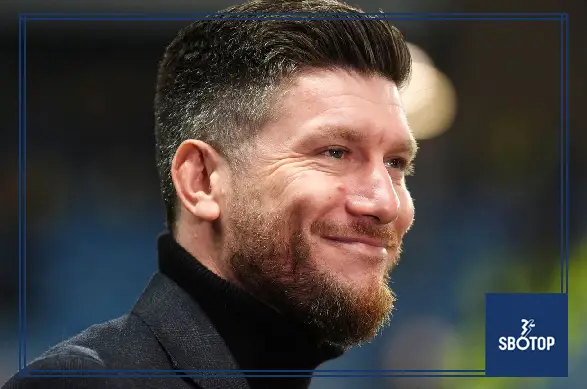
The Scottish football landscape has entered a new era with Sebastien Pocognoli taking over as Scotland head coach following the departure of Steve Clarke. The Belgian coach has been handed an initial two-year contract, bringing a fresh voice and a different footballing philosophy to the national team.
Pocognoli’s appointment represents a significant change for Scotland. Clarke’s seven-year tenure delivered greater consistency, consecutive European Championship qualifications and Scotland’s return to the World Cup, but the team’s group-stage elimination at the 2026 tournament brought his reign to an end. Pocognoli now inherits a squad that has made considerable progress but is expected to take another step forward.
At 39, Pocognoli is also a relatively young appointment for an international head coach. His rise has been rapid. After developing his coaching career in Belgium, he guided Union Saint-Gilloise to a historic league title before taking charge of Monaco. That experience has now led him to one of the most important jobs in Scottish football.
His appointment is therefore not simply a change of manager. It represents a potential change in identity.
From Playing Career to Coaching
Pocognoli’s football education began on the pitch. The former left-back enjoyed a lengthy playing career that included spells with several prominent European clubs. He represented Genk, AZ Alkmaar, Standard Liège, Hannover 96, West Bromwich Albion, Brighton & Hove Albion and Union Saint-Gilloise.
He also represented Belgium at senior level, earning 13 international caps.
His time in England is particularly interesting from a Scottish perspective.
Pocognoli spent time with both West Bromwich Albion and Brighton, giving him first-hand experience of British football culture. That background could help him understand certain aspects of the Scottish game, even though his managerial philosophy has largely been shaped by his experiences in Belgium and France.
After retiring as a player, Pocognoli moved into coaching.
Rather than immediately seeking a senior management position, he developed his experience through youth football. He worked within the Union Saint-Gilloise and Genk structures and also spent time with Belgium’s youth national teams.
That period helped him develop a coaching philosophy before he made the jump into senior football.
The Breakthrough at Union Saint-Gilloise
Pocognoli’s reputation changed dramatically during his time at Union Saint-Gilloise.
Taking charge of the senior side in 2024, he produced an extraordinary first season.
Union Saint-Gilloise won the Belgian Pro League in the 2024/25 campaign, ending a 90-year wait for a league championship. The club also reached the UEFA Champions League group stage for the first time and won the Belgian Super Cup.
Those achievements immediately placed Pocognoli on the radar of bigger clubs.
Winning a domestic championship with an established giant is impressive.
Doing it with a club that had been waiting nine decades for the title is something else entirely.
It demonstrated that Pocognoli could create a competitive team, develop a clear tactical identity and handle the pressure of a title race.
He was subsequently recognised as Belgian Coach of the Year.
That award further underlined the rapid development of his managerial career.
The Monaco Chapter
Pocognoli’s success in Belgium led to an opportunity in Ligue 1.
Monaco appointed him in 2025, giving the young coach the chance to manage at a much higher level of European football.
His spell in the principality ultimately lasted only one season.
Pocognoli left Monaco in June 2026 after the club finished seventh in Ligue 1.
The Monaco experience was clearly more complicated than his time at Union Saint-Gilloise.
However, it should not necessarily be viewed as a failure.
Managing a club with Monaco’s expectations, resources and ambitions provided Pocognoli with another level of experience.
He had to deal with a different dressing room, greater scrutiny and opponents with significantly larger resources.
That experience could prove valuable now that he has moved into international football.
Why Scotland Chose Pocognoli
The Scottish Football Association’s decision to appoint Pocognoli appears to reflect a desire for a fresh approach.
Before his appointment was confirmed, reports identified him as the SFA’s leading candidate to succeed Clarke. The association had spoken with several potential candidates before settling on the Belgian.
His profile offered something different.
Pocognoli is young, ambitious and has already demonstrated that he can win a major domestic title.
He also has experience working with players at different developmental stages.
That combination could appeal to an association looking beyond the immediate future.
Scotland are not starting from scratch.
Clarke has already established a stronger foundation than the national team possessed for many years.
The challenge for Pocognoli is to build on that foundation rather than dismantle it.
The Clarke Legacy
Any discussion of Pocognoli must begin with the achievements of his predecessor.
Clarke transformed Scotland’s competitive standing.
Under his leadership, Scotland qualified for consecutive European Championships and returned to the World Cup for the first time in 28 years.
Those accomplishments should not be underestimated.
Scotland had endured long periods of frustration before Clarke brought greater stability to the national side.
The qualification campaigns created a stronger sense of belief among supporters.
However, tournament performances remained a source of disappointment.
Scotland exited Euro 2020 without progressing beyond the group stage, suffered another group-stage elimination at Euro 2024 and then failed to advance from the 2026 World Cup group stage.
Clarke ultimately stepped down following the latest disappointment.
Pocognoli therefore inherits both an opportunity and a challenge.
The team is in a better position than it was before Clarke arrived.
But expectations have also increased.
A New Footballing Identity
One of the biggest questions surrounding Pocognoli is how Scotland will play.
Reports and commentary around his coaching career have highlighted an attacking approach, aggressive pressing and a desire to be proactive with and without the ball.
That could represent a noticeable shift.
Clarke’s Scotland were often praised for their organisation and competitive structure, but critics sometimes argued that the team could be too cautious.
Pocognoli appears interested in taking greater initiative.
That does not necessarily mean Scotland will abandon defensive discipline.
Instead, the objective could be to combine organisation with greater aggression.
For a national team, this is easier said than done.
International managers have limited time with their players.
Unlike club coaches, they cannot spend every day on the training pitch.
Pocognoli will therefore need to communicate his ideas quickly.
The Importance of Pressing
Pressing could become an important element of Pocognoli’s Scotland.
A proactive pressing system can create opportunities by forcing opponents into mistakes.
It can also allow a team to regain possession closer to the opposition goal.
However, pressing requires exceptional coordination.
One player moving at the wrong time can open a passing lane.
If the front line presses while the midfield remains too deep, the opposition can simply play through the pressure.
Pocognoli will therefore have to establish clear responsibilities.
The players must understand when to press, where to press and when to retreat.
The success of his philosophy will depend heavily on those details.
Scotland’s Generation of Talent
Pocognoli also arrives at a time when Scotland possesses a number of talented players.
The squad has developed considerably during Clarke’s tenure.
Players with experience at major European clubs now form part of the national-team structure.
That gives Pocognoli a strong foundation.
The challenge will be getting the best from those individuals within his system.
Some players may naturally fit his approach.
Others may require tactical adjustments.
The manager must also identify younger players capable of making the transition into international football.
Developing the Next Generation
Pocognoli’s experience with youth football could become one of his greatest assets.
His background includes work with Belgium’s youth national teams and academy structures.
That experience means he understands the importance of developing players rather than simply relying on established names.
For Scotland, that could be particularly valuable.
The national team needs a sustainable pipeline of talent.
A successful generation cannot last forever.
Eventually, established players will retire or decline.
The next group must already be developing behind them.
Pocognoli can play an important role in that process.
A Two-Year Contract
The SFA has given Pocognoli an initial two-year contract.
That timeframe provides an interesting balance.
It gives the manager enough time to establish his ideas while also creating clear expectations.
His immediate focus will be the Nations League.
Scotland’s campaign begins away to Slovenia on September 26, 2026, followed by further fixtures against Switzerland and North Macedonia in the group.
Those matches will provide Pocognoli with his first competitive opportunity to demonstrate his approach.
The Nations League will therefore be an important early test.
A Difficult First Assignment
Pocognoli will have very little time to prepare.
International football does not provide months of uninterrupted training.
Players arrive from their clubs, spend a limited period with the national team and then return to domestic competition.
That makes preparation extremely demanding.
Pocognoli will need to communicate his philosophy quickly.
The first few matches may therefore be about finding a balance between his preferred style and what the squad can realistically execute.
He cannot expect everything to change immediately.
The Challenge of Managing Expectations
Scotland’s supporters will understandably have high expectations.
The Tartan Army has experienced a period of renewed optimism.
Qualifying for major tournaments has become more normal than it was previously.
The next ambition is obvious: Scotland want to perform better once they arrive at those tournaments.
Pocognoli must therefore improve results without creating unrealistic promises.
His comments since taking the job suggest that he understands the importance of supporters.
He has spoken positively about Scotland’s passion and said he wants to help make the fans smile.
That connection could become an important part of his tenure.
The Foreign Manager Question
Pocognoli is only the second foreign manager to take charge of Scotland’s men’s national team.
The previous foreign appointment was Germany’s Berti Vogts, who managed the team between 2002 and 2004.
That history makes the appointment notable.
Scottish football has traditionally had a strong preference for domestic managers.
Pocognoli therefore arrives with an opportunity to establish a new precedent.
His success or failure could influence how future appointments are approached.
If he performs well, the SFA may become more comfortable looking beyond Scotland for coaching talent.
Learning From Monaco
The Monaco experience could ultimately prove just as valuable as Pocognoli’s success at Union.
Success teaches a coach what works.
Difficult periods teach a coach what does not.
At Monaco, Pocognoli faced a level of scrutiny and expectation that was different from his Belgian experience.
He had to deal with a club expected to challenge near the top of Ligue 1.
Although the season ended with a seventh-place finish and his departure, the experience exposed him to elite-level football.
Scotland could benefit from that education.
International football presents its own pressures, but Pocognoli is not entering the role without experience of demanding environments.
Tactical Flexibility Will Matter
One potential challenge is whether Pocognoli can adapt his preferred tactical approach to international football.
At club level, a coach has considerable time to develop a system.
At international level, that luxury disappears.
Scotland may face opponents with very different styles.
Some will defend deeply.
Others will press aggressively.
Some will dominate possession.
Others will attempt to counterattack.
Pocognoli must therefore be flexible.
A successful international manager needs a clear identity but also the ability to adjust.
Also Read:
- SBOTOP: Scottish League Cup Round-Up: Celtic Advance at Dundee United as Aberdeen Kilmarnock and Ross County Join Them in the Next Round
- SBOTOP: Sheffield United and Birmingham City Share the Spoils in Tense 0-0 Draw at Bramall Lane
- SBOTOP: Josh Coburn’s Brace Powers Millwall to 2-0 Victory as Ten-Man Bristol City Fall to Defeat