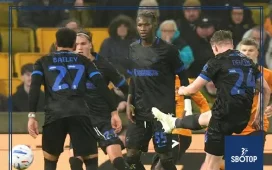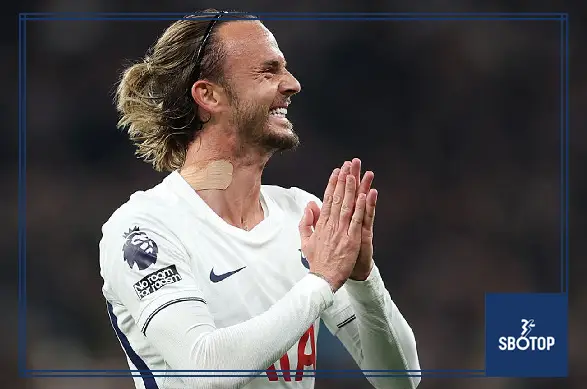
James Maddison needed only 14 minutes to give his first Tottenham start in almost 18 months an unforgettable moment. Receiving Mohammed Kudus’s pass outside the penalty area, he struck a curling shot beyond Carl Rushworth and into the corner. After a prolonged struggle to return to the starting line-up, his technique supplied the clearest possible reminder of his quality.
Tottenham still had work to do. Coventry City equalised early in the second half before Omar Marmoush restored the lead and Ben Davies added a late third. The 3-1 victory on October 19, 2026, finally delivered Spurs’ first Premier League win of the season.
For Maddison, the evening combined personal achievement with a result his team urgently needed. For Tottenham, it offered encouragement without removing the need for improvement. A memorable comeback helped secure three points, but building a more dependable season would require much more than one outstanding finish.
A Return Measured in Patience
Maddison’s previous competitive start for Tottenham had come against Bodø/Glimt in the Europa League on May 1, 2025. His selection against Coventry ended a wait of 536 days.
That distinction matters. This was his return to the starting team, rather than his first appearance after an uninterrupted absence. He had already returned to action before being ready to start again.
Long rehabilitation periods are rarely defined by one simple milestone. Returning to training, appearing as a substitute and becoming capable of handling a starting role involve different demands.
The significance of this evening therefore extended beyond his name appearing on the team sheet. Starting restored an opportunity to influence a match from its opening stages, establish a rhythm and take responsibility while the contest was still developing.
A Finish That Reintroduced His Quality
The opening goal arrived when Kudus moved inside from the right and supplied Maddison near the edge of the area. The midfielder met the opportunity with a first-time finish, sending the ball on a precise, curling path beyond the goalkeeper.
Its quality lay in the combination of speed and control. Taking the shot immediately denied Coventry additional time to close the space, while the placement made the attempt difficult to reach.
For a returning player, such execution can be particularly satisfying. The moment required instinct, balance and confidence, all under the pressure of a competitive match.
However, the goal should not be treated as medical proof that every consequence of his injury difficulties had disappeared. It demonstrated his ability to produce an exceptional action. Sustaining performance across repeated appearances remained a separate challenge.
Coventry Added a Personal Dimension
Scoring against Coventry brought an additional layer of emotion. Maddison’s connection with the club made this a different occasion from an ordinary league appearance.
That background did not alter his professional responsibility. Tottenham needed a result, and he had been selected to help deliver one. His contribution served his current team while inevitably drawing attention to his footballing roots.
It would be speculative to describe precisely what he felt at the instant the ball crossed the line. What could be observed was the importance of the moment within his return.
The wider lesson is that footballing loyalties and professional duties can coexist. A player can retain a meaningful attachment to one club while committing fully to another. On this occasion, the quality of Maddison’s finish left little doubt about his immediate purpose.
His Influence Extended Beyond the Goal
A spectacular strike naturally dominated attention, but Maddison’s value also lay in his willingness to receive possession and connect Tottenham’s attacking moves.
A creative midfielder can help teammates by providing an option between the opposition’s lines. Receiving there can draw a defender forward, open a passing lane or allow the ball to be moved into a more threatening area.
These are general tactical principles rather than an explanation for every Tottenham attack. They nevertheless help clarify why a player with Maddison’s qualities can influence a team even when he is not providing the final pass.
The challenge for Spurs is to make those connections available regularly. Creativity becomes more effective when the surrounding movement gives the playmaker several useful choices, allowing individual quality to operate within a functioning collective structure.
Rudoni Ensured the Evening Remained Competitive
Tottenham’s advantage did not last through the opening minutes of the second half. Jack Rudoni equalised for Coventry, bringing the visitors level and reopening the contest.
The goal prevented the evening from becoming a straightforward celebration of Maddison’s return. Spurs had to respond to a setback rather than simply protect the lead established before the interval.
For a team still seeking its first league victory, that situation carried obvious pressure. A promising opening could easily have become another frustrating result.
Analytically, the response after an equaliser offers a useful measure of composure. Players need to maintain attacking intent without abandoning defensive responsibilities. Tottenham’s eventual victory showed that they found further scoring opportunities, although conceding remained a reminder that their performance had not been flawless.
Marmoush Restored Tottenham’s Advantage
Marmoush supplied the next decisive contribution, putting Tottenham back in front before the hour mark. His goal ensured that Maddison’s opener became part of a winning performance rather than an isolated highlight.
That distribution of responsibility was important. A returning player can lift a team, but he should not have to solve every problem created during the match.
Different scorers also give a victory a broader foundation. Tottenham benefited from contributions across the side, with another player providing the answer after Coventry had cancelled out their initial advantage.
From an analytical perspective, the useful objective is to repeat that shared responsibility. Teams become more difficult to contain when the opposition must account for several potential sources of goals. One evening cannot establish lasting attacking variety, but it can provide examples worth developing.
Davies Supplied the Late Reassurance
Ben Davies added Tottenham’s third deep into stoppage time, creating a more comfortable final margin after a competitive second half.
The timing shaped the meaning of the goal. With only a narrow advantage, Tottenham still faced the possibility that one opposition attack could change the result. The additional goal sharply reduced that uncertainty.
Nevertheless, the final score should not obscure the route taken to reach it. Tottenham had been level after the interval and needed to regain control of the result.
Their three goals all came from outside the penalty area, making the evening particularly notable for the quality of its finishing. That was an achievement to enjoy, although future victories would ideally be supported by several reliable ways of creating chances rather than depending on exceptional shooting alone.
Managing Minutes Remained Part of the Comeback
Maddison was replaced by Conor Gallagher in the 69th minute. His evening therefore ended before the match itself was settled.
Substitution after a long period without starts should not automatically be interpreted as a setback. Returning players often require a gradual increase in competitive workload, although the precise reasoning behind any decision belongs to the coaching and medical staff.
More broadly, recovery involves balancing immediate usefulness against the demands of repeated appearances. Feeling capable of continuing is only one part of that assessment.
For Tottenham, the sensible long-term aim is regular availability. A productive starting appearance represents progress, but its value increases if it becomes the beginning of a sustainable sequence. That requires patience even when a player’s performance makes supporters eager to see more.
Kulusevski’s Appearance Strengthened the Sense of Renewal
Dejan Kulusevski also returned to action late in the match after a lengthy absence. His appearance gave the evening another significant recovery milestone.
The two returns carried different immediate roles: Maddison started and scored, while Kulusevski re-entered competitive football from the bench. Both developments expanded the possibilities available to Tottenham.
In tactical terms, additional creative players can offer different combinations and reduce dependence on a small group. However, availability does not instantly establish match sharpness or guarantee an effective partnership.
The next stage would involve integrating those options carefully. Training relationships, physical readiness and the demands of individual fixtures all matter. The encouraging development was that Tottenham had more possibilities to explore, rather than an assurance that every attacking problem had already been solved.
A First Win Creates an Opportunity
Tottenham’s first Premier League victory of the campaign changed the immediate mood around the team. It ended their search for an opening league success and gave the players a result to support their work.
Yet a first victory is a starting point, not evidence of complete recovery. The most useful response is to identify the actions that helped produce it and improve the areas that remained uncertain.
Spurs could take encouragement from their finishing and their ability to regain the lead. They also had reason to examine how Coventry found a way back into the match.
Maddison’s contribution gave that assessment a positive setting. After such a long wait to start again, he supplied a moment of genuine distinction while helping his teammates secure something tangible. The goal would remain the defining image of his evening; the victory made it more valuable. Tottenham’s task was to carry the benefits forward through patient management, stronger collective play and results that could turn renewed optimism into lasting progress.
Also Read: