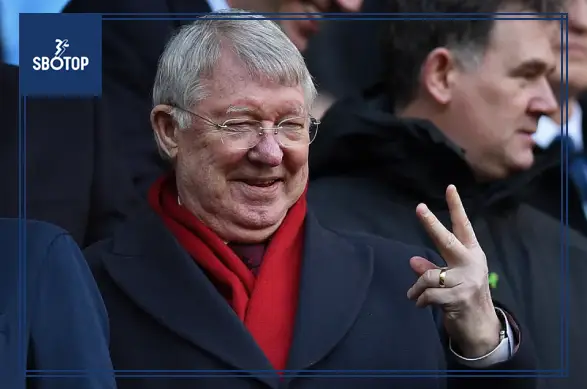
Sir Alex Ferguson worked with countless talented footballers during his remarkable 27-year reign at Manchester United. Among them were players known for their technical ability, tactical awareness, leadership and remarkable football intelligence.
However, when Ferguson discussed the players who impressed him most with their intelligence away from the pitch, his choices were rather unexpected.
Paul Scholes had previously been described by Ferguson as the smartest footballer he had coached, particularly because of his exceptional understanding of the game. But Scholes was not among the two players Ferguson highlighted when talking specifically about intelligence away from football.
Instead, Ferguson named Patrice Evra and Diego Forlan.
Both players had very different careers at Manchester United, but Ferguson was particularly impressed by their ability to learn and speak multiple languages.
Patrice Evra Impressed Ferguson With His Intelligence
Patrice Evra was the first name Ferguson mentioned.
The French defender spent eight years at Manchester United after joining the club and eventually established himself as one of the Premier League’s leading left-backs.
Evra was known for his energy and aggressive style on the pitch. During his time at Old Trafford, he also became an important member of several successful Manchester United teams and won five league titles.
Away from football, however, Ferguson noticed another side of Evra’s personality.
The former Manchester United manager was particularly impressed by Evra’s memory and ability to communicate in several languages.
Ferguson once described Evra as having an extraordinary brain while speaking to The Big Issue, with the comments later reported by Express Sport.
The former United boss also believed Evra’s ability to speak five languages was particularly useful inside the dressing room.
That skill allowed the defender to communicate with teammates from different backgrounds and contribute to the atmosphere within the squad.
Ferguson also viewed Evra as a naturally entertaining and enjoyable personality.
The defender’s family background may have played a role in that intelligence as well. Ferguson noted that Evra’s father had been a diplomat, something he felt was reflected in the former United player’s personality and ability to communicate.
Diego Forlan Took Ferguson’s Praise Even Further
If Evra impressed Ferguson, Diego Forlan perhaps impressed him even more.
The Uruguayan forward also had the ability to speak around five languages fluently, according to Ferguson.
Forlan’s language skills were not simply a party trick. Ferguson recalled an example that demonstrated just how seriously the striker approached learning.
When Forlan moved to Cerezo Osaka, Ferguson was told that the striker spent about a week preparing before giving a five-minute interview to Japanese media in Japanese.
For Ferguson, that was an extraordinary achievement.
Learning a new language is already challenging, but preparing to conduct a media interview in that language showed Forlan’s willingness to learn and adapt.
It was one of the reasons Ferguson considered him among the most intelligent players he had encountered away from the pitch.
Forlan’s Manchester United Career Did Not Go as Planned
Forlan’s intelligence was not always reflected by his performances at Manchester United.
The Uruguayan striker scored 17 goals in 98 appearances for the club. His time at Old Trafford ultimately fell short of the expectations surrounding him.
Ferguson later acknowledged that he had failed to get the best out of the forward.
Ole Gunnar Solskjaer also recalled a conversation with Ferguson after Forlan had left Manchester United.
According to Solskjaer’s recollection, Ferguson described Forlan as a great player and admitted that it was his own mistake that he had never managed to get the best from him.
That assessment became particularly interesting when considering what happened next in Forlan’s career.
Forlan Found His Best Form in Spain
After leaving Manchester United, Forlan’s career developed significantly in Spain.
He went on to enjoy highly productive spells with Villarreal and Atletico Madrid, scoring more than 150 goals across his career with the two clubs.
His performances in Spain helped establish Forlan as one of the most respected forwards of his generation.
He also became an important figure for Uruguay on the international stage.
At the 2010 World Cup, Forlan played a major role as Uruguay reached the semi-finals. His performances during the tournament further demonstrated the quality that Ferguson had believed was present in the striker.
Forlan’s career therefore became an example of a player who struggled to fully establish himself at Manchester United before flourishing elsewhere.
Why Ferguson’s Choices Are So Interesting
Ferguson’s choices reveal that football intelligence can mean much more than understanding tactics or reading a game.
Paul Scholes represented one form of intelligence for Ferguson. His ability to understand the game, control situations and make intelligent decisions on the pitch made him stand out.
Evra and Forlan, meanwhile, demonstrated another kind of intelligence.
Their ability to learn languages, remember information and adapt to different environments clearly caught Ferguson’s attention.
The qualities Ferguson highlighted included:
- Strong memory and learning ability.
- The capacity to communicate in multiple languages.
- Adaptability to different cultures.
- Confidence when communicating with others.
- A willingness to learn new skills.
These qualities can be especially valuable inside a football dressing room, where players from many countries and cultures must work together.
Two Unexpected Names From Ferguson’s Manchester United Era
Ferguson managed Manchester United for 27 years and worked with some of the biggest names in football.
That makes his choice of Patrice Evra and Diego Forlan particularly fascinating.
Scholes may have been Ferguson’s choice when it came to football intelligence, but Evra and Forlan stood out for different reasons.
Evra’s ability to communicate in multiple languages and his remarkable memory impressed Ferguson, while Forlan’s language skills and willingness to learn Japanese demonstrated an unusual level of adaptability.
Forlan’s later success with Villarreal, Atletico Madrid and Uruguay also showed that his Manchester United career did not fully represent his ability as a footballer.
Ultimately, Ferguson’s comments offer an interesting reminder that intelligence in football can take many forms. Sometimes, the qualities that impress a legendary manager most are not the ones immediately visible during a match.
ALSO READ :