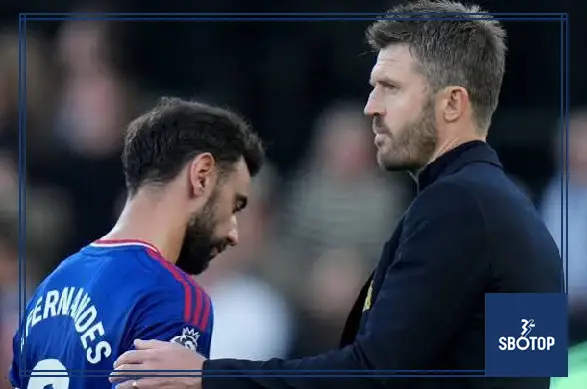
Michael Carrick’s response to Manchester United’s mounting difficulties centred on continuity: Bruno Fernandes would remain captain, and the head coach would continue working without demanding guarantees about his own future.
Speaking on 29 October, Carrick sought to draw attention back towards football after a damaging sequence of results and questions about his relationship with Fernandes. His position was clear, although the challenges facing United remained substantial.
The captaincy decision settled one immediate issue. It did not establish that every disagreement had disappeared, nor did Carrick’s refusal to seek assurances amount to confirmation of long-term backing from the club’s leadership.
Instead, his comments outlined how he intended to handle the pressure: retain an established leader, accept responsibility and concentrate on improving performances. For United, the significance would ultimately depend on whether those intentions translated into a more convincing team.
Fernandes Retains His Leadership Role
Carrick confirmed that Fernandes would continue wearing the captain’s armband, describing the midfielder as committed to Manchester United and to improving the team’s situation. He also stressed that Fernandes remained an important member of the group.
That backing carried weight because the discussion had moved beyond ordinary selection debate. When a captain is left out during a difficult period, questions naturally arise about authority, trust and the relationship between the dressing room and coaching staff.
Keeping Fernandes in the role gave the squad a clear point of reference. Whatever questions surrounded recent performances, Carrick was not announcing a change in the team’s formal leadership.
There is also a practical distinction between captaincy and selection. An established captain can retain responsibility within the group while remaining subject to the manager’s decisions about individual matches. Leadership does not automatically guarantee a starting place, just as omission does not automatically end a player’s leadership role.
The Results Behind the Scrutiny
The immediate background was United’s 3-0 home defeat by Bournemouth, for which Fernandes was an unused substitute. That followed a 4-1 Champions League defeat at Como and public criticism from the Portuguese midfielder about the team’s tactics.
Those events created an uncomfortable sequence. A heavy European loss raised questions about the football. The captain’s reaction then brought the relationship with the head coach into the discussion. His subsequent omission ensured that the next result would be examined through both lenses.
Chronology, however, cannot establish motive by itself. Carrick maintained that leaving Fernandes out was a football decision for that particular game. It would therefore be inaccurate to present disciplinary punishment as an officially confirmed explanation.
The distinction matters because selection choices can have several overlapping considerations. Without a complete account from those involved, claims about precisely why a decision was taken remain interpretations rather than established facts.
Moving Beyond a Public Disagreement
Reports described talks between Carrick and Fernandes before the manager’s press conference. Carrick subsequently backed his captain and directed attention towards the next match.
That public position suggested a willingness to continue working together. It did not provide a detailed account of their private conversation, and there is no basis for inventing concessions, apologies or promises made behind closed doors.
For a manager and captain, restoring an effective working relationship does not necessarily require identical opinions. Football teams depend on players interpreting instructions under pressure, and disagreement can reveal problems that require attention.
The important issue is how disagreement is handled. A useful conversation can clarify responsibilities and expose misunderstandings. A continuing public dispute can make every tactical decision appear personal.
Carrick’s response attempted to reduce that ambiguity. The next meaningful evidence would come through the team’s organisation, the captain’s conduct and the consistency of their shared message.
Commitment Still Needs a Footballing Expression
A declaration of commitment has limited value unless it becomes visible in performance. For Fernandes, the challenge associated with retaining the captaincy extends beyond individual creativity or emotional investment.
Captains influence how teammates respond to setbacks. They can help maintain concentration after conceding, reinforce instructions and prevent frustration from spreading through the side.
That responsibility is particularly relevant when confidence is fragile. Players may become hesitant, attempt unnecessarily difficult passes or abandon their positions in pursuit of an immediate response. Leadership can help establish a calmer rhythm.
This is an assessment of what the role demands, rather than a claim about instructions Carrick gave Fernandes privately. The public confirmation concerned his continued captaincy. How that responsibility would be exercised on the pitch remained a separate question.
For United, the most useful outcome would be leadership that helps the whole team function more reliably.
Emotion and Authority Can Coexist
Asked about Fernandes’ emotional style, Carrick defended the existence of different leadership personalities and emphasised his captain’s concern for the club and team.
There is no single personality that guarantees effective captaincy. A quiet organiser can provide reassurance, while a more expressive player can bring urgency and demand higher standards. Either approach requires judgment.
Emotion becomes productive when it sharpens concentration and encourages teammates. It becomes less useful when it distracts from the next passage of play or allows frustration to determine decisions.
The relevant standard is therefore behaviour and its effect on the group. A captain’s visible disappointment may be understandable, but teammates still need clear communication and consistent effort.
Carrick’s backing left Fernandes with an opportunity to demonstrate that his influence could support recovery. Retaining the armband preserved his responsibility; it did not remove the scrutiny attached to it.
Carrick Accepts the Uncertainty
On his own position, Carrick said he did not require assurances from United’s hierarchy. He presented the pressure as part of the responsibility of managing the club and identified preparation for the Chelsea fixture as his immediate priority.
That was a statement about his approach to the job. It should not be interpreted as evidence that a guarantee had been offered, that internal discussions had ended or that future decisions were already settled.
A coach can accept uncertainty while continuing to plan training and select teams. Indeed, the work requires decisions even when the broader situation is unresolved.
The distinction between personal composure and institutional security is essential. Carrick’s comments showed how he wished to conduct himself publicly. They could not, on their own, establish what the club’s decision-makers would do later.
Any claim about an inevitable departure or guaranteed survival would go beyond those remarks.
Why Reassurance Cannot Repair Performances
Public backing can briefly reduce uncertainty, but it cannot solve problems within a team’s football. Improvements require clear tasks, effective preparation and players carrying out their responsibilities together.
For a manager under pressure, the danger is allowing discussion about employment to dominate the working environment. Training can become overshadowed by speculation, while every selection is interpreted as an attempt at self-preservation.
Carrick’s emphasis on preparation offered a way to keep attention on decisions within his control. That approach has practical value, although its effectiveness depends on the quality of the work behind it.
Players need to understand what is expected when they have possession, when they lose it and when opponents force them backwards. General appeals for togetherness cannot replace those details.
Confidence is more likely to grow when the team repeatedly executes a clear plan.
The Captaincy Decision Preserves Stability
Changing captains during a difficult period can create a visible sense of action. It can also introduce another adjustment when the squad already needs clarity.
Retaining Fernandes avoided that particular disruption. As an interpretation, Carrick’s choice can be understood as preserving an existing leadership structure while addressing other problems. It cannot be treated as proof of his private reasoning.
Continuity has value when responsibilities remain meaningful. It becomes less persuasive if it appears disconnected from performance standards.
The balance is to support an established leader while maintaining accountability across the squad. A captain must still meet the demands placed on teammates, and the manager must retain authority over selection.
That relationship works best when support and scrutiny coexist. Fernandes’ continued status offered stability, but stability would need to serve better football rather than become an end in itself.
Responsibility Extends Across the Team
The focus on Carrick and Fernandes was understandable because their roles carry unusual visibility. Nevertheless, reducing United’s difficulties to one relationship would oversimplify the task.
A team’s organisation depends on connections between positions. Pressure from the forwards needs support behind it. Midfielders require passing options. Defenders need protection, communication and coordinated movement.
Neither a managerial statement nor a captain’s individual performance can compensate indefinitely for disconnected collective work.
That is why improvement should be assessed through repeatable actions. Are players supporting the ball? Are distances between units manageable? Does the team respond coherently when possession changes?
These are analytical measures rather than claims about a specific tactical plan. They offer a more useful way to judge progress than interpreting every gesture on the touchline.
The central relationship matters because it can help communicate standards throughout the squad. Other senior players also have responsibilities, particularly when difficult moments demand immediate decisions. A functioning leadership group spreads that burden and helps prevent every setback from becoming a test of one individual.
Progress Must Become Visible
Carrick’s October comments established a straightforward public position: Fernandes remained his captain, and uncertainty about the coaching role would not prevent him from continuing his work.
What they did not establish was a completed recovery. A press conference can clarify intentions, but it cannot demonstrate that a team has corrected its weaknesses.
For supporters, convincing evidence would involve performances with greater control, concentration and resilience. For players, it would mean understanding their responsibilities and trusting teammates to fulfil theirs.
The manager and captain therefore faced connected obligations. Carrick needed to provide an effective framework, while Fernandes needed to help make that framework work on the pitch.
Their willingness to move forward together was a starting point. The credibility of that message would depend on the football that followed.
Also Read: