

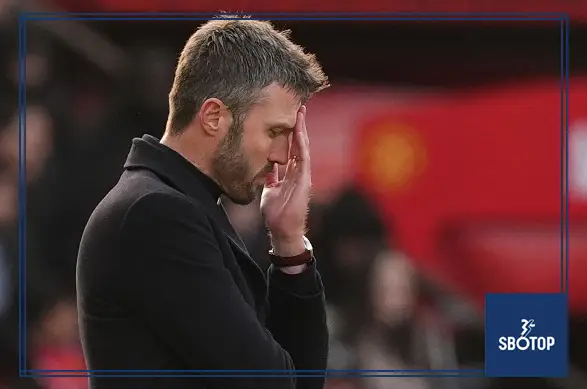
Michael Carrick faced intense scrutiny after Manchester United’s 3-0 home defeat by Bournemouth on 25 October 2026. The result extended United’s winless run to eight matches across all competitions and left them just one point above the Premier League relegation places.
For a head coach who had guided United into the Champions League the previous season, the deterioration was severe. His decision to leave captain Bruno Fernandes on the bench added another dimension to an afternoon already defined by defensive mistakes and an inadequate response.
However, reports that Carrick was close to losing his job must be distinguished from a confirmed dismissal. He remained in charge afterwards and subsequently led United to a 3-2 Champions League victory over Roma on 3 November. The Bournemouth defeat was a major crisis point, but it did not immediately end his tenure.
Bournemouth Expose United’s Weaknesses
The defeat at Old Trafford developed through three decisive finishes. Rayan opened the scoring in the 38th minute, Marcus Tavernier doubled the advantage before half-time, and Evanilson added the third in the 71st minute.
United failed to produce the response required after any of those setbacks. Bournemouth, by contrast, executed their opportunities and maintained sufficient defensive control to finish without conceding.
The scoreline reflected more than an unfortunate incident or a marginal decision. United encountered repeated difficulties in protecting their goal, recovering from mistakes and building attacks that could alter the match.
From an analytical perspective, the most damaging feature was the absence of a convincing recovery. A team can concede while still showing a coherent route back. Against Bournemouth, United struggled to establish that route.
That left Carrick facing questions about both the immediate performance and the broader direction of his team.
A Poor Start Gives the Pressure Substance
United had seven points from their opening eight Premier League fixtures after the Bournemouth match. Their record stood at one victory, four draws and three defeats, placing them 16th at that stage.
It was their lowest points total after eight league games since the 1986/87 season. The historical comparison underlined the scale of the problem, although the immediate concern was more practical: United were not collecting enough points.
Their last league victory had come in August. By late October, the gap between expectations and results had become difficult to dismiss as an ordinary fluctuation.
These figures explain why scrutiny of Carrick was grounded in performance rather than simply the symbolism of losing heavily at home.
Nevertheless, an early-season position is not a final outcome. The table described United’s situation after the fixture; it did not establish that relegation, recovery or a managerial change would follow.
Fernandes’ Omission Becomes a Second Story
Carrick left Fernandes out of the starting line-up after the captain had publicly questioned aspects of United’s approach following a 4-1 Champions League defeat at Como.
The timing inevitably connected the two events in public discussion. Carrick, however, explained the selection in football terms. Fernandes was available among the substitutes but remained unused throughout the Bournemouth defeat.
That distinction matters. Being left on the bench is confirmed; the full private reasoning behind a selection cannot be established solely through its timing.
United’s failure to improve ensured the decision attracted further attention. When a manager changes a prominent part of the team during a difficult run, the replacement approach is judged against the response it produces.
Against Bournemouth, that response was insufficient. However, the defeat does not prove that Fernandes would have prevented the goals or transformed United’s attacking performance had he started.
Support for Carrick Complicates the Atmosphere
The reaction at Old Trafford was not a straightforward rejection of the head coach. Supporters sang Carrick’s name and applauded him, while frustration was also directed towards players and the club’s leadership.
That distinction gave the aftermath an unusual character. Carrick faced considerable pressure over results while still receiving visible sympathy from sections of the crowd.
Support for a manager does not remove the responsibility attached to his position. Equally, it indicates that supporters may view the problems as extending beyond the person selecting the team.
Recruitment, squad construction, player performance and executive decisions all influence the environment in which a head coach works. They cannot automatically be separated from a team’s difficulties.
However, the existence of wider issues should not become a reason to avoid examining coaching decisions. United’s challenge was to understand how those different responsibilities interacted rather than assign every failure to a single figure.
Predictions of Dismissal Remain Predictions
In the immediate aftermath, former players and commentators argued that Carrick’s position had become extremely difficult. Some predicted his departure; others called for the club to make a change.
Those assessments were opinions about what should happen or what appeared likely. They were not announcements from Manchester United.
Carrick’s applause towards supporters also attracted interpretation as a possible farewell. Body language, however, cannot confirm an employment decision. A manager acknowledging support after a difficult match may be responding to several emotions.
This is where precise reporting becomes essential. Being under pressure, facing internal discussion and being dismissed are different stages.
At the time of the Bournemouth defeat, Carrick’s future was uncertain. Presenting that uncertainty as a completed departure would have gone beyond the confirmed position. Subsequent events demonstrated why maintaining that distinction mattered.
United Retain Carrick After the Defeat
Carrick continued in his role following the Bournemouth match and prepared the team for their next league assignment at Chelsea.
His continued presence established that the immediate expectation of dismissal had not become a confirmed outcome. It did not, however, amount to proof of unlimited backing or a guarantee about his longer-term future.
Clubs can retain a manager for different reasons, and those reasons should not be assumed without evidence. An unchanged appointment is a fact; the complete internal calculation behind it may remain private.
For Carrick, staying in charge preserved the opportunity to influence events through training, selection and results.
The football demands remained substantial. United needed greater defensive reliability, more effective attacking connections and a stronger response when matches turned against them. Continued employment gave Carrick time to address those needs, but did not resolve them by itself.
The Captaincy Issue Moves Towards Resolution
Carrick subsequently confirmed that Fernandes would remain United captain. He also said the midfielder remained committed to the club and indicated that their discussions had allowed them to move forward.
That development provided important context for the Bournemouth omission. The selection decision had not become a confirmed permanent removal of Fernandes from his leadership position.
It also showed why a difficult public episode should not automatically be described as an irreversible breakdown. Managers and players continue speaking, training and making decisions after disagreements become visible.
However, resolving communication does not guarantee improved performance. A positive working relationship must still function within a team capable of executing its approach.
For United, the practical value of moving forward would depend on whether their leading players could contribute effectively. Statements about unity could support that process, but results would provide the stronger test.
Roma Comeback Changes the Immediate Picture
United’s 3-2 victory over Roma on 3 November supplied a significant later development. Carrick remained in the dugout as his team recovered from two goals behind to win at Old Trafford.
The result ended their extended search for a victory and offered evidence of a response under pressure. It also made it inaccurate to describe the Bournemouth defeat as the final act of Carrick’s tenure.
Fernandes scored from the penalty spot, while Matheus Cunha struck twice to complete the comeback. The match provided a contrasting image to the Bournemouth loss: United found a recovery rather than allowing the deficit to determine the evening.
Nevertheless, one dramatic win did not erase the preceding difficulties. It changed the immediate mood and added a positive result, but sustained improvement still required further evidence.
Carrick had gained a response, not a definitive solution to every question surrounding his position.
What a Sustainable Recovery Requires
From an analytical perspective, United’s next challenge was to make their better moments repeatable. Emotional recoveries can be valuable, but a team also needs a dependable performance level when circumstances are less dramatic.
Defensive organisation is part of that foundation. Players require clear responsibilities, suitable support around the ball and reliable reactions when possession is lost.
Attacking improvement also depends on relationships rather than isolated talent. Midfielders must provide options, forwards need coordinated movement, and possession must lead towards useful opportunities.
These are general requirements for a stronger team, not claims about specific private instructions from Carrick.
The same principle applies to evaluation. A manager should be assessed across patterns of performance and results, while individual errors and exceptional moments remain part of the picture. Neither one damaging defeat nor one stirring comeback provides the complete answer.
A Crisis Point, Rather Than a Confirmed Ending
Bournemouth’s victory placed Carrick in a precarious position because it exposed problems already visible in United’s results. The captain’s omission, the home crowd’s reaction and the league table intensified the scrutiny.
Yet the confirmed sequence matters. Carrick was not immediately dismissed, Fernandes retained the captaincy, and United later produced a comeback win over Roma.
Those developments do not make the original concern unreasonable. They show that predictions about a manager’s future must remain separate from decisions a club has actually taken.
For Carrick, the route beyond the crisis depended on building consistency from a position of uncertainty. The Bournemouth defeat brought his authority and effectiveness under examination. Remaining in charge preserved his chance to answer, but only sustained improvement could make that answer convincing.
Also Read: