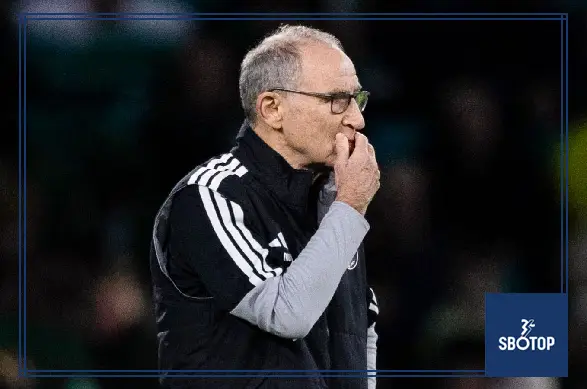
Martin O’Neill has acknowledged that Celtic remain a team under development as he works to balance attacking talent with players’ preferred positions. His assessment followed questions about a forward line containing several players more naturally suited to central roles.
Speaking on 30 October 2026, before Celtic’s trip to Falkirk, O’Neill accepted the substance of captain Callum McGregor’s concerns about how the attack was functioning. The manager’s response combined recognition of the problem with a determination to find a workable solution.
The issue was broader than individual comfort. Selecting talented footballers is only the beginning; the greater challenge is creating a structure in which their movement, responsibilities and decisions complement one another.
Dundee United Draw Exposes the Question
The immediate context was Celtic’s 2-2 draw with Dundee United. O’Neill started Callum Osmand, Kasper Høgh and Camilo Duran together, effectively placing three centre-forwards across the attacking line.
With Celtic trailing 2-1 at half-time, he removed Osmand and Høgh, introduced Jota and Hasseim Hassan, and moved Duran into the middle. Celtic subsequently recovered a point.
Those changes provided a concrete illustration of the selection dilemma. The initial combination offered several players with central attacking instincts, while the adjustments introduced more natural width.
The improved scoreline does not prove that every problem disappeared after the substitutions. Nevertheless, the contrast between the two approaches explains why positional balance became a central topic after the match.
O’Neill Accepts McGregor’s Main Point
McGregor questioned whether Celtic had sufficiently clear profiles for each attacking position. His concern was that a striker operating wide would often continue behaving like a striker, affecting the team’s overall function.
O’Neill agreed that Osmand and Duran were essentially centre-forwards. He suggested Osmand could benefit from playing alongside a stronger central partner, while expressing uncertainty about asking him to lead the line alone.
That response acknowledged meaningful differences between attacking roles. Two players can both be described as forwards while offering distinct qualities and requiring different support.
It also avoided turning the captain’s assessment into a public confrontation. Agreement about a tactical issue is not evidence of a dispute. In this instance, manager and captain identified the need for a better collective arrangement.
Position Is More Than a Place on the Team Sheet
A starting position provides only a rough outline of a player’s work. The more important questions concern where he receives possession, which spaces he attacks and how he responds when the ball moves elsewhere.
A centre-forward used on the wing may naturally drift towards goal. That can create an additional penalty-area threat, but it can also leave the team without a reliable wide outlet.
Conversely, a natural winger may hold the touchline longer, offering a different passing angle and stretching the opposition’s defence.
These are general tactical considerations rather than a claim that every Celtic attack followed the same pattern. They explain why selecting three capable forwards does not automatically produce a balanced forward line.
The relationships between those players matter as much as their individual ability.
Width Can Help Players in Central Areas
Maintaining width can benefit footballers who prefer operating through the middle. When defenders must cover the full width of the pitch, they can find it harder to remain compact around central attackers.
If several forwards move inside simultaneously, the opposite can happen. Passing lanes narrow, opponents defend a smaller area, and the player in possession may have fewer straightforward options.
That does not make using a striker wide inherently wrong. The approach can work when another teammate supplies width or when coordinated movement creates room elsewhere.
The key is ensuring that one player’s movement is supported by another’s positioning. Without that coordination, adding attacking talent can produce congestion rather than greater threat.
For Celtic, this provides a useful framework for understanding the concern raised after Dundee United.
The Midfield Feels the Consequences
McGregor’s assessment also connected attacking profiles with Celtic’s ability to control matches. His concern extended beyond scoring opportunities to the difficulty of regaining possession when the game became stretched.
That connection is important. An attack lacking clear outlets can force midfielders into riskier passes or longer carries. If possession is lost while several teammates are ahead of the ball, recovery becomes more demanding.
This is tactical analysis, not confirmation of a single cause behind every difficult Celtic passage.
Football involves interacting factors, including the opponent’s pressure, passing accuracy and defensive positioning. Still, the relationship between forward movement and midfield control helps explain why the captain discussed the issue.
An attacking adjustment can influence the whole team, even when its most obvious effect appears near the opposition’s penalty area.
Flexibility Remains Part of O’Neill’s Thinking
O’Neill did not suggest that every player must always occupy his favourite position. He pointed out that footballers have performed outside their natural roles before and referenced Osmand’s positive impact against Benfica.
He also described the squad as still developing familiarity and indicated that establishing suitable positions would remain part of the work ahead.
The distinction is between useful flexibility and an arrangement that repeatedly limits the team. A player may succeed in an unfamiliar role during one match without that role becoming his best long-term fit.
Equally, one disappointing performance does not establish that an experiment can never work.
O’Neill’s task was therefore to evaluate the combinations rather than apply a rigid rule. Adaptability could remain valuable while the broader structure continued to evolve.
A Learning Curve for Players and Coaches
The learning process involves both the footballers adapting to responsibilities and the coaching staff assessing what combinations are effective.
Players need time to understand the preferences of new teammates: whether a forward wants the ball into feet, attacks space behind or moves towards a particular side.
Coaches, meanwhile, must judge whether those tendencies fit together. A familiar formation can behave very differently depending on the players occupying its positions.
Training can develop those relationships, but competitive matches expose them under pressure. Opponents restrict space, force quicker decisions and reveal weaknesses that may be less obvious during preparation.
Describing Celtic as a work in progress therefore identifies a process rather than a finished solution. The important measure is whether the lessons produce clearer football.
Selection Requires Difficult Trade-Offs
Finding balance can mean leaving a talented player out. That is often less attractive than attempting to accommodate every prominent attacker, but a coherent team does not always contain the greatest possible number of forwards.
A manager may need a winger’s positioning more than another striker’s finishing instincts. In another fixture, a second central attacker could be more useful than maintaining the same wide structure.
Those choices depend on available players, fitness and the opponent. O’Neill’s comments did not confirm a permanent formation change or guarantee a particular starting combination.
Any prediction about Celtic adopting one system for the rest of the season would go beyond the announcement.
The more defensible interpretation is that he recognised a problem requiring adjustment while retaining several possible ways to address it.
Domestic Results Do Not End the Discussion
At the time of O’Neill’s remarks, Celtic were four points clear of Rangers in the Scottish Premiership, but they had lost their opening three Europa League matches.
That combination provided contrasting contexts for the debate: a strong domestic position alongside an unsuccessful start in Europe.
Neither record alone explained the tactical question. Leading the league did not prove that the attacking arrangement was functioning perfectly, while European defeats could not automatically be attributed to players operating outside preferred positions.
The value of reviewing performances is precisely that results do not reveal every underlying detail.
A team can win while leaving room for improvement. It can also lose despite showing useful qualities. Celtic’s challenge was to identify repeatable strengths and weaknesses without allowing either context to obscure the other.
What Improvement Would Look Like
A better-functioning attack would be visible through clearer options for the player on the ball, more complementary movement and fewer situations in which several teammates seek the same space.
It would also help Celtic respond coherently after losing possession. Forward positioning matters defensively because it influences how quickly the team can apply pressure or recover its shape.
These are analytical indicators rather than promises made by O’Neill. They offer practical ways to assess whether adjustments are working.
Individual goals remain valuable, but the wider structure should help create opportunities consistently. The aim is to make good performances less dependent on isolated moments of quality.
That would allow Celtic’s attacking talent to strengthen collective control instead of occasionally competing for the same areas.
Finding a Team Within the Available Talent
O’Neill’s acknowledgement left Celtic’s central task clearly defined: build an arrangement that respects individual strengths while serving the whole side.
There was no confirmed final answer in his October remarks. There was recognition that some attackers were being used away from their most natural roles, agreement that the team needed to function better, and confidence that further work could improve the balance.
The next stage required decisions about combinations, responsibilities and opportunities. Those decisions would be assessed through performances rather than the language of a press conference.
For Celtic, the learning curve concerned turning a collection of attacking options into a more connected team—one in which flexibility created advantages and every player’s movement helped the others perform.
Also Read: