Rangers rescued a point at Tynecastle through Olwethu Makhanya’s 89th-minute equaliser, drawing 2-2 with Hearts on an evening when Celtic were also held by Dundee United. Two dramatic contests produced eight goals but no change to the four-point gap separating Glasgow’s leading rivals.
Kevin Kelsy put Rangers ahead before Claudio Braga and Calvin Miller transformed the match early in the second half. Makhanya’s late intervention prevented defeat on Derek McInnes’s return to his former club, although Rangers almost completed an even more dramatic recovery.
At Celtic Park, Camilo Duran’s opener was overturned by quick goals from Zac Sapsford and Neil Farrugia. Liam Scales restored parity after the interval, but Celtic could not find a winner.
The results left each leading contender with reasons for frustration, while Hearts and Dundee United demonstrated why neither fixture could be treated as a routine assignment.
McInnes Returns to Familiar Territory
The Tynecastle encounter carried an additional emotional dimension because McInnes was returning with Rangers after leaving Hearts during the summer.
That background sharpened the atmosphere, but the competitive importance of the match required little additional explanation. Rangers wanted to maintain pressure on Celtic, while Hearts had an opportunity to take points directly from a team above them.
For players, such occasions demand concentration beyond the surrounding narrative. Familiarity between a manager and his former club may influence preparation, yet the immediate contest still turns on positioning, decisions and execution.
The changing scoreline reflected that reality. Rangers established an advantage, Hearts responded decisively, and the visitors eventually found another route back.
McInnes’s return therefore ended without a victory for either side. The central footballing story became the difficulty both teams experienced in protecting a lead once their opponents increased the pressure.
Kelsy Punishes an Early Hearts Error
Rangers opened the scoring in the 16th minute after Hearts surrendered possession near their own penalty area. Kelsy exchanged passes with Ryan Naderi before holding off defenders and finishing beneath Beau Reus.
The move gave Rangers an important reward for exploiting a mistake quickly. Hearts had little time to rebuild their defensive shape once possession changed hands, and the combination around the box turned the opening into a goal.
For the visitors, scoring first offered the possibility of controlling the match more comfortably. It required Hearts to seek an equaliser while giving Rangers opportunities to attack any space left behind.
However, an early lead only creates an advantage; it does not establish command automatically. Rangers still needed to retain possession effectively, defend the next phase and prevent Hearts from building momentum.
The second half would expose how fragile that position remained.
Braga and Miller Reverse the Momentum
Hearts changed the direction of the match almost immediately after the interval. Braga equalised in the 48th minute, removing Rangers’ lead before the visitors could settle into the second half.
Nine minutes later, Miller put the home side ahead. Tomas Magnusson won possession from Kim Minsu and released Braga down the left. Braga drove into the penalty area, and his attempt broke off Manny Fernandez into Miller’s path. Miller finished low from close range.
The sequence transformed the demands on both teams. Hearts now had an advantage to defend, while Rangers needed to recover from conceding twice in a short period.
It also underlined the importance of turnovers. Rangers had profited from a Hearts mistake for the opener; Hearts then used a change of possession to create their second.
Neither side could assume that having the ball would protect them from danger when an attack broke down.
Makhanya Delivers the Late Rescue
As the match approached its final minutes, Rangers faced the prospect of leaving Edinburgh without a point. Their recovery came through substitute Badredine Bouanani’s delivery and Makhanya’s finishing.
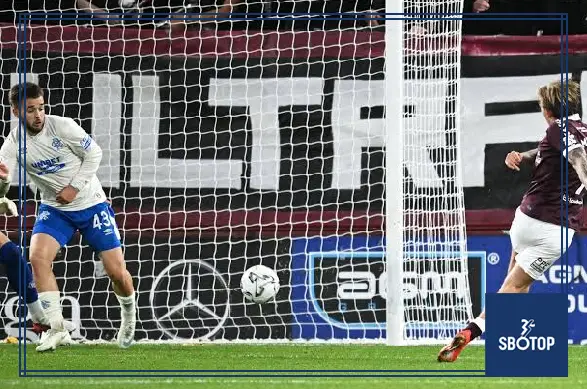
Bouanani sent a free-kick into the penalty area from the left, and Makhanya headed home in the 89th minute.
The equaliser rewarded Rangers for maintaining an attacking threat, but it was also a sharp disappointment for Hearts after their second-half turnaround.
There was still time for another decisive moment. Dujon Sterling had an excellent opportunity in the closing seconds but directed the ball with his chest towards Reus, allowing the Hearts goalkeeper to collect rather than concede.
Rangers therefore finished with relief and regret together: relief at avoiding defeat, regret that the final opportunity did not produce victory. Hearts experienced the reverse, having come close to securing three points before needing to ensure they retained one.
Celtic’s Bright Start Proves Misleading
At Celtic Park, the leaders initially appeared to be building towards a more comfortable evening. Duran scored in the 18th minute, giving Martin O’Neill’s side an early advantage against Dundee United.
Yet the visitors responded with a concentrated burst that overturned the match. Sapsford equalised in the 28th minute, and Farrugia scored three minutes later.
Celtic consequently reached half-time trailing despite having made the first breakthrough. The speed of the reversal mattered: a promising position became a recovery mission within minutes.
For Dundee United, the two goals supplied both a lead and evidence that they could cause problems beyond simply resisting Celtic’s attacks.
For the hosts, the immediate task was to recover their organisation and avoid allowing disappointment to undermine their second-half response. Their early goal had not provided lasting control, and the visitors had made that failure costly.
Scales Restores Hope but United Hold Firm
Celtic responded after the interval, with substitute Jota contributing to their improved attacking threat. The equaliser arrived in the 65th minute when Scales headed in from Jota’s delivery following a quickly taken corner.
That combination restored the possibility of a home victory with time remaining. Celtic continued searching for a third goal, but Dundee United prevented the pressure from producing another breakthrough.
The visitors’ defensive work deserves recognition alongside Celtic’s disappointment. Protecting a point at Celtic Park required concentration after the momentum had shifted and the home side had found renewed encouragement.
United also retained occasional opportunities to advance rather than spending every remaining moment inside their own penalty area.
Celtic’s recovery secured something from a difficult position, but it did not complete the turnaround. The distinction was important: equalising removed the immediate threat of defeat without delivering the three points the leaders had sought.
Jota’s Contribution Gives Celtic Something Useful
Although the result frustrated Celtic, Jota’s involvement in the equaliser provided a positive feature within the performance.
A substitute can affect a match by altering the type of threat an opponent must defend. Here, the dangerous delivery gave Scales an opportunity to convert, turning attacking pressure into a clear finishing action.
That matters because pressure alone can become repetitive. Defenders may survive numerous attacks if the delivery remains predictable or arrives after the relevant spaces have closed.
The goal demonstrated a more effective connection between supply and movement. It was a concrete contribution rather than simply another spell of possession.
However, one productive appearance should not automatically determine future selection. The evidence supports the narrower conclusion that Jota helped Celtic recover a point on this occasion. What that means for subsequent matches depends on fitness, preparation and the requirements of each opponent.
A Night of Opportunities Partly Recovered
The two draws created contrasting interpretations depending on when each match was assessed.
Rangers led and then trailed, making their final point both less than their initial position promised and more than the closing minutes appeared likely to provide. Celtic followed a similar broad pattern, scoring first before needing to recover.
Hearts could point to a strong comeback but also a lead surrendered late. Dundee United could value an away point while remembering that they had held the advantage at half-time.
Those distinctions explain why the same result can contain different emotions. A draw is fixed in the table, but its meaning within a performance changes with the sequence of events.
The useful assessment therefore includes both resilience and missed opportunities. Recovery deserves credit, while the mistakes that made recovery necessary still require attention. Neither conclusion cancels the other.
The Four-Point Gap Survives the Drama
Celtic’s lead over Rangers remained four points after both teams drew, while Rangers stayed four points ahead of Hearts.
That was the immediate consequence. The matches did not establish how the championship would finish, nor did they prove that either Glasgow side would continue dropping points.
For Celtic, the frustration was a home opportunity left incomplete. For Rangers, it was the failure to turn the leaders’ draw into a reduction of the deficit, tempered by the value of Makhanya’s rescue.
Hearts and Dundee United had reasons to value their performances without being reduced to supporting roles in another club’s title challenge.
Eight goals brought repeated changes of momentum, yet the leading gap remained intact. Makhanya supplied the latest intervention, Scales prevented Celtic’s defeat, and both challengers left with work still to do.
Also Read: