Lewis O’Brien scored his first goal of the season to earn Wrexham a 1–1 Championship draw with Wolverhampton Wanderers at the Racecourse Ground on Saturday, 7 November 2026. Adam Armstrong put Wolves ahead in the 25th minute with a first-time finish from Nasser Djiga’s long pass. O’Brien replied in the 27th, rising to meet Issa Kaboré’s cross before the visitors had much time to settle into their lead.
The two goals came close together, but the point took much longer to secure. Anthony Patterson made important saves as Wolves pressed after the break, while Kieffer Moore came close to putting Wrexham ahead from a free kick. The draw extended Wolves’ unbeaten run to six matches but denied them the chance to go top. For Wrexham, it meant four points from two home games against teams at the top end of the table, following a midweek victory over leaders Middlesbrough.
Wrexham’s early opening came from the back
Phil Parkinson made one change to the side that beat Middlesbrough, bringing Ollie Rathbone in for George Thomason. Wolves head coach César Peixoto made five changes after his team’s midweek comeback victory at Bristol City. Djiga and Mateus Mané were among those brought in, while Sean Neave, who had scored twice against Bristol City, began on the bench. The contrast in selection was evident before kick-off, though the opening exchanges gave neither side much room to exploit it.
Wrexham tested José Sá first. Callum Doyle intercepted a pass around halfway and carried the ball forward, moving away from Fer López before shooting from an angle. Sá got down to save. The run showed how swiftly Wrexham could move into the final third when there was space in front of a defender. Clear openings remained scarce for much of the first 20 minutes, however, and it was Wolves who put together the first sustained spell of danger.
Djiga’s long pass puts Armstrong through
Armstrong had already brought Patterson into action before setting up a chance for Mané, whose effort the goalkeeper also kept out. Wolves scored soon afterwards. Djiga sent a lofted pass over the Wrexham back line and into Armstrong’s path. The striker watched it drop and struck first time, giving Patterson little opportunity to close him down or set himself for a second touch. It was Armstrong’s fifth goal of the campaign and his third in four games.
The pass and finish stood out in a match that had offered few clean routes to goal. Djiga could take several Wrexham players out of the move with one delivery because Armstrong was already running beyond the defence. The forward still had to judge when the ball would fall into range and catch it cleanly. The resulting lead briefly put Wolves at the top of the live table and gave them the chance to dictate how the rest of the first half would be played. Wrexham took that chance away before the visitors could use it.
Kaboré and O’Brien answer within two minutes
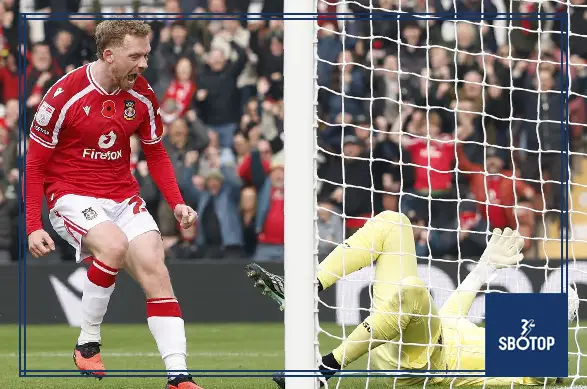
Wrexham’s response came down the right. Kaboré delivered a cross that gave O’Brien a target to attack as he ran into the area. The midfielder timed his leap, got above the defenders and guided his header past Sá. The goals were recorded two minutes apart, and the speed of the reply changed the mood of the contest. Wolves had just found their way through with a pass from deep. Wrexham replied by getting the ball wide and finding a runner who could meet the delivery in stride.
For O’Brien, the movement mattered as much as the contact. Kaboré’s cross gave him something to attack, but he still had to arrive early enough to challenge for the ball and get enough elevation to direct it. It was his first goal since January and nearly the first of two that afternoon. In first-half stoppage time, he got another shot away and forced Sá to save low at the expense of a corner. Wrexham went into the interval level, having made Wolves defend another dangerous moment after giving up their lead.
The immediate equaliser also preserved Wrexham’s options. Had Wolves taken the lead into the interval, Parkinson would have had to decide when to commit more players forward against a side that had already shown the danger of a pass over the top. At 1–1, Wrexham could still pick their moments. That became increasingly important in the second half, when Wolves had more of the ball and Patterson was called on to keep the score level.
Moore goes close as Wolves begin to push Wrexham deeper
Mané shot into the side netting early in the second half as Wolves went looking for a second. Wrexham’s best opening of the period came from a Rathbone free kick, which Moore met with a flick that went narrowly wide shortly after the hour. Parkinson later identified it as Wrexham’s best opportunity to win the game. The chance showed why the hosts could still pose a problem even when the visitors were having longer spells of possession. One well-placed delivery gave Moore a chance to redirect the ball from close enough to trouble Sá.
Both managers turned to their benches around that point. Parkinson sent on Thomason for Rathbone, and Peixoto introduced Rafiki Saïd in place of Rodrigo Gomes. Saïd gave Wolves another source of delivery as they began to pin Wrexham back. With around 20 minutes remaining, he lifted a cross towards López, who arrived late in the area and made clean contact with a header. Patterson read the danger and pushed the effort around the post. Mané then sent a chance wide from a tight angle after Ladislav Krejčí headed the resulting corner back into the area.
Patterson makes the saves that protect the point
Wolves kept finding routes to goal as the game entered its final stages. Substitute Tommy Doyle struck from long range and forced Patterson into another save. Hugo Bueno then crossed for Marshall Munetsi, who headed over from a promising position. The chances came from different distances and angles. Patterson had to deal with López arriving in the box and then reset for a shot from much farther out, while the defenders still had to account for players attacking crosses.
Parkinson freshened up his side in the 77th minute, introducing Matty James, Ben Sheaf and Bailey Cadamarteri, then replaced Kaboré with Danny Imray. Peixoto sent on Jean-Ricner Bellegarde and Neave for the final minutes. Wolves continued to look for a winner, but the late changes brought no further goal. The visitors had found the breakthrough in the first half by attacking the space behind Wrexham. As the hosts defended deeper, Wolves’ clearest chances increasingly came from crosses or a shot from distance.
Patterson’s contribution gave O’Brien’s header its lasting value. He had denied Mané before Armstrong scored and then made the saves from López and Tommy Doyle after Wrexham drew level. Those interventions mattered because Wolves were spending enough time in advanced areas to make a second goal plausible. Wrexham could point to Moore’s chance at the other end, but keeping the score at 1–1 required them to deal with repeated pressure as the game wore on.
Two managers see different value in the draw
Parkinson was pleased to take four points from Middlesbrough and Wolves and acknowledged that his players looked tired in the second half. Peixoto felt Wolves had done enough to win, pointing to their possession and the chances they created. Both assessments had support in the match. Wrexham came close through Moore and reacted quickly when they went behind. Wolves spent more of the closing stages looking for a winner and forced Patterson into the more demanding saves.
For Wolves, an unbeaten run of six matches continued, but the visit to the Racecourse Ground ended with a missed opportunity to claim first place. For Wrexham, the result confirmed that the win over Middlesbrough was followed by another competitive performance against a promotion contender. Much of the match was spent protecting the point, but the most important action came when Wrexham were still behind. Kaboré found room to cross, O’Brien reached the ball before the defenders, and a lead that might have allowed Wolves to control the afternoon lasted only until the 27th minute.
Also Read: