


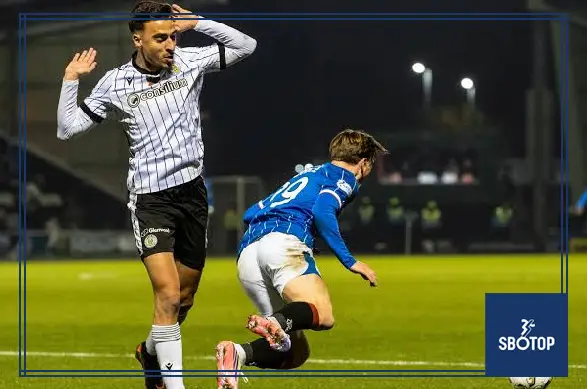
Two challenges involving Rangers defender James Penrice show why a replay can confirm a referee’s call in one match and expose a mistake without correcting it in another. Against St Mirren, Penrice won a penalty that Scottish FA head of refereeing Willie Collum supported. In the League Cup semi-final against Aberdeen, Collum thought Penrice should have been booked for a high challenge. The video assistant referee was right to stay out of that decision because the challenge fell short of a red card.
Those incidents featured in the November 2026 edition of the Scottish Football VAR Review, in which Collum and presenter Gordon Duncan examined decisions from the Premiership and League Cup. The programme also covered a sending-off against St Johnstone, a penalty awarded after an offside flag at Tannadice and a disallowed Dundee United goal. The Scottish Cup has its own rules about when VAR is available, a distinction that matters when comparing how similar incidents are handled across competitions.
The Penalty That Would Have Stood Either Way
Referee Nick Walsh pointed to the spot in the 17th minute of Rangers’ Premiership match at St Mirren after Samuel Ramos challenged Penrice inside the area. Ryan Naderi converted the penalty, and Rangers went on to win 2–0. The amount of contact was disputed, but Collum supported Walsh’s decision. He said Ramos missed the ball and made contact with Penrice, and that the footage was consistent with what the well-positioned referee described.
Collum also said VAR would have stayed out if Walsh had waved play on and accurately described what he had seen. The footage supported a penalty without making a decision to play on clearly and obviously wrong. That makes the incident a useful example of how the original call can determine the outcome when officials are assessing contact that falls within a range of reasonable judgments.
A supporter watching the replay can decide whether the contact was enough for a foul. The video official has a narrower task once the referee has made that judgment. In Paisley, the question was whether the footage exposed a clear error in Walsh’s description or decision. Collum’s view was that it did neither, so the penalty stood.
At Tannadice, the Offside Flag Had to Be Checked First
Dundee United’s 1–1 draw with Motherwell on 7 November produced a different route to a penalty. Tom Sparrow delivered the ball into the area, where Tawanda Maswanhise went down under a challenge from Dylan Tait. The assistant referee raised the flag for offside, initially taking precedence over the possible foul. The video officials checked the build-up and established that there had been no offside offence.
That finding cleared the way for referee Ryan Lee to assess Tait’s challenge at the monitor. Lee awarded Motherwell a penalty after watching the replay. The order was important. The officials first had to establish whether an earlier offence had already stopped the attack. Once offside was ruled out, the contact in the box could determine the restart.
Both this incident and the penalty at St Mirren ended with a spot kick, but the officials got there by different routes. Walsh had seen the challenge and made a call the video team could support. At Tannadice, the video team resolved an issue in the build-up and then asked Lee to judge the challenge. The referee retained the decision on whether the contact amounted to a foul.
Why Fotheringham Saw Red and Donovan Stayed On
Collum backed the decision to send off St Johnstone’s Kai Fotheringham for a challenge on Nicolas Raskin at Ibrox. Referee Chris Graham initially allowed play to continue, then showed a straight red card after watching the incident at the monitor. Collum identified the movement that followed Fotheringham’s contact with the ball. His leg extended and his foot came up into Raskin’s calf with enough force for the challenge to endanger the opponent.
Winning the ball was one part of the sequence. The danger came from what Fotheringham did immediately afterwards. Collum treated the red card as a correct outcome and the original decision to let play continue as a missed incident that warranted intervention. The replay gave Graham a chance to judge the entire movement and the force of the contact.
Celtic defender Colby Donovan’s tackle on Zac Sapsford in a 2–2 Premiership draw with Dundee United provided a comparison. Steven McLean showed Donovan a yellow card and the video officials did not recommend a red-card review. Collum supported that outcome. He highlighted the lesser contact and the way Donovan’s leg bent and came away, rather than continuing to extend through the challenge. The review also discussed the yellow shown to Hearts’ Rogers Mato against Motherwell, which Collum regarded as close to the threshold. Those comparisons show why officials examine the motion of a challenge as well as where the boot makes contact.
The League Cup Challenge Collum Would Have Booked
Penrice was on the other side of a disputed decision when Rangers beat Aberdeen 1–0 in the League Cup semi-final at Hampden Park on 31 October. He stretched for the ball and caught Afeez Aremu high on the side of his body. Ryan Lee awarded Aberdeen a free kick and showed no card. Video assistant John Beaton checked the incident and did not send Lee to the monitor.
Collum thought the challenge was reckless and deserved a yellow. He also thought the force of the contact fell short of what would justify a red. A still image could show the height of Penrice’s boot, but the moving footage was needed to assess intensity. In Collum’s judgment, the height made the challenge worthy of a caution, while the lack of force kept it below the sending-off threshold.
That left room for Collum to disagree with the referee’s disciplinary decision and support Beaton’s handling of the check. VAR cannot intervene simply to add a missing first yellow card. The same semi-final supplied two potential handball incidents for the review, involving Aberdeen’s Ayoub Mouloua and Rangers’ Dujon Sterling. Neither resulted in a penalty. A handball assessment considers where the ball struck the player and whether the arm position was justified by the movement, rather than treating every contact as an offence.
Sapsford’s Disallowed Goal Turned on a Teammate’s Position
Sapsford thought he had scored against Aberdeen when he finished from Jesse Randall’s delivery in Dundee United’s 3–2 Premiership win. VAR Nick Walsh called referee David Dickinson to the monitor to assess Daniel Bennie, who was in an offside position when the shot was taken. Dickinson ruled the goal out after the review. Dundee United later sought an explanation from the Scottish FA.
The decision hinged on whether Bennie interfered with an opponent. An offside position becomes punishable when the player becomes involved in the ways defined by the law. These include clearly obstructing an opponent’s view, challenging for the ball or making an obvious action that clearly affects an opponent’s ability to play it. Establishing where Bennie stood was one part of the review. Judging what his presence did to an opponent was the part Dickinson had to resolve.
United still won, but their request for clarification shows why explanations matter even when a decision does not cost a team points. The position of a player can often be checked directly from the footage. The effect on a defender or goalkeeper needs an explanation grounded in what that player could see or do as the shot came in.
The Scottish Cup Has Its Own Rules on VAR Availability
The men’s Scottish Cup rules for 2026/27 make VAR use in the semi-finals and final subject to the Scottish FA board’s discretion. The rules also provide for VAR in rounds four, five and six at the registered ground of a top-division club where the equipment is already installed, subject to further conditions concerning broadcast coverage or club agreement. The competition rules therefore make the venue and circumstances of the tie relevant to whether video assistance is available.
That distinction helps explain why a Premiership match and a Scottish Cup tie can have different review options. A referee applies the same laws on fouls, handball and offside in both. When VAR is available, the officials can check eligible decisions using the footage. In a tie without it, the referee and assistants must resolve the same questions from what they see on the field.
Across the incidents Collum discussed, the starting point was the referee’s decision and the question the replay could answer. Ramos’s challenge on Penrice supported the penalty Walsh had already awarded. The offside check at Tannadice allowed Lee to assess a foul he might otherwise have had no reason to review. Fotheringham’s challenge warranted a red card, while Penrice’s contact with Aremu warranted a caution VAR could not supply. Those distinctions explain how the same system can uphold a contested call, correct a serious missed incident or leave an error in place because the decision falls outside its remit.
Also Read:
- SBOTOP: Bruno Fernandes Puts Contract Talks Aside After Reported Second Rebuff to Manchester United
- SBOTOP: Morgan Rogers Defends Cole Palmer’s England Commitment as Tuchel Sticks With His Midfield Choices
- SBOTOP: Harry Kane Has the Ballon d’Or and England’s Caps Record Three Trophies Still Drive Him