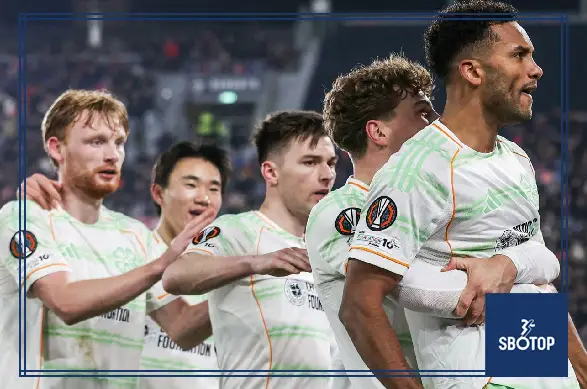
European nights rarely follow a script, and Celtic’s dramatic 2–2 draw away to Bologna was a perfect example of chaos, courage, and character colliding under pressure. Reduced to ten men yet refusing to buckle, Martin O’Neill’s Hoops survived a fierce second-half fightback to keep their Europa League hopes alive. It was a match defined not just by goals and red cards, but by resilience, belief, and a refusal to surrender when everything seemed stacked against them.
On a cold Italian evening, Celtic were pushed to their limits. By the final whistle, they had earned more than a point—they had earned respect.
A European Night Heavy with Stakes
Celtic arrived in Bologna knowing the importance of the occasion. With qualification still finely balanced, this was a match that could shape their entire European campaign. Victory would place them firmly in control of their destiny; defeat could leave them relying on other results.
Bologna, playing at home and backed by a passionate crowd, were equally desperate. Italian sides rarely take European fixtures lightly, and Bologna’s approach reflected that seriousness. From the warm-up onward, the atmosphere crackled with tension.
For Martin O’Neill, a manager synonymous with Celtic’s most memorable European moments, the night carried echoes of the past. This was a test of his team’s tactical discipline and mental toughness—qualities that would be stretched to the absolute limit.
Bright Start Celtic Play with Authority
Against expectations, Celtic began the match with confidence and composure. Rather than sitting deep, they pressed Bologna early, disrupting their rhythm and asserting themselves in midfield. The Hoops moved the ball quickly, switching play to stretch the Italian side’s defensive shape.
This positive approach paid off. Celtic’s first goal came from intelligent build-up play, crafted through patience rather than panic. A quick interchange in midfield opened space, and a precise pass split Bologna’s back line. The finish was clinical, silencing the home crowd and giving Celtic a crucial early advantage.
For a few moments, it felt like the perfect European away performance was unfolding.
Bologna Respond but Celtic Stay Calm
Unsurprisingly, Bologna reacted with urgency. They increased the tempo, pushing their full-backs higher and committing more bodies forward. Celtic were forced to defend deeper, but they did so with organization and calm.
The Hoops’ defensive line held firm, cutting out crosses and limiting Bologna to speculative shots from distance. When danger did arise, Celtic’s goalkeeper was equal to the task, making key saves that preserved the lead.
As the half progressed, Celtic began to exploit the spaces Bologna left behind. Counterattacks became sharper, more threatening. It was during one such moment that Celtic struck again.
Two Goals Ahead Dream Scenario Turns Real
Celtic’s second goal was a masterpiece of counterattacking football. Winning possession near their own box, they transitioned forward with speed and precision. A perfectly weighted through ball sent the attacker racing clear, and the finish was calm, confident, and devastating.
At 2–0, Celtic were in dreamland. Away from home, against strong opposition, they had established a commanding lead. The Bologna crowd fell quiet, and belief surged among the traveling supporters.
But European football has a habit of shifting momentum in the blink of an eye.
The Turning Point Red Card Changes Everything
Just before halftime, the match took a dramatic turn. A mistimed challenge in midfield resulted in a second yellow card, and Celtic were reduced to ten men. The decision sparked protests from the Celtic players, but the referee stood firm.
In an instant, the dynamic of the game changed completely.
From being in control, Celtic now faced a long, exhausting battle. O’Neill gathered his players during the break, aware that tactical adjustments and mental strength would be crucial. The message was simple: stay compact, stay disciplined, and believe.
Second Half Bologna Launch the Siege
With a numerical advantage, Bologna came out for the second half with renewed intensity. They dominated possession, pushing Celtic deeper and deeper into their own half. Waves of attacks followed, with crosses, shots, and set pieces raining down.
Celtic’s defensive effort was immense. Every player worked tirelessly, tracking runs, blocking shots, and throwing bodies in front of the ball. The midfield dropped deeper, forming a protective shield in front of the back line.
Despite the pressure, Celtic held on—until Bologna finally found a breakthrough.
Bologna Fight Back Pressure Finally Pays
The first Bologna goal came from sustained pressure. A loose clearance fell kindly at the edge of the box, and the resulting strike deflected past the goalkeeper. The stadium erupted, sensing a comeback was on.
At 2–1, momentum swung fully in Bologna’s favor. The Italian side smelled blood, pushing forward with even greater urgency. Celtic’s legs began to tire, and the space between lines grew harder to manage.
The equalizer soon followed. A well-worked move down the flank ended with a low cross into the box, converted from close range. Just like that, Celtic’s two-goal cushion was gone.
At 2–2, with over 20 minutes still to play, Celtic faced the ultimate test.
Digging Deep Ten Men One Mission
Many teams would have collapsed under such circumstances. Celtic did not.
O’Neill made crucial substitutions, reinforcing the midfield and freshening tired legs. The tactical focus shifted entirely to survival. Lines were compact, pressing was selective, and every clearance was treated like gold.
Bologna continued to attack, but frustration began to creep into their play. Shots were rushed, crosses overhit, and decision-making faltered as Celtic refused to break.
This was where experience mattered. Celtic’s senior players led by example, calming younger teammates and organizing the defensive structure. Communication was constant, concentration unwavering.
Final Minutes Hearts in Mouths
The closing stages were agonizing. Bologna threw everything forward, even sending defenders into the box for set pieces. The crowd urged them on, every attack greeted with deafening noise.
Celtic defended with their lives. Tackles were timed perfectly, headers won under pressure, and the goalkeeper made a crucial late save to deny what looked like a certain winner.
When the referee finally blew the full-time whistle, the Celtic players collapsed to the ground in exhaustion. The scoreline read 2–2, but it felt like a victory.
Martin O’Neill’s Tactical Masterclass
Much credit must go to Martin O’Neill. His ability to adapt mid-game, particularly after the red card, was instrumental in Celtic’s survival. He reorganized the team effectively, ensuring defensive balance without completely surrendering attacking threat.
O’Neill’s calm presence on the touchline contrasted sharply with the chaos on the pitch. His experience in European competition shone through, guiding his players through one of the most difficult scenarios football can offer.
This result added another chapter to his legacy as a manager capable of inspiring belief on the biggest stages.
What the Result Means for Celtic’s Europa League Hopes
The draw keeps Celtic’s Europa League dream alive. While victory would have placed them in a stronger position, escaping Bologna with a point—especially under the circumstances—could prove decisive.
Qualification now depends on the final group matches, but Celtic have momentum and belief. They have shown they can compete, suffer, and survive at this level.
For the players, this match will serve as a reference point—a reminder of what is possible when commitment and discipline align.
Individual Performances That Stood Out
Several Celtic players deserve special recognition. The defense, under relentless pressure, held together admirably. The midfield worked tirelessly, covering ground and disrupting Bologna’s rhythm whenever possible.
The goalscorers showed composure in crucial moments, while the goalkeeper’s late interventions preserved the draw. But perhaps the most impressive aspect was the collective spirit—every player understood the task and executed it with determination.
This was a team performance in the truest sense.
Also Read: