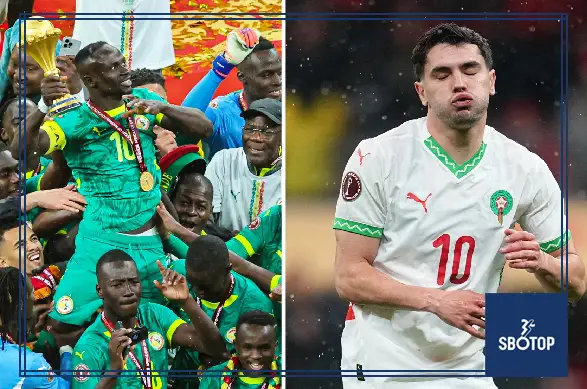
The African football landscape has been thrown into unprecedented turmoil after a shocking ruling from the Confederation of African Football declared the Morocco national football team the new Africa Cup of Nations champions following a controversial disciplinary reversal that stripped the title from the Senegal national football team.
What began as a celebrated continental final has now transformed into one of the most disputed decisions in modern football governance. The fallout has raised fundamental questions about officiating, VAR intervention, sporting legitimacy, and the future of tournament governance in Africa.
This is not just a story about two teams. It is a story about trust in the system itself.
A Final That Ended Twice
At the heart of the controversy lies a dramatic AFCON final that initially ended with celebrations for Senegal. Players lifted the trophy, fans flooded the streets, and officials prepared for closing ceremonies.
But behind the scenes, concerns were already building.
A decisive penalty awarded during the closing stages of the match became the focal point of dispute. The penalty, converted under immense pressure, extended Senegal’s lead and effectively sealed the match. At full-time, it appeared to be a legitimate championship-winning moment.
However, Morocco immediately lodged a formal complaint, claiming that the incident had been incorrectly officiated and that video assistant referee protocols had not been properly followed.
That complaint would eventually change everything.
The Controversial Penalty Incident
The turning point of the entire tournament occurred in the 83rd minute of the final. A rapid attacking sequence saw a Senegalese forward challenged near the edge of the penalty area. The referee initially awarded a penalty, signaling no hesitation. Senegal converted the spot-kick, and the match shifted decisively.
But replays told a more complicated story.
Multiple camera angles suggested that the contact occurred either on the line or just outside the box. Even more importantly, questions were raised about whether VAR officials fully reviewed all available footage before confirming the decision.
For the Morocco national football team, this moment became symbolic of what they described as “a failure of technological fairness.”
For the Senegal national football team, it was simply a refereeing decision made in real time under pressure—part of the game.
CAF Opens a Historic Investigation
The Confederation of African Football initially responded cautiously, stating that refereeing matters are part of the game and typically not subject to post-match reversal.
However, pressure from multiple football associations forced the governing body to launch a full disciplinary review.
The investigation included:
- Referee testimony
- VAR communication logs
- Match footage breakdown
- Technical officiating reports
- Independent arbitration review
What they found would later be described as “procedural inconsistencies affecting match integrity.”
VAR Breakdown and Communication Failure
One of the most significant findings was related to VAR communication delays.
According to internal reports, there was confusion between the on-field referee and the VAR room regarding the exact point of contact in the penalty incident. Crucially, not all camera angles were immediately reviewed during the decision-making window.
This raised a difficult question:
Did a technical failure influence the outcome of a continental final?
The answer to that question became the foundation of CAF’s final ruling.
The Decision That Shocked Football
After weeks of deliberation, the Confederation of African Football issued an extraordinary statement:
The match result would be annulled due to “material officiating errors affecting competitive fairness.”
As a result:
- The title was stripped from Senegal
- Morocco were declared AFCON champions
- The result was officially reclassified in tournament records
It marked one of the rarest administrative reversals in international football history.
Immediate Reaction from Senegal
The response from the Senegal national football team was swift and emotional.
Players and staff expressed disbelief, arguing that:
- The referee made a final on-field decision
- VAR exists to support, not override, real-time calls
- Retroactive punishment undermines sporting integrity
One senior player reportedly stated that “you cannot rewrite history after the final whistle.”
The Senegal Football Federation immediately filed an appeal, escalating the matter to higher arbitration bodies.
Morocco’s Unexpected Championship
For the Morocco national football team, the announcement brought a complicated mix of pride and discomfort.
On paper, they were now continental champions. In reality, they had not lifted the trophy on the pitch.
Inside the camp, reactions were mixed:
- Some players accepted the title as rightful correction
- Others expressed sympathy for Senegal
- Coaches emphasized respect for CAF’s decision while acknowledging the unusual circumstances
Fans across Morocco reacted strongly, with celebrations in some cities and debate in others.
A Divided Football World
The ruling immediately split opinion across global football.
Supporters of CAF’s Decision Argue:
- Fairness must override tradition
- Technology errors cannot be ignored
- Integrity of competition is paramount
Critics Argue:
- Football must be decided on the pitch
- Administrative reversals damage credibility
- VAR should not become a tool for rewriting results
Former players, referees, and analysts all weighed in, turning the incident into a global talking point.
Legal and Institutional Consequences
The fallout extended beyond football debate.
Legal experts in sports governance began analyzing whether CAF had exceeded its authority by overturning a final result.
Key issues included:
- Jurisdiction of post-match disciplinary rulings
- Limits of VAR intervention authority
- Precedent for future tournament disputes
Some warned that the decision could open the door to endless legal challenges in future competitions.
Impact on AFCON Reputation
The Africa Cup of Nations, one of the most prestigious tournaments in global football, now faces questions about credibility.
While CAF insisted that the ruling demonstrated commitment to fairness, critics argued it exposed structural weaknesses in officiating systems.
Sponsors and broadcasters also expressed concern about long-term reputational damage.
The Broader VAR Debate
This controversy has reignited global discussion about VAR usage.
Key issues highlighted include:
- Inconsistent application across tournaments
- Lack of transparency in decision-making
- Human error within technological systems
- Absence of standardized review timelines
Some experts now call for a “VAR overhaul” across international football.
What Happens Next
The situation remains unresolved in many respects.
The appeal from Senegal is ongoing, and further arbitration could:
- Reinstate the original result
- Uphold CAF’s decision
- Or propose a shared or nullified championship outcome
Until then, the 202X AFCON remains one of the most disputed tournaments in football history.
Also Read:
- SBOTOP: Morocco national football team Crowned AFCON Champions After Confederation of African Football Strips Title from Senegal national football team Following Penalty Controversy
- SBOTOP: Watford FC Roar Back with 3-1 Triumph Over Wrexham AFC Tightening Grip on Play-Off Chase
- SBOTOP Manchester United Controversy: Fernandes Snubbed from All-Time XI, Ugarte Told to Move On