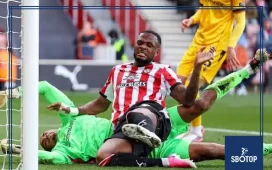
The fallout from Arsenal’s unexpected defeat to AFC Bournemouth has ignited a wave of analysis across the Premier League. What initially appeared to be a single disappointing result has quickly evolved into a deeper conversation about structural weaknesses—particularly in open-play attacking efficiency and mental resilience. More significantly, the loss has opened a crucial window for Manchester City to seize control of the title race.
For a team that has spent much of the season praised for its tactical identity and consistency, this moment represents a critical inflection point. The questions being asked are not just about one match, but about whether Arsenal possess the complete profile required to sustain a title challenge until the very end.
The Open-Play Puzzle When Structure Meets Limitation
At the heart of the current scrutiny lies Arsenal’s struggles in open play. Under Mikel Arteta, the team has developed a sophisticated system built on positional play, ball retention, and controlled progression. However, against well-organized defenses like that of AFC Bournemouth, this structure can sometimes become predictable.
Arsenal’s build-up often relies on patience and calculated movement, but when opponents compress space and deny central channels, creativity becomes harder to generate. In such scenarios, teams need players capable of producing moments of individual brilliance or unexpected variation.
Against Bournemouth, Arsenal struggled to break lines consistently in open play. Their attacks frequently stalled in the final third, with passes circulating around the defensive block rather than penetrating it. This lack of incision has raised concerns about whether their system can adapt when Plan A is neutralized.
Predictability vs. Creativity in the Final Third
One of the recurring criticisms of Arsenal following the defeat is predictability. While their positional structure ensures control, it can also limit spontaneity.
In the Premier League, elite teams often combine structure with unpredictability. Manchester City, for instance, maintain positional discipline but also rely on players capable of breaking patterns with quick combinations or direct actions.
Arsenal, by contrast, appeared hesitant to deviate from their established approach. Wide areas were used frequently, but deliveries into the box lacked variety. Central combinations were attempted but often disrupted by Bournemouth’s compact defensive shape.
This raises a broader tactical question: does Arsenal’s system allow enough freedom for creative improvisation in high-pressure situations?
The Mental Aspect Pressure of the Title Race
Beyond tactics, the psychological dimension of Arsenal’s performance has come under intense scrutiny. Competing for the Premier League title requires not only technical quality but also mental resilience.
The defeat to Bournemouth has highlighted potential fragility in this area. When Arsenal conceded and momentum shifted, their response lacked the authority and composure typically associated with title-winning teams.
In crucial moments, decision-making appeared rushed. Passes were forced, positioning became less disciplined, and the overall structure began to unravel slightly under pressure.
For Mikel Arteta, addressing this mental aspect is just as important as refining tactical details.
Momentum Shift Manchester City’s Opportunity
Perhaps the most significant consequence of Arsenal’s defeat is the advantage it provides to Manchester City. In a tightly contested title race, momentum can shift rapidly, and City are known for capitalizing on such moments.
Historically, Manchester City have demonstrated an exceptional ability to maintain consistency in the final stages of a season. Their experience in high-pressure scenarios often gives them an edge over rivals.
With Arsenal dropping points, City now have a clearer pathway to assert control. The psychological impact of this shift cannot be underestimated—it places additional pressure on Arsenal while reinforcing confidence within the City squad.
Defensive Stability vs. Attacking Inefficiency
Interestingly, Arsenal’s defensive record has remained relatively strong, but it is their attacking inefficiency in open play that has come under scrutiny.
Against AFC Bournemouth, Arsenal created opportunities but lacked the clinical edge to convert them consistently. This imbalance—strong defensive structure but inconsistent attacking output—can be problematic in tight title races.
In the Premier League, where margins are often defined by a single goal, the ability to convert chances becomes critical.
Arteta’s Tactical Evolution Under the Microscope
The evolution of Mikel Arteta as a manager has been widely praised, but moments like this invite deeper analysis of his tactical flexibility.
Arteta’s system has brought structure and identity to Arsenal, but adaptability remains a key challenge. Against Bournemouth, adjustments were made, but they did not produce the desired impact.
In elite competitions, the ability to change approach mid-game—whether through formation shifts, personnel changes, or altered tempo—is essential.
The question now is whether Arteta can introduce additional layers to Arsenal’s attacking play without compromising the stability that has defined their progress.
The Role of Individual Brilliance
Another factor in Arsenal’s struggles has been the absence of consistent individual match-winners in key moments.
While the team functions well collectively, title races often hinge on players who can produce decisive actions when systems are neutralized. Manchester City have repeatedly benefited from such contributions in past campaigns.
For Arsenal, identifying and empowering players to take responsibility in critical situations will be vital moving forward.
Fan Reaction and Growing Concern
The reaction among Arsenal supporters has been a mix of concern and cautious optimism. While the team’s overall progress under Mikel Arteta is undeniable, the defeat has raised fears about repeating past patterns of late-season inconsistency.
Fans recognize the quality within the squad but are increasingly aware that small weaknesses can have significant consequences in a competitive title race.
The Importance of Immediate Response
In the Premier League, setbacks are inevitable, but the response to those setbacks defines a team’s character.
For Arsenal, the next few matches will be crucial. A strong reaction could restore confidence and maintain pressure on Manchester City.
Conversely, further dropped points could allow the title race to slip away.
Lessons from the Bournemouth Defeat
The loss to AFC Bournemouth provides several important lessons for Arsenal:
- The need for greater unpredictability in open-play attacking
- Improved composure under pressure
- Enhanced tactical flexibility
- The importance of clinical finishing
These lessons, if addressed effectively, could strengthen the team for the remainder of the season.
Also Read:
- SBOTOP: Arsenal Stunned by Bournemouth as Costly Defeat Deals Major Blow to Title Ambitions
- SBOTOP: Ipswich End 20-Year Carrow Road Drought with 2–0 Victory Over Norwich to Reclaim Championship Second Spot
- SBOTOP: Coventry Held by Sheffield Wednesday in 0–0 Draw as Premier League Promotion Dream Delayed Another Week for the Sky Blues