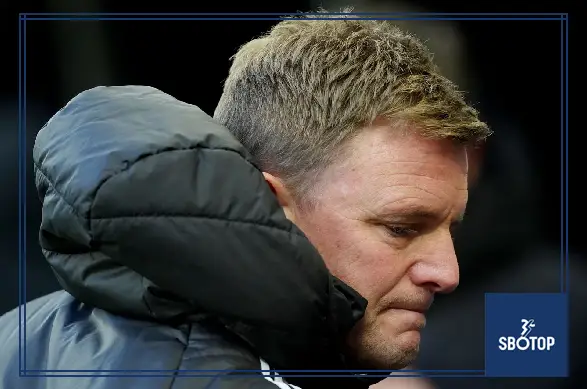
In the ever-evolving landscape of the Premier League, managerial reputations can rise and fall with remarkable speed. Yet, amidst the constant churn, Eddie Howe has steadily built a profile rooted in consistency, tactical intelligence, and long-term vision at Newcastle United FC.
Recent public endorsements from respected voices such as Gary Neville and Paul Merson have added fresh momentum to Howe’s growing reputation. While Neville has openly praised Howe’s work at Newcastle, Merson has gone a step further, suggesting that Chelsea FC would embrace him “all day long” if the opportunity arose.
These remarks have ignited wider discussions about Howe’s standing among elite managers and his potential future trajectory.
Eddie Howe’s Transformation of Newcastle United
When Eddie Howe took charge of Newcastle United FC, the club was navigating uncertainty both on and off the pitch. Expectations were high, but immediate success was far from guaranteed.
Howe’s approach focused on building from the ground up:
- Establishing a clear tactical identity
- Improving defensive organization
- Enhancing player fitness and intensity
- Creating a unified dressing room culture
Over time, these elements combined to transform Newcastle into a competitive and structured side capable of challenging stronger opponents.
What stands out most is the sustainability of this progress. Rather than relying on short-term fixes, Howe has built a foundation that continues to evolve.
Gary Neville’s Endorsement A Mark of Respect
Gary Neville is not known for offering praise lightly. His analysis often emphasizes tactical clarity, leadership qualities, and long-term planning—criteria that Howe appears to meet convincingly.
Neville’s support reflects recognition of several key aspects of Howe’s management:
- Tactical discipline combined with attacking intent
- Ability to improve individual players
- Strong communication and leadership style
- Adaptability across different match situations
For a former player and analyst of Neville’s stature to publicly back Howe adds credibility to the argument that he belongs among the Premier League’s most effective managers.
Paul Merson’s Perspective A Chelsea Fit
While Neville’s comments focus on recognition, Paul Merson has taken a more speculative angle by linking Howe to Chelsea FC.
Merson’s suggestion that Chelsea would take Howe “all day long” highlights a perceived compatibility between Howe’s managerial style and Chelsea’s current needs.
Chelsea, a club often associated with high expectations and frequent managerial changes, could benefit from:
- Stability in leadership
- Clear tactical identity
- Focus on player development
- Long-term project planning
These are precisely the qualities Howe has demonstrated at Newcastle.
Tactical Philosophy Balance and Structure
One of Howe’s defining characteristics is his balanced tactical approach. Unlike managers who prioritize either defense or attack, Howe seeks equilibrium between the two.
At Newcastle United FC, this has manifested in:
- Organized defensive lines
- Coordinated pressing systems
- Quick transitions from defense to attack
- Efficient use of wide areas
This balance allows Newcastle to compete effectively against both top-tier and mid-table teams.
It also makes Howe adaptable—a crucial trait in modern football, where tactical flexibility often determines success.
Player Development Under Howe
Another area where Howe has earned praise is his ability to improve players individually. Several Newcastle players have developed significantly under his guidance, showing improvements in:
- Tactical awareness
- Technical execution
- Physical conditioning
- Decision-making under pressure
This developmental focus aligns with modern football’s emphasis on maximizing squad potential rather than relying solely on high-profile transfers.
For clubs like Chelsea, which often integrate young talent, this quality is particularly valuable.
Leadership Style Calm Authority
Howe’s leadership style contrasts with the more confrontational approaches seen elsewhere in the league. He operates with calm authority, focusing on communication and clarity rather than theatrics.
This approach has helped create a stable environment at Newcastle, where players understand their roles and expectations.
Leadership in football is not only about tactics—it is about managing personalities, maintaining morale, and navigating pressure. Howe’s ability to balance these elements has been a key factor in his success.
Why Chelsea Are Mentioned in the Conversation
The connection between Howe and Chelsea FC is not purely speculative. Chelsea’s recent managerial history has been marked by frequent changes, tactical inconsistency, and fluctuating results.
In such an environment, a manager like Howe—who emphasizes structure, development, and long-term planning—appears to offer a different approach.
However, the question remains whether Chelsea would be willing to commit to the kind of patience required for Howe’s methods to fully take effect.
The Challenge of Leaving Newcastle
Despite external interest, Howe’s current position at Newcastle United FC is strong. The club is progressing, the project is stable, and the support structure is aligned with his vision.
Leaving such an environment for a more volatile situation would involve significant risk.
Managers often face this dilemma: remain in a stable, growing project or pursue opportunities at clubs with higher immediate expectations but less long-term security.
For Howe, this decision—should it ever arise—would be career-defining.
The Broader Impact on Managerial Perception
The discussion around Howe reflects a broader shift in how managers are evaluated in the Premier League.
Success is no longer measured solely by trophies. Increasingly, factors such as:
- Player development
- Tactical innovation
- Squad cohesion
- Long-term progress
are considered equally important.
Howe’s rise exemplifies this shift. His reputation is built not just on results, but on the process behind those results.
Media Influence on Managerial Narratives
Endorsements from figures like Gary Neville and Paul Merson play a significant role in shaping public perception.
Media narratives can elevate a manager’s profile, influence club decision-making, and even affect player confidence.
In Howe’s case, these endorsements reinforce an already growing belief that he belongs among the league’s top managerial talents.
The Importance of Timing in Football Careers
Timing is crucial in football. A manager’s reputation can align with opportunities at specific moments, creating pathways to bigger roles.
For Howe, the current period represents a peak in recognition. Whether this leads to a move or further consolidation at Newcastle depends on multiple factors, including club performance, available opportunities, and personal ambition.
Stability vs Ambition The Key Decision
If interest from clubs like Chelsea FC were to materialize, Howe would face a classic dilemma:
- Stay at Newcastle and continue building a long-term project
- Move to a high-profile club with immediate expectations
Both paths offer different rewards and risks.
Stability provides control and continuity. Ambition offers exposure and the chance to compete at the highest levels more quickly.
Newcastle’s Perspective Retaining a Key Asset
From Newcastle’s standpoint, Howe is more than a manager—he is a central figure in the club’s long-term strategy.
Retaining him is crucial for maintaining momentum and ensuring continuity. Losing him would not only disrupt tactical plans but also affect the broader vision of the club’s development.
Also Read:
- SBOTOP: Claudio Braga Backs Hearts’ Title Charge as Belief Fuels Scottish Premiership Ambitions
- SBOTOP: Paul Schaffran Details How Bio-Banding and Strategic Overhaul Reshaped Borussia Dortmund’s Academy Development Model
- SBOTOP: Xavi Simons Injury Sidelines Tottenham Playmaker for Season and Netherlands World Cup Campaign After Wolves Stretcher Exit