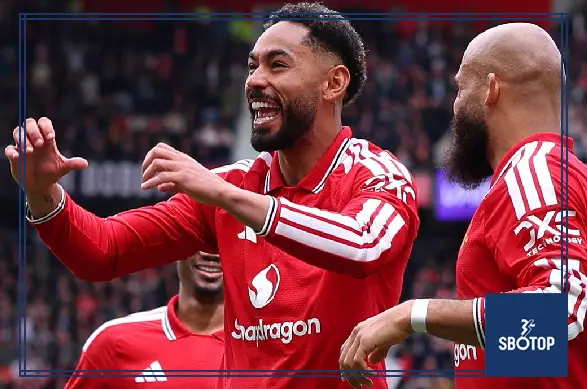
Manchester United’s attacking identity has rarely felt as sharply defined in recent seasons as it does now, with Matheus Cunha and Bryan Mbeumo emerging as transformative figures in the club’s evolving frontline. Under the steady, detail-driven guidance of Michael Carrick, the team is beginning to show the outlines of a new structure—one built not just on individual brilliance, but on tactical coherence, pressing discipline, and purposeful attacking combinations.
While United’s long-term rebuild is still in progress, the presence of Cunha and Mbeumo has accelerated expectations. Their chemistry, movement, and relentless attacking intent have given Carrick a platform to shape a team that looks more modern, more flexible, and more dangerous in transition than in previous iterations.
This is not a finished project. But it is, increasingly, a recognizable one.
A New Attack With Clear Purpose
For years, Manchester United’s attack has been criticized for inconsistency—moments of brilliance scattered across matches that lacked rhythm or repetition. What has changed this season is not just the quality of individual players, but the structure around them.
Matheus Cunha brings unpredictability. He is not a fixed reference striker, nor a traditional winger. Instead, he operates in the half-spaces, drifting between lines, pulling defenders out of position, and creating pockets of chaos that United have often lacked.
Bryan Mbeumo, on the other hand, offers precision and directness. His movement off the ball is intelligent, his finishing is calm, and his ability to stretch defenses vertically gives United a constant outlet in transition.
Together, they create a dual threat: one destabilizing, one decisive.
Carrick has leaned into this contrast rather than trying to standardize it. The result is an attack that feels less predictable and more adaptable.
Carrick’s Tactical Philosophy Taking Shape
Michael Carrick’s approach has always leaned toward control through intelligence rather than domination through volume. As a manager, he emphasizes structure without suffocation—allowing creative players space to interpret situations while maintaining collective discipline.
At Manchester United, this philosophy is beginning to materialize in clear phases:
First, a controlled buildup from the back, often involving midfield rotation and full-backs stepping into central zones.
Second, a transitional trigger phase where Cunha’s movement becomes central—dropping deep, dragging markers, and linking play between midfield and attack.
Third, acceleration into wide channels where Mbeumo thrives, exploiting space behind defensive lines.
Carrick is not trying to reinvent football. Instead, he is refining United’s transitions into something repeatable and dangerous.
Matheus Cunha The Connector United Needed
Cunha’s impact goes beyond goals and assists. His real value lies in connection—bridging midfield creativity with attacking execution.
In previous seasons, United often struggled to connect these zones fluidly. Strikers stayed high, midfielders hesitated, and attacks became isolated sequences rather than continuous waves.
Cunha changes that dynamic completely.
He drops into midfield to receive under pressure, often drawing two defenders with him. This creates space for runners like Mbeumo and midfield surges from deeper positions.
He is also comfortable turning under pressure, something that allows United to break pressing systems that previously disrupted their rhythm.
Perhaps most importantly, Cunha plays with freedom. Carrick has not constrained him to rigid positional rules. Instead, he is given permission to roam, interpret, and disrupt.
That freedom is proving decisive.
Bryan Mbeumo Directness and End Product
If Cunha is the connector, Mbeumo is the finisher of moves. His game is built on timing, awareness, and ruthless execution in attacking phases.
Mbeumo’s ability to stay wide and then attack central spaces at the perfect moment has given United a new attacking dimension. Defenders are forced into uncomfortable decisions: step out and risk leaving space behind, or drop and allow him time on the ball.
He thrives in both scenarios.
Carrick’s system maximizes this strength by ensuring that Mbeumo is often the final receiver in quick transitions. Rather than asking him to constantly participate in buildup, the system positions him closer to the decisive zone.
The result is efficiency. Fewer touches, more impact.
The Chemistry Between Cunha and Mbeumo
What makes this partnership particularly exciting is not just their individual profiles, but how they complement each other.
Cunha attracts pressure. Mbeumo exploits the space that pressure creates.
Cunha drifts centrally. Mbeumo stretches vertically.
Cunha delays the moment. Mbeumo accelerates it.
This rhythm creates a natural attacking balance that Manchester United have often lacked in recent years.
Opponents are forced to constantly adjust. When they track Cunha tightly, Mbeumo finds space. When they stay compact, Cunha slips into dangerous pockets between the lines.
It is not a fixed partnership—it is a dynamic problem.
Midfield Support The Hidden Engine
Behind this attacking duo, United’s midfield structure has quietly improved. Carrick has prioritized players who can circulate possession quickly and resist pressing traps.
This is crucial because Cunha and Mbeumo rely on fast, clean supply lines.
Midfielders now operate with clearer roles: one anchors transitions, another progresses the ball, and another supports attacking overloads.
This clarity reduces chaos in buildup phases and ensures that when the ball reaches the final third, it arrives with intent rather than uncertainty.
The improvement may not always be obvious in highlight reels, but it is essential to the system’s stability.
Defensive Stability Enables Offensive Freedom
One of the most overlooked aspects of United’s attacking improvement is their defensive structure.
Carrick understands that attacking freedom requires defensive security. If the back line is unstable, forwards are forced to drop deeper, disrupting attacking spacing.
By stabilizing the defensive block—through better positioning, improved pressing triggers, and more disciplined full-back roles—Carrick has created a foundation that allows Cunha and Mbeumo to stay higher and more dangerous.
This balance is what separates functional teams from chaotic ones.
Transition Football United’s Biggest Weapon
Manchester United under Carrick are becoming particularly dangerous in transition.
Once possession is won, the team shifts quickly into forward motion. Cunha often initiates these transitions, while Mbeumo finishes them.
The speed of these attacks forces opponents into reactive defending, which is where United are most effective.
This is not possession for possession’s sake. It is controlled acceleration.
Carrick’s system does not require 70% possession. It requires the right 10-second windows to be executed perfectly.
Tactical Flexibility in Attack
Another key development is tactical flexibility. United are no longer locked into a single attacking shape.
At times, Cunha operates as a false nine. In other moments, Mbeumo drifts centrally while wide players stretch the pitch.
This fluidity makes it harder for opponents to prepare defensively. They cannot mark positions—they must mark movements.
Carrick encourages this adaptability, trusting his attackers to interpret space intelligently.
The Psychological Shift Within the Squad
Beyond tactics, there is also a psychological shift taking place.
Players are beginning to play with more confidence in attacking situations. Instead of overthinking final-third decisions, they are taking risks again.
Cunha’s creativity and Mbeumo’s decisiveness contribute to this mindset. When players see successful execution from key figures, it reinforces belief across the squad.
Momentum in football is not only about results—it is about conviction.
Challenges Still Ahead
Despite the positive developments, this project is still in its early stages.
Consistency remains a question. Maintaining intensity across a full season is always the biggest challenge for evolving teams.
Opponents will also adapt. As data builds on United’s patterns, teams will attempt to isolate Cunha or limit space for Mbeumo.
Carrick will need to evolve the system continuously to stay ahead of tactical countermeasures.
Depth is another concern. Injuries or fatigue could expose gaps in attacking rotation.
The Carrick Project Long-Term Vision
What is emerging under Michael Carrick is not an instant transformation, but a structured rebuild.
He is not chasing short-term chaos or reactive fixes. Instead, he is constructing a system that can evolve over time.
Cunha and Mbeumo are central to that vision, but they are not the entire story. They are the current expression of a broader tactical identity being formed.
A Manchester United team that presses with intelligence, transitions with speed, and attacks with clarity is beginning to take shape.
Also Read:
- SBOTOP: Martin O’Neill Rejects Hearts’ ‘Embarrassed Scottish Football’ Claim Over Celtic Park Pitch Invasion as ‘Nonsense’
- SBOTOP: Roy Keane Slams West Ham for Lack of Fight and Intensity After Disappointing Defeat at Newcastle
- SBOTOP: West Ham’s Survival Fears Intensify as Costly Mistakes Hand Newcastle Dominant Victory at St James’ Park