The Premier League once again finds itself at the center of controversy after a highly debated refereeing decision in the match between Manchester United and Nottingham Forest. A goal involving Matheus Cunha stood despite strong protests from Nottingham Forest players, who argued that Bryan Mbeumo handled the ball in the buildup.
Following the match, the Professional Game Match Officials Limited (PGMOL) conducted a review and acknowledged that an error had been made in allowing the goal to stand. The incident has reignited long-standing debates about consistency in VAR decisions, interpretation of handball rules, and the pressure placed on match officials in high-stakes Premier League fixtures.
The result of the match itself may fade with time, but the controversy surrounding the decision is likely to remain a talking point for weeks, if not longer.
The Incident That Changed the Game
The key moment occurred during a tightly contested phase of the match, when Manchester United launched a quick attacking sequence. Bryan Mbeumo, heavily involved in the build-up, appeared to make contact with the ball using his arm before the attack continued.
The move eventually led to Matheus Cunha finding the back of the net. While United players celebrated, Nottingham Forest immediately protested, insisting that the goal should be disallowed due to a clear handball in the buildup phase.
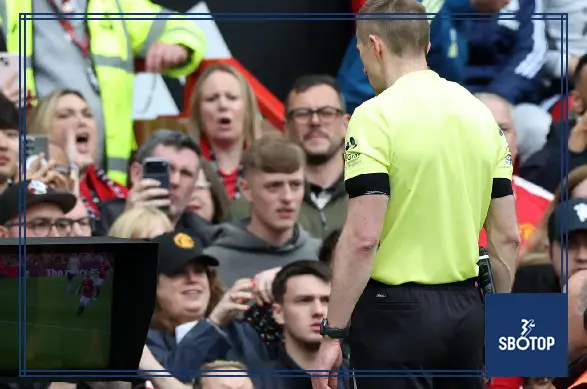
The referee initially allowed play to continue, and after a brief VAR check, the goal was confirmed. That decision would later become the subject of intense scrutiny.
From the moment the ball hit the net, tension inside the stadium escalated. Nottingham Forest players surrounded the referee, demanding clarification, while United’s players defended the legitimacy of the goal.
VAR Check and On-Field Decision
According to standard Premier League protocol, VAR intervened to review the buildup. The officials examined multiple camera angles to determine whether Mbeumo’s contact with the ball constituted a punishable handball and whether it directly influenced the goal.
After a short review, the on-field decision stood: the goal was awarded.
At the time, the explanation given was that the handball was either not deemed deliberate or not considered to have an immediate, clear impact on the goal-scoring action.
However, this interpretation would soon be challenged after further internal review by PGMOL.
PGMOL’s Admission of Error
In a rare public acknowledgment, PGMOL later admitted that the decision to allow the goal was incorrect. According to their internal review, the handball by Bryan Mbeumo should have been penalized, and the goal ruled out.
This admission immediately intensified debate across the football community. While refereeing bodies occasionally acknowledge mistakes, it is far less common for such acknowledgments to directly contradict a VAR-confirmed goal in a Premier League match.
The statement reignited frustration among Nottingham Forest supporters and staff, who felt that the integrity of the match had been compromised.
Nottingham Forest’s Frustration
For Nottingham Forest, the decision felt like a turning point in the match. Up to that moment, they had competed strongly and maintained defensive discipline against Manchester United’s attacking pressure.
Losing a goal under controversial circumstances left players visibly frustrated. Post-match reactions from the club emphasized the need for greater consistency and transparency in officiating decisions.
From their perspective, the issue was not just about one incident, but about a pattern of inconsistent VAR interpretations throughout the season.
Forest officials reportedly sought clarification from the Premier League regarding the reasoning behind the original decision, particularly the interpretation of the handball rule in this specific context.
Manchester United’s Perspective
On the other side, Manchester United accepted the goal without protest at the time of the match. Players and coaching staff focused on continuing the game rather than engaging in lengthy disputes.
However, after PGMOL’s admission, the situation became more complicated. While the goal remains part of the official match record, the acknowledgment of error has inevitably cast a shadow over the result.
Inside the United camp, the reaction was more reserved. There was an understanding that refereeing decisions are part of the game, even controversial ones. Still, the situation has raised questions about fairness and consistency in high-level competition.
The Handball Rule Debate Resurfaces
At the heart of the controversy is the interpretation of the handball rule, one of the most debated regulations in modern football.
According to current guidelines, not every accidental handball results in an immediate foul. Factors such as intention, arm position, proximity, and direct impact on goal-scoring opportunities are all considered.
In this case, VAR officials initially determined that Mbeumo’s contact did not meet the threshold for a punishable offense.
However, PGMOL’s later review suggested that the handball did, in fact, have a direct influence on the attacking phase leading to the goal.
This contradiction highlights the ongoing challenge referees face in applying subjective rules consistently across different matches.
VAR Under Pressure Once Again
The incident has once again placed VAR under intense scrutiny. Introduced to eliminate clear and obvious errors, VAR was expected to bring greater fairness to the game. Instead, it has often been criticized for inconsistency and lack of clarity.
In this match, the system did intervene—but ultimately supported a decision that was later deemed incorrect.
This has led to renewed calls for reform, including clearer guidelines on handball interpretation and more transparent communication between VAR officials and fans.
Some analysts argue that the problem is not technology itself, but the human interpretation behind it. Others believe that VAR has added complexity without solving the core issues of officiating consistency.
Impact on the Match Outcome
While it is impossible to say with certainty how the match would have ended without the controversial goal, there is no doubt that the decision had a psychological impact on both teams.
Manchester United gained momentum after the goal, while Nottingham Forest struggled to regain composure. Momentum shifts in football are often subtle, but highly influential.
The timing of the goal also mattered. Conceding under disputed circumstances can affect team morale, especially when players feel the decision was unfair.
Even though the match continued, the controversy lingered in the background, shaping the emotional rhythm of the game.
Reactions from Pundits and Analysts
Football analysts and former referees have been quick to weigh in on the situation. Many expressed concern about the lack of consistency in VAR decisions involving handball incidents.
Some argued that if the handball had been clearly identified in real time, the goal would have been disallowed immediately, avoiding post-match controversy.
Others pointed out that similar incidents earlier in the season had been judged differently, reinforcing the perception of inconsistency.
The broader consensus is that clearer, more uniform interpretation guidelines are urgently needed.
Fan Reaction and Social Media Debate
As expected, the incident sparked widespread debate on social media. Fans from both clubs expressed strong opinions, with hashtags related to VAR and refereeing trending shortly after the match.
Nottingham Forest supporters were particularly vocal, arguing that their team had been unfairly denied a crucial moment in the match.
Manchester United fans, meanwhile, were more divided. Some acknowledged the controversy but emphasized that such decisions are part of football, while others defended the legitimacy of the VAR review process at the time.
The debate quickly expanded beyond the two clubs, with neutral fans and pundits joining the discussion.
The Role of PGMOL Moving Forward
PGMOL now faces renewed pressure to improve communication and decision-making transparency. While admitting errors is a step toward accountability, critics argue that it is not enough without systemic improvements.
Suggestions include:
- More detailed explanations of VAR decisions during matches
- Faster post-match clarification of controversial incidents
- Standardized interpretation of handball situations
- Increased referee training under high-pressure scenarios
The goal is to reduce ambiguity and rebuild trust between officials, clubs, and supporters.
Long-Term Implications for the Premier League
Incidents like this do more than affect a single match—they shape perceptions of the league’s fairness and credibility.
The Premier League prides itself on being the most competitive and watched football league in the world. However, recurring controversies involving VAR risk undermining that reputation.
Clubs are becoming increasingly vocal, and pressure is mounting for reforms that ensure greater consistency and transparency.
Also Read:
- SBOTOP: Cunha and Mbeumo Ignite Man United’s Attack as Carrick Builds a New Foundation for the Future
- SBOTOP: Martin O’Neill Rejects Hearts’ ‘Embarrassed Scottish Football’ Claim Over Celtic Park Pitch Invasion as ‘Nonsense’
- SBOTOP: Roy Keane Slams West Ham for Lack of Fight and Intensity After Disappointing Defeat at Newcastle