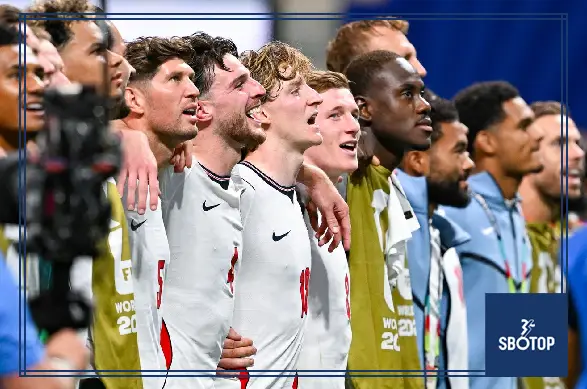
England’s World Cup campaign has found more than a rhythm on the pitch. It has found a soundtrack. As Thomas Tuchel’s side push deeper into the 2026 tournament, Oasis’ classic “Wonderwall” has become the emotional anthem linking players, fans, history, nostalgia, and belief into one shared moment after each major victory. What started as a post-match singalong has grown into a defining symbol of England’s summer, with Harry Kane and Jude Bellingham standing at the heart of the scenes.
The song has been heard across England’s World Cup journey in North America, from early wins to the dramatic knockout victory over Mexico. Supporters have sung it in the stands, players have joined arm-in-arm on the pitch, and clips of Kane, Bellingham, and teammates belting it out have spread rapidly online. Sky Sports described “Wonderwall” as the song soundtracking England’s campaign, calling it a unifying moment shared between the players and fans after big wins.
In a tournament filled with pressure, heat, travel, late drama, and national expectation, the anthem has given England something softer but just as powerful: emotional release. It has become the sound of survival, celebration, and renewed hope.
A Song That Became More Than a Song
Football tournaments are rarely remembered only for goals. They are remembered for images, sounds, rituals, and emotional details that turn a run of matches into a national story. For England in 2026, “Wonderwall” has become one of those details.
The song, first released in the 1990s, already carried generations of cultural memory. It was never created as a football anthem, yet it has always had the kind of simple, communal pull that makes thousands of people want to sing together. At this World Cup, that quality has found a new stage.
The Guardian reported that the Oasis track had been sung by England fans from Texas to Massachusetts before following the team toward Mexico City, where England faced co-hosts Mexico in the last 16. That geographic spread matters. England fans have not been gathered in one traditional home venue. They have followed the team across a vast tournament landscape, through different cities, climates, and stadiums. The song has helped create continuity.
Wherever England go, the chorus of support follows.
Kane at the Centre of the Moment
Harry Kane has played many roles for England: captain, striker, penalty taker, leader, record chaser, and emotional reference point. At this World Cup, he has also become the frontman of the team’s new singalong ritual.
After England’s early victories, Kane was seen leading teammates toward the travelling support, standing in front of the fans and joining the song. The image quickly became familiar: players linking arms, faces turned toward the stands, supporters singing back at them, and Kane visibly absorbing the connection.
LBC reported that Kane led his teammates toward the fans after England’s win over DR Congo, with similar scenes following victories over Croatia and Panama. The same report noted that the ritual had become a tradition by the time England were preparing for Mexico.
For Kane, the significance appears to go beyond routine celebration. According to Sky Sports, he described the first major singalong after the Croatia win as one of his favourite moments in an England shirt, linking it to the emotional connection between players and fans.
That is why the moment matters. It is not just performative. It looks and feels like a squad trying to share its journey with the people who have travelled thousands of miles to follow them.
Bellingham Brings the Fire
If Kane gives the ritual leadership, Jude Bellingham gives it energy. Bellingham’s World Cup has been defined by intensity: chest-out performances, big goals, emotional celebrations, and a natural ability to pull the crowd into his orbit. His role in the “Wonderwall” scenes fits that personality perfectly.
Sky Sports noted that after England beat DR Congo, Bellingham encouraged the crowd to raise the volume during the team’s rendition. It was a small gesture, but one that captured his influence. Bellingham does not simply play in big moments; he amplifies them.
That same force carried into England’s dramatic 3-2 win over Mexico at the Azteca, where he scored twice in a performance that helped push the Three Lions into the quarterfinals. The Guardian described the match as a thriller, with Bellingham scoring the first two England goals before Kane added a penalty and England survived late pressure with 10 men.
After a match like that, singing was not just celebration. It was release. England had survived altitude, noise, pressure, a red card, and a furious Mexican response. “Wonderwall” gave the players and fans a way to breathe together.
The Mexico Win Made the Anthem Louder
England’s win over Mexico may be the moment that turned the anthem from a charming tournament detail into a serious cultural storyline. This was not a comfortable group-stage victory. It was a knockout fight in one of football’s most iconic stadiums, against a co-host nation backed by enormous emotion.
England led 2-0 through Bellingham, conceded before half-time, then lost Jarell Quansah to a red card early in the second half. Kane’s penalty restored a two-goal cushion, but Mexico came back again through Raúl Jiménez, forcing England to defend through a frantic finish. The Guardian reported that England finished in a deep 5-3-1 shape and held on to reach a quarterfinal against Norway.
When the whistle finally went, the celebration carried extra weight. This was the kind of win that bonds a squad. It was messy, tense, imperfect, and unforgettable. The players looked exhausted, but the song started again.
Fox Sports even published video of England singing “Wonderwall” after the Mexico win, showing how quickly the moment became part of the match’s wider story.
Kane Losing His Voice Became a Viral Symbol
The most human detail after the Mexico match was Kane’s voice. The England captain had sung so intensely with the fans that he could barely speak during his post-match interview.
The Sun reported that Kane lost his voice after joining the travelling supporters in singing “Wonderwall” and that Liam Gallagher reacted approvingly on social media. The moment was funny, but it was also revealing. Kane, often portrayed as calm, controlled, and professional, looked completely swept up in the emotion of the win.
That contrast made the clip go viral. Fans saw not just the captain of England, but a player who had given everything physically and emotionally. He had scored, fought through the match, celebrated with supporters, and then turned up to speak with almost no voice left.
In an era when football can feel heavily managed and media-trained, the rawness of that moment stood out. Kane did not need a perfect quote. His cracked voice told the story.
Why This Anthem Works
England have had tournament songs before. Some have been official releases, others terrace favourites, and others accidental soundtracks. “Wonderwall” works because it feels accidental and organic. Nobody had to force it into the tournament. It grew naturally from the fans and was accepted by the players.
LBC noted that England supporters have a long history of turning pop songs into tournament anthems, with “September” becoming associated with the 2018 World Cup and “Sweet Caroline” becoming central during the 2021 run. In 2026, the chosen song is “Wonderwall.”
The difference is tone. “Sweet Caroline” was bright, loud, and easy to shout. “Wonderwall” feels more emotional and reflective. It carries nostalgia. It feels like a song about hope, longing, and collective belief, even when sung badly by thousands of tired fans after a stressful football match.
That makes it perfect for England. This is a nation that has spent decades turning football hope into ritual. Every tournament brings excitement, doubt, memory, fear, and the question of whether this could finally be the year. “Wonderwall” fits that emotional uncertainty better than a pure party song.
A Bridge Between Generations
One reason the anthem has caught fire is that it connects different generations of England fans. Older supporters remember Oasis from the 1990s. Younger supporters know the song as a cultural staple that has never really disappeared. Players in the squad grew up hearing it everywhere, even if some may not know every word.
That cross-generational quality matters at a World Cup. Families watch together. Friends gather in pubs. Travelling supporters sing in stadiums far from home. Social media turns short clips into shared national moments. A song everyone recognises becomes a bridge.
The Guardian quoted Three Lions podcast host Russell Osborne describing the song as part of a reciprocal relationship between travelling fans and players, with both sides singing back to each other and enjoying a shared experience.
That is the key. It is not only fans singing at players. It is players singing with fans.
Also Read: