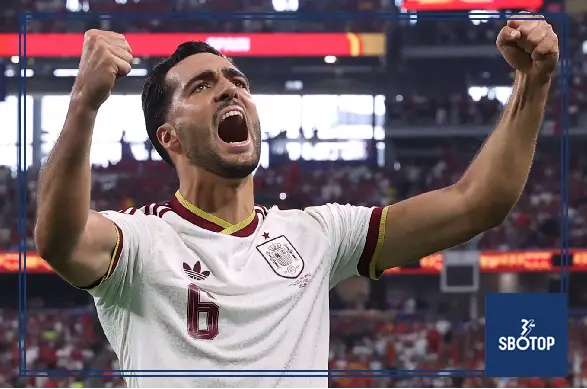
Spain found a way through one of the most emotional matches of the World Cup, beating Portugal 1-0 after Mikel Merino struck in stoppage time to send La Roja into the quarter-finals. In a tense Iberian knockout battle where patience mattered as much as quality, Merino became the decisive figure, delivering the late goal that broke Portugal’s resistance and pushed Spain one step closer to another major tournament charge. FIFA’s match report confirmed that Merino scored in the 90+1st minute at Dallas Stadium, sealing Spain’s place in the FIFA World Cup 2026 quarter-finals.
For Portugal, the defeat was devastating. A match of fine margins became a painful ending, and the focus inevitably turned toward Cristiano Ronaldo. The Portuguese icon has built a career around delivering in impossible moments, but this time there was no late rescue, no trademark finish, and no final act of defiance. As Spain celebrated, Ronaldo’s World Cup dream faded in one of the most difficult ways possible: a narrow defeat to a historic rival, decided just when extra time seemed within reach.
The result carried more weight than a standard knockout victory. Spain advanced, Portugal went home, and one of football’s most famous World Cup stories appeared to reach its final page. The Associated Press described Merino’s late goal as the strike that sent Spain through and ended Ronaldo’s World Cup career, underlining the emotional significance of the moment.
Spain Stay Calm When It Matters Most
Spain’s victory was not a performance built on chaos. It was built on composure. In a match between two teams who know each other well, Spain trusted their structure, moved the ball with patience, and waited for the right moment to attack. Portugal defended with discipline and carried their own threat, but Spain’s ability to remain calm deep into the match proved decisive.
This is the kind of win that says a lot about a team’s tournament mentality. Some knockout games are won with early dominance. Others are won by surviving the tension and staying sharp when the game becomes mentally exhausting. Spain did the latter. They did not panic when the breakthrough failed to arrive early. They did not abandon their identity. They continued to probe, pass, rotate, and search for space.
Merino’s winner was the reward for that persistence. Late goals rarely come from nowhere. They often arrive because one team keeps believing that the next movement, the next run, or the next pass can change everything. Spain believed until the final minutes, and Merino turned that belief into the goal that settled the match.
Merino Becomes the Night’s Hero
Mikel Merino may not always dominate the headlines in a Spain squad filled with technical quality, but this was his moment. In knockout football, heroes are not always the players who attract the most attention before the match. They are the players who appear when the game demands courage.
Merino’s timing was perfect. With Portugal holding on and extra time approaching, he found the decisive space and produced the finish that changed Spain’s tournament. According to reports, the goal came in the first minute of stoppage time, a late blow that left Portugal with almost no room to respond.
That timing made the goal even more dramatic. Portugal had defended for so long, fought through pressure, and kept themselves alive. Then, in one decisive sequence, Spain broke through. For Merino, the strike will become one of the defining moments of his international career. For Spain, it was proof that their squad depth and tactical discipline can produce match-winners from different areas of the pitch.
In a World Cup knockout match, one touch can become history. Merino delivered his at exactly the right time.
Ronaldo’s Painful Silence
For Cristiano Ronaldo, the night was defined by absence rather than explosion. The world has spent years expecting him to rise in big moments. His career is full of late goals, dramatic celebrations, and matches turned by sheer will. Against Spain, however, the script did not bend in his favour.
This was not because Ronaldo lacked desire. Nobody could question his hunger. But desire alone is not always enough at World Cup level, especially against a Spain side capable of controlling rhythm and limiting clear chances. Portugal needed one decisive Ronaldo moment, and it never came.
That is what made the defeat so painful. Ronaldo’s World Cup journey has always carried a sense of unfinished business. He has won club trophies, individual awards, and a European Championship with Portugal, but the World Cup remained the one mountain he could not climb. This defeat brought that dream closer to its end than ever before.
At 41 during the 2026 World Cup, Ronaldo’s future on this stage was always going to be surrounded by questions. The loss to Spain gave those questions a painful answer for many observers. The final whistle felt less like the end of a match and more like the closing of an era.
Portugal Left to Regret Fine Margins
Portugal did not collapse. They were not embarrassed. They were beaten by one late moment in a match where both sides understood the stakes. That may make the defeat even harder to accept.
A heavy loss can sometimes offer clarity. A narrow defeat creates endless questions. What if Portugal had taken one chance? What if they had slowed Spain’s final attack? What if they had pushed harder earlier? What if Ronaldo had found half a yard inside the box?
These questions will follow Portugal beyond the tournament. The team had enough talent to believe it could go further. They had experience, technical quality, and attacking depth. But in a knockout match against Spain, potential did not become progress.
The 1-0 scoreline will hurt because Portugal were close. They were close to extra time, close to another chance, close to keeping Ronaldo’s dream alive. Instead, Merino’s late strike turned closeness into heartbreak.
Spain’s Tournament Identity Grows Stronger
Spain’s win over Portugal strengthened a tournament identity that has become increasingly clear: this is a team built on control, cohesion, and collective contribution. Reuters reported before Spain’s quarter-final against Belgium that Luis de la Fuente’s side had become one of the most consistent and disciplined teams in the competition, with a long unbeaten run and a strong sense of club-like understanding.
That cohesion matters in matches like this. Spain did not rely on one superstar to rescue them. They relied on structure. Players understood their positions, their pressing triggers, their passing lanes, and their responsibilities. When the match tightened, that collective understanding helped them remain stable.
Merino’s goal also highlighted Spain’s squad balance. Tournament winners often need unexpected scorers. They need goals from midfielders, defenders, substitutes, and role players. Spain’s strength has never been only about one attacking name. It has been about the system creating opportunities for many players to contribute.
Against Portugal, that system delivered at the perfect moment.
The Iberian Rivalry Adds Emotion
Spain against Portugal is never just another match. The rivalry carries geography, history, pride, and familiarity. The players often know each other from club football. The styles can feel connected yet different. The tension is always personal.
That made this World Cup meeting even more intense. It was not only a fight for a quarter-final place. It was a battle between neighbours, between two football cultures, and between two teams with genuine ambitions. Portugal wanted to extend Ronaldo’s story. Spain wanted to prove its new generation had the mentality to beat elite opponents on the biggest stage.
In that context, Merino’s goal felt even sharper. It was not a routine winner. It was a strike that silenced Portugal, sent Spain forward, and reshaped the emotional landscape of the tournament. One side advanced with belief. The other was left with regret.
These are the moments that define World Cup rivalries. The margin was one goal, but the emotional distance between joy and pain was enormous.
De la Fuente’s Spain Show Their Maturity
Luis de la Fuente deserves credit for the maturity Spain showed. Knockout games against major rivals can tempt teams into emotional football. Spain resisted that temptation. They remained disciplined, trusted their method, and refused to let the match become too wild.
That maturity comes from coaching, but also from shared experience. De la Fuente has worked with many Spanish players across different levels, helping build a sense of continuity in the national setup. Reuters noted that his background with Spain’s youth teams has contributed to the cohesion visible in the senior side.
This matters because international football gives coaches limited time. Unlike club managers, they cannot train players every day for months. Systems must be clear, relationships must be strong, and players must understand the plan quickly. Spain look like a team with that understanding.
Against Portugal, the reward was not a flashy victory. It was a controlled one. And in the World Cup knockout rounds, controlled victories are often the most valuable.
Also Read: