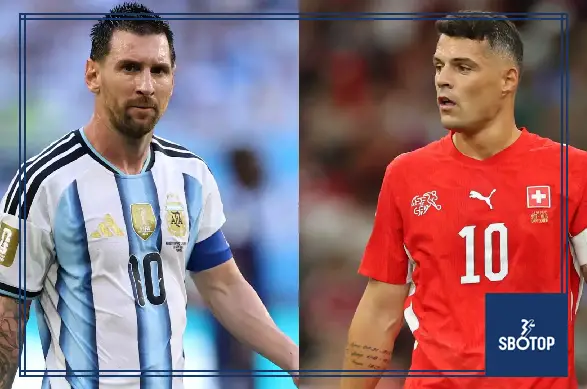
Granit Xhaka has spent much of his international career trying to push Switzerland beyond the limits traditionally placed upon them. The experienced captain has helped his country qualify consistently for major tournaments, survive difficult knockout matches and challenge some of Europe’s strongest national teams.
Now, however, he is preparing for an opportunity that could define an entire generation.
Switzerland will face defending champions Argentina in the quarter-finals of the 2026 World Cup, with Lionel Messi standing between the Swiss and a first appearance in the tournament’s last four. Argentina possess the history, attacking quality and global superstar power, but Xhaka insists Switzerland are not entering the match merely to admire their opponents.
The Swiss captain has spoken of a growing hunger inside the squad. Reaching the quarter-finals for the first time since 1954 represents a major achievement, yet the players do not want their journey to end with a respectable defeat against the reigning champions. They believe Argentina have shown weaknesses, and Xhaka wants Switzerland to approach the occasion with courage rather than fear.
For several Swiss players, the opportunity to share a World Cup stage with Messi is a dream. One member of the squad suggested that football experiences do not become much greater than facing the Argentine legend. That admiration, however, will disappear once the match begins.
Switzerland may respect Messi, but their primary objective is to eliminate him.
Switzerland Finally Break Their Quarter-Final Barrier
Switzerland’s progress to the last eight carries enormous historical significance.
Before the 2026 tournament, the national team had repeatedly reached the knockout rounds of major competitions without taking the next decisive step. They were respected for their organization, discipline and consistency, but often eliminated when facing more established opponents.
That narrative changed against Colombia.
The round-of-16 match finished goalless after 120 tense minutes in Vancouver. Neither side produced enough attacking quality to settle the contest in open play, forcing qualification to be decided through a penalty shootout.
Gregor Kobel became one of Switzerland’s heroes. The goalkeeper saved Cucho Hernández’s penalty, allowing Ruben Vargas to convert the decisive kick and complete a 4-3 shootout victory. Manuel Akanji had missed his own attempt, but Kobel’s intervention ensured that Switzerland’s long wait for a World Cup quarter-final was over.
The victory placed Switzerland among the final eight for the first time in 72 years.
Kobel described the achievement as enormous, not only for the players but for the entire country. His comments reflected the relief of a team that had carried the weight of previous disappointments into another high-pressure knockout match.
Switzerland had finally crossed a barrier that had stopped several talented generations.
Xhaka, Ricardo Rodriguez, Akanji, Remo Freuler and other experienced players have been involved in painful tournament exits. They understand how quickly an international campaign can end and how rare opportunities like this can be.
That history explains why satisfaction has not replaced ambition.
The quarter-final is not being treated as a ceremonial reward. Switzerland want to prove they can go further.
Xhaka’s Hunger Defines the Swiss Mentality
Xhaka’s influence extends far beyond his passing range or defensive work. He is Switzerland’s emotional leader, the player expected to set standards when pressure rises. His international career has contained controversy, criticism, dramatic victories and personal redemption, but he has remained central to the team through every phase. Ahead of the Argentina match, Granit Xhaka has emphasized hunger.
The word is important because Switzerland could easily approach the quarter-final with the mentality that they have already succeeded. Reaching this stage after such a long absence would allow the players to return home with considerable pride, regardless of the result.
Xhaka is resisting that temptation.
He wants his teammates to see Argentina as an opportunity rather than a final destination. Switzerland may not receive many chances to reach a World Cup semi-final, and the captain does not want caution or excessive respect to prevent them from competing fully.
His message reflects the personality he has shown throughout his career.
Xhaka is rarely passive. He wants responsibility, demands the ball under pressure and is willing to confront opponents directly. Those characteristics can sometimes create risk, but they are also valuable when a team must believe it belongs on the same field as the defending champions.
Switzerland need confidence without recklessness. Xhaka’s task is to provide exactly that balance.
Facing Messi Is a Dream and a Danger
Messi remains the central figure in Argentina’s World Cup campaign at the age of 39.
He may no longer cover the same distance or accelerate with the frequency seen during his physical peak, but his influence remains extraordinary. Argentina continue to organize much of their attacking play around his ability to read space, receive between the lines and produce decisive actions from apparently harmless situations.
The Swiss players understand the scale of the challenge.
Some have never faced Messi before and openly regard the match as a career highlight. Playing against one of football’s greatest figures in a World Cup quarter-final is an experience few professionals receive.
Yet admiration can become dangerous if it creates hesitation.
Messi does not require a defender to lose concentration for an entire match. One moment is enough. A passing lane left open for two seconds can lead to a clear chance. A midfielder who steps forward at the wrong time can allow him to turn and attack the back line.
Switzerland therefore need to separate the occasion from the task.
They can appreciate the significance after the final whistle. During the match, Messi must be treated as a tactical problem rather than a global icon.
That does not mean assigning one player to follow him everywhere. Messi’s movement is too intelligent, and strict man-marking could damage Switzerland’s defensive structure.
Instead, the team must control the spaces he prefers.
Xhaka and Freuler will likely have major responsibility for protecting the area in front of the central defenders. When Messi moves deeper, Switzerland must decide whether to follow him or allow him possession away from goal. When he approaches the penalty area, the distance between midfield and defense must remain compact.
Stopping Messi requires collective concentration.
Argentina Survived a Major Scare Against Egypt
Argentina reached the quarter-finals through one of the most dramatic comebacks of the tournament.
Egypt led 2-0 with only 11 minutes of normal time remaining and appeared close to producing a historic upset. Argentina had struggled to break through, while Messi had missed a first-half penalty and struck the post.
The defending champions then transformed the match.
Cristian Romero reduced the deficit in the 79th minute. Messi scored the equalizer four minutes later, and Enzo Fernández completed the comeback in stoppage time to secure a 3-2 victory.
The result showed both Argentina’s strength and vulnerability.
Their mentality remains exceptional. A team without deep belief might have accepted defeat after falling two goals behind so late. Argentina continued attacking, trusted their quality and found three decisive moments in a short period.
However, Switzerland will also study the problems that placed the champions in such danger.
Egypt found opportunities, defended with intensity and disrupted Argentina’s rhythm. The match suggested that Lionel Scaloni’s side can be exposed when opponents move forward quickly and attack the spaces around an aging defensive structure.
Argentina also endured a difficult 3-2 victory over Cape Verde earlier in the knockout stage. Those narrow results have encouraged Switzerland coach Murat Yakin, who believes the champions have appeared more vulnerable than their reputation suggests.
Yakin’s observation does not mean Switzerland consider Argentina weak.
It means they have evidence that the match can be competitive.
Also Read: