


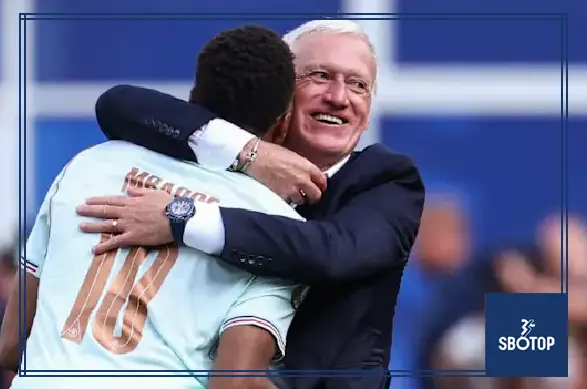
France’s convincing passage into the 2026 World Cup semi-finals was accompanied by an uncomfortable sight that briefly overshadowed another decisive performance from Kylian Mbappé.
The France captain scored, helped create another goal and inspired Les Bleus to a 2-0 quarter-final victory over Morocco. However, he was unable to complete the match after experiencing discomfort in his right ankle.
Mbappé went down without an obvious collision during the second half and received attention from France’s medical staff. Didier Deschamps replaced him with Jean-Philippe Mateta in the 77th minute, after which the Real Madrid forward was seen on the substitutes’ bench with ice wrapped around the affected area.
Deschamps confirmed after the final whistle that Mbappé had felt some pain in his ankle. The France coach described the substitution as a precaution rather than evidence of a serious injury, but the sight of his most influential attacker leaving a World Cup knockout match naturally created concern.
Mbappé later attempted to calm those fears, explaining that he had taken a knock but felt fine. His comments suggested that France expect him to be available for the semi-final, although the national team’s medical staff will continue assessing him during the recovery period.
For a team chasing a third World Cup title and a third consecutive appearance in the final, even a minor concern involving Mbappé must be treated seriously.
Deschamps Refused to Take an Unnecessary Risk
Deschamps’ decision reflected the wider context of the match. France were already leading 2-0 when Mbappé indicated that he was uncomfortable. Morocco had offered little attacking threat, and Les Bleus appeared to have complete control of the quarter-final.
Keeping Mbappé on the pitch would have offered limited benefit.
France did not urgently require another goal, and the risk of worsening a possible ankle problem was greater than the value of allowing their captain to finish the match.
Deschamps therefore acted quickly.
The coach also substituted midfielder Manu Koné, who had suffered a blow to the knee and was experiencing physical discomfort. Deschamps explained that such problems were understandable because the matches were arriving rapidly and players had accumulated significant workloads.
Tournament management requires coaches to look beyond the immediate result.
A quarter-final must be won, but the players required for the semi-final and potential final must also be protected whenever the match situation allows it.
France had earned the opportunity to manage Mbappé’s minutes by establishing a two-goal advantage. Deschamps used that advantage sensibly.
Mbappé’s Ice Pack Created Immediate Anxiety
The image of Kylian Mbappé sitting with ice around his ankle rapidly became one of the main talking points after the game.
Ice is routinely used to reduce pain and swelling after a knock, so its presence does not automatically indicate a serious injury. Nevertheless, the visual carried additional importance because of the player involved and the stage of the tournament.
Mbappé is not simply one member of France’s attack.
He is the captain, leading goalscorer and most feared individual threat. His acceleration changes the positioning of opposing defences, while his ability to score from limited opportunities gives France an advantage even when their overall performance is imperfect.
Any injury affecting his ankle could influence his most important qualities.
A forward who depends on explosive changes of direction, rapid acceleration and powerful shooting requires complete confidence in his lower body. Even minor discomfort can affect the willingness to sprint, challenge for loose balls or attack a defender repeatedly.
The encouraging sign was Mbappé’s own reaction.
He did not speak as though he expected to miss the next match. Instead, he described the problem as a knock and suggested that Mateta was in better physical condition to complete the quarter-final at that moment.
An Eventful Night for France’s Captain
The injury concern arrived at the end of a match containing almost every possible emotion for Mbappé.
France were awarded a first-half penalty, giving their captain an early opportunity to open the scoring. Mbappé’s effort was saved by Morocco goalkeeper Yassine Bounou, creating a rare moment of failure for a player who has been so reliable throughout the tournament.
The miss did not damage his confidence.
Mbappé remained involved, continued attacking Morocco’s defensive line and eventually broke the deadlock in the 60th minute. He received possession near the left side of the penalty area and curled an accurate finish beyond Bounou.
Only six minutes later, Ousmane Dembélé scored France’s second goal after another dangerous attacking sequence involving Mbappé.
The rapid combination of goals ended Morocco’s resistance and ensured France would progress without requiring extra time.
Deschamps praised Mbappé’s response to the missed penalty.
The forward did not allow disappointment to affect the rest of his performance. He continued demanding possession and remained confident enough to take responsibility when the next opportunity arrived.
That reaction demonstrated why Deschamps views him as more than an exceptional goalscorer.
He is expected to set the emotional standard for the team.
Mbappé’s Tournament Has Reached Historic Levels
The goal against Morocco took Mbappé to eight at the 2026 World Cup, placing him level with Lionel Messi at the top of the scoring standings at that point in the tournament.
He had also contributed three assists, meaning he had been directly involved in 11 French goals. Such influence underlined how central he had become to the competition’s most productive attack.
The quarter-final also represented Mbappé’s 20th World Cup appearance.
At 27, he became the youngest player to reach that total and matched Hugo Lloris’ French record for appearances at the tournament. His goal against Morocco was also his 20th at World Cups, continuing a remarkable scoring record across the 2018, 2022 and 2026 editions.
Those numbers explain why any fitness doubt creates such anxiety.
France possess extraordinary attacking depth, but no replacement can reproduce Mbappé’s entire influence.
Dembélé, Michael Olise, Désiré Doué, Bradley Barcola and Mateta all offer quality. They can create, score and play across several positions.
Mbappé provides those qualities while also forcing opponents to build their entire defensive strategy around him.
France’s Attack Depends on the Fear Mbappé Creates
Mbappé’s value cannot be measured only through goals and assists.
His presence changes the space available to teammates.
Defenders are reluctant to move too far forward because they know he can attack the space behind them. Full-backs may avoid joining attacks because they fear leaving him isolated against a centre-back. Midfielders often position themselves deeper to block passes toward him.
Those adjustments create opportunities elsewhere.
Dembélé can receive with more room on the opposite side. Olise can move into central areas. France’s midfielders can advance because the opposition’s attention remains fixed on Mbappé.
Morocco’s cautious approach demonstrated the respect France’s forward line commands.
The Atlas Lions defended in a compact shape and attempted to deny space around their penalty area, but that strategy left them with little attacking presence. France remained patient, controlled midfield and eventually found the breakthrough.
Without Mbappé, future opponents could defend differently.
They might move their line higher, press France more aggressively and commit additional players to attack.
France would remain dangerous, but the psychological effect would change.
Deschamps Has Built Greater Attacking Depth
The positive news for France is that this team is less dependent on one player than some earlier versions.
Dembélé has become a reliable goalscorer and delivered the second goal against Morocco with a composed finish. His pace, dribbling and movement give France another attacker capable of deciding knockout matches.
Olise has added creativity between the lines, while Doué provides directness and technical quality. Barcola can stretch a defence from the left, and Mateta offers a more physical centre-forward profile.
France had scored a tournament-leading total before the Morocco match and increased that number to 16 with their quarter-final victory. Their attacking strength has been accompanied by improved defensive stability, including three consecutive clean sheets during the knockout phase.
That depth gives Deschamps options if Mbappé cannot train fully immediately.
He could reduce the captain’s workload, use him from the bench or alter the attacking structure during preparation.
However, depth should not be confused with complete replaceability.
France can survive without Mbappé for part of a match. Winning a World Cup semi-final without him would be a much more difficult challenge.
Medical Staff Must Monitor the Ankle Carefully
France’s medical team will focus on how the ankle responds after the match.
Some knocks appear minor immediately but become more painful once swelling develops. Others look concerning during the game but improve rapidly with rest and treatment.
The assessment will likely involve mobility, pain levels, swelling and Mbappé’s ability to run, turn and strike the ball normally.
The medical staff must also consider his recent workload.
Mbappé has played a central role throughout the tournament and entered the quarter-final after a physical round-of-16 contest against Paraguay. Deschamps had previously expressed concern about the aggressive treatment his captain received in that match, even instructing teammates to help protect him during the closing stages.
Repeated contact can gradually affect a player even when no single challenge causes a serious injury.
France cannot evaluate the Morocco incident in isolation. They must consider the accumulation of matches, tackles, sprinting and limited recovery time.
The Semifinal Offers Little Margin for Compromise
France’s next opponent will be the winner of Spain’s quarter-final against Belgium.
Either matchup would present a significantly greater challenge than Morocco managed.
Spain entered the latter stages with one of the strongest defensive records in the tournament and a possession structure capable of forcing opponents to spend long periods without the ball. Belgium, meanwhile, reached the quarter-finals after scoring four times against the United States.
France’s semi-final is scheduled for July 14, leaving only a short recovery window after the Morocco victory.
That timing increases the importance of every training decision.
Mbappé does not necessarily need to participate fully in the earliest recovery sessions. Deschamps can allow him to work separately, receive treatment and gradually test the ankle closer to the match.
The priority is not proving his fitness immediately.
It is ensuring that he can perform safely and effectively when the semi-final begins.
Also Read:








