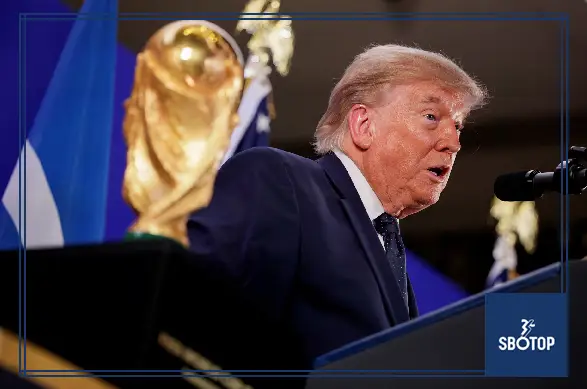
Donald Trump is preparing to take centre stage at the 2026 World Cup final after becoming one of the tournament’s most visible—and divisive—figures away from the pitch.
The United States president is expected to attend the championship match between Argentina and Spain at New York/New Jersey Stadium, where he will sit alongside FIFA President Gianni Infantino and participate in the trophy presentation. His appearance will place him at the heart of football’s biggest ceremony, concluding a tournament in which his administration, public statements and unusually close relationship with FIFA repeatedly generated international debate.
Trump has presented the World Cup as a major American success. Record attendances, crowded fan zones and worldwide television coverage allowed him to celebrate the United States as a country capable of staging football’s largest event. However, his involvement extended far beyond the ceremonial responsibilities normally associated with a host nation’s leader.
Questions about immigration, visa restrictions, security operations and political influence followed the tournament from its preparation phase to the final week. The most explosive controversy arrived when Trump personally asked Infantino to review a red card issued to United States striker Folarin Balogun. FIFA subsequently suspended the player’s automatic one-match ban, allowing him to face Belgium in the round of 16.
That intervention created a global argument about whether political power had entered a disciplinary process that was supposed to remain independent.
Trump insisted that he had merely requested a review of what he considered a poor refereeing decision. Critics saw something more troubling: a powerful political leader contacting FIFA’s president on behalf of his national team, followed by a decision that directly benefited that team.
As the World Cup reaches its conclusion, Trump is returning to its most visible stage. His presence at the final will be presented as part of the official celebration, but it will also remind viewers of the controversies that shaped the tournament beyond football.
From Host President to Central Character
Political leaders commonly appear at major sporting events. Presidents and prime ministers attend opening ceremonies, welcome visiting officials and congratulate champions. Their role is usually symbolic and carefully separated from events on the field. Donald Trump rarely operates as a background figure.
Throughout his political career, he has understood the value of major sporting occasions as platforms for visibility. Stadiums provide large audiences, powerful imagery and moments that can be presented as national celebrations. The World Cup offered all three on an unprecedented scale.
The 2026 tournament was awarded to the United States, Canada and Mexico in 2018, during Trump’s first presidential term. He has repeatedly claimed credit for helping bring the competition to North America and treated its successful organisation as part of his political record.
His second term placed him back in office when the tournament finally arrived. That gave him an opportunity few leaders receive: taking credit both for the original hosting decision and for the completed event eight years later.
Trump’s relationship with Infantino strengthened that position. The FIFA president has been a regular visitor to the White House, while the two men have publicly praised each other at official events. Before the final, Infantino thanked Trump for supporting the competition and credited him with helping make it successful.
For FIFA, cooperation with the United States government was essential. The tournament involved security planning, visas, customs procedures, transport and coordination across multiple levels of government. For Trump, close association with FIFA provided access to one of the world’s most valuable stages.
That relationship became politically useful but institutionally uncomfortable once the president intervened in a football disciplinary matter.
The Balogun Decision Changes the Tournament
Balogun was sent off during the United States’ victory over Bosnia and Herzegovina after a video review of his tackle on Tarik Muharemovic. Under the normal tournament process, a direct red card resulted in an automatic suspension for the next match.
That should have ruled the striker out of the United States’ round-of-16 meeting with Belgium.
Instead, the case took an extraordinary turn. Trump contacted Infantino and asked FIFA to examine the incident. FIFA later announced that the implementation of Balogun’s suspension would be delayed under a provision allowing disciplinary sanctions to be suspended for a probationary period.
The red card itself was not removed, but Balogun was permitted to play.
Trump publicly welcomed the outcome and described the original punishment as an injustice. United States players and coach Mauricio Pochettino also supported the decision, arguing that the challenge had not deserved such a severe consequence.
Belgium reacted very differently.
The Belgian football federation said it was astonished and argued that FIFA’s decision appeared inconsistent with regulations requiring players who receive red cards to miss their team’s next match. The federation examined its options while supporters and commentators questioned whether any other country could have secured a similar review.
The controversy quickly became larger than Balogun.
The central issue was no longer whether the referee had made the correct decision. Referees and video officials make controversial calls throughout every tournament. The larger question was why a national president had contacted FIFA about the eligibility of a player representing his country.
Even observers who considered the original red card harsh expressed discomfort with the process. A mistaken decision can be corrected through established appeal systems. Direct communication between a head of government and FIFA’s president creates a different impression, especially when the outcome benefits the host nation.
FIFA maintained that Trump did not determine the decision. Its disciplinary body had the authority to suspend the sanction, and previous cases had involved partially suspended bans.
Nevertheless, the sequence was politically damaging. Trump requested a review, FIFA granted unusual relief and Balogun became available for an important knockout match. The appearance of influence was almost impossible to avoid.
Questions About FIFA’s Independence
Football’s governing body has long insisted that national associations must remain free from government interference. FIFA has suspended federations when politicians have attempted to control appointments, elections or team management.
The Balogun controversy therefore raised an obvious question: Would FIFA have reacted the same way if the intervention had come from a less powerful country?
There is no definitive way to answer that question. FIFA possessed the legal discretion to suspend the ban, and the organisation denied that political pressure determined the outcome.
However, institutional independence depends on more than technical legality. It also depends on confidence that rules are applied consistently.
Belgium’s complaint focused on that consistency. Other players had served automatic suspensions during the tournament, while Balogun received immediate relief after Trump became involved. The decision encouraged the belief that access to FIFA’s leadership could matter as much as access to its formal legal procedures.
The controversy later led to calls for an investigation into Infantino’s conduct and FIFA’s political neutrality. The International Olympic Committee received a complaint concerning the FIFA president’s role, while wider criticism emerged from European officials concerned about governance and sporting integrity.
Even without evidence that Trump directly ordered the reversal, the incident demonstrated the risks created by an overly close relationship between a sports administrator and a powerful political leader.
Infantino needed government cooperation to deliver the tournament. Trump valued the visibility FIFA provided. Once a sporting dispute entered that relationship, the boundary between partnership and influence became difficult to identify.
Immigration Policies Cast an Early Shadow
The Balogun case was the tournament’s most dramatic political controversy, but concerns surrounding Trump’s World Cup role had existed long before the first match.
Rights organisations warned that the administration’s immigration crackdown, travel restrictions and deportation operations could discourage international supporters from travelling to the United States. Fan groups reported difficulties affecting ticket holders from several participating countries, while some visitors remained uncertain about whether valid match tickets would improve their chances of receiving visas.
The administration defended its approach by arguing that national security remained the priority. Trump said officials were working to admit appropriate visitors while preventing people considered security risks from entering the country. Homeland Security officials also said they had coordinated with FIFA but would not discuss individual visa cases.
That position reflected the government’s legal authority. Hosting a sporting event did not remove the United States’ power to enforce immigration law or screen international arrivals.
Yet the practical result created tension with FIFA’s promise of a welcoming global competition.
Teams from countries affected by restrictions could qualify for the World Cup while their supporters struggled to attend. Rights groups argued that inclusion could not be measured only by the number of nations on the pitch. Fans, journalists, workers and officials also needed meaningful access.
The administration later dropped a proposed bond requirement for certain ticket holders registered through a special visa system. The adjustment reduced one potential financial barrier, but concerns remained over delays, denials and the possible presence of immigration-enforcement officers around tournament sites.
For Trump’s supporters, strict screening demonstrated responsible management of a major international event. For critics, it showed how the tournament’s message of unity was limited by domestic political priorities.
Threats to Move Matches Raise Further Alarm
Trump also generated controversy before the tournament by suggesting that matches could be moved away from cities he considered unsafe.
Boston became one of the most prominent examples. Trump criticised the city’s political leadership and indicated that he might support relocating scheduled World Cup matches if security conditions failed to meet his expectations.
FIFA responded that decisions over match locations belonged to football’s governing body rather than the United States president.
The exchange highlighted another institutional boundary. The federal government had enormous influence over security and logistics, but host-city agreements remained part of FIFA’s tournament structure. Allowing political disagreement with a local mayor to threaten match assignments would have undermined the predictability required to organise a global event.
No major relocation followed the threat, but the comments contributed to the impression that Trump viewed the World Cup partly through the lens of domestic political conflict.
Host cities led by Democrats feared becoming targets of presidential criticism. Local officials had to prepare for millions of visitors while managing the possibility that political disputes could become attached to tournament operations.
For FIFA, the comments created an additional challenge. The organisation needed Trump’s administration as a partner but also had to demonstrate that tournament decisions were not controlled by the White House.
Canada and Mexico Remain Part of the Story
The World Cup was officially a three-country event, with Canada and Mexico sharing hosting responsibilities with the United States.
However, Trump’s language often placed America at the centre of the success.
At a reception before the final, he suggested that the United States should host the competition again and joked that a future edition could exclude Canada and Mexico. The comment reflected his preference for presenting the tournament as an American achievement, even though the original bid depended on regional cooperation.
That attitude carried additional political meaning because Trump’s relationship with both neighbours had included disagreements over trade, tariffs, borders and foreign policy.
Football offered a temporary image of partnership. Supporters travelled between the three countries, national leaders attended major ceremonies and the tournament branding emphasised North American unity.
Trump’s comments complicated that image. They were consistent with his “America First” approach, but they also risked minimising the contributions of the other hosts.
Canada and Mexico provided venues, infrastructure, supporters and political cooperation. Their participation helped make the bid attractive by distributing matches across a large and commercially powerful region.
A future United States-only World Cup remains hypothetical. Still, Trump’s statement showed that he was already looking beyond 2026 and considering how another tournament could serve American prestige.
Also Read: