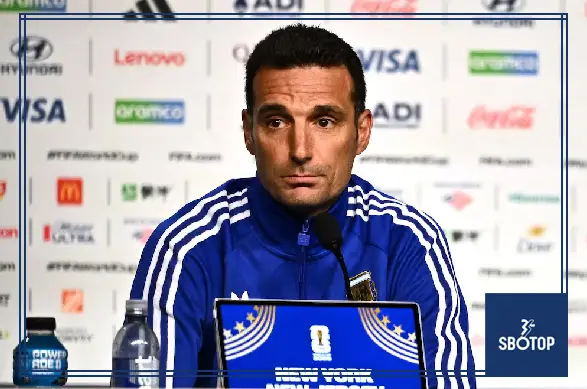
Argentina have already experienced the ultimate celebration in international football, but Lionel Scaloni insists that winning the World Cup once has not reduced his team’s desire to do it again.
Ahead of the 2026 final against Spain, the Argentina coach explained that the extraordinary passion shown by the country’s supporters continues to inspire his players. The defending champions are not competing only to add another trophy to their collection. They are carrying the hopes of families, communities and millions of fans who treat every national-team match as a deeply personal occasion.
Scaloni said seeing Argentines celebrate together makes it impossible for the squad to become emotionally detached from what is at stake. Domestic rivalries are temporarily forgotten, streets fill with blue-and-white shirts and supporters who may disagree about almost everything else embrace when the national team scores. That collective joy, he believes, gives the players a powerful reason to keep fighting even after achieving the greatest success of their careers.
Argentina will face European champions Spain in New York/New Jersey with the opportunity to become the first country since Brazil in 1962 to retain the men’s World Cup. It would be Argentina’s fourth world title and another defining achievement for a generation that has already transformed the nation’s recent football history.
Success Has Not Reduced Argentina’s Hunger
One of the most difficult challenges facing a champion is maintaining the same level of desire after reaching the summit. Before the 2026 tournament began, some observers questioned whether Argentina could reproduce the emotional intensity that drove them to victory in Qatar four years earlier. The players had already experienced the parade, lifted the trophy and ended the country’s long wait for another world championship. Several members of Scaloni’s squad had also won major South American honours, giving them little left to prove.
Argentina’s performances throughout the knockout rounds have answered those doubts.
Scaloni’s side repeatedly found itself under pressure, yet responded with the determination of a team still chasing its first title. Argentina required extra time to overcome Cape Verde and Switzerland, recovered from two goals behind to defeat Egypt and then produced another dramatic comeback against England in the semifinal. Trailing after Anthony Gordon’s second-half goal, Argentina equalised through Enzo Fernández before Lautaro Martínez scored the stoppage-time winner that sent the defending champions into another final.
The route has not been smooth, but that may have strengthened Argentina’s belief.
Scaloni has said his team often produces its best football when circumstances become difficult. Rather than being paralysed by pressure, the players appear to become more aggressive and emotionally united. They continue demanding the ball, attacking loose spaces and trusting one another even when elimination is only minutes away.
That mentality suggests their competitive hunger survived the celebrations of 2022.
The trophy may already be part of their history, but the supporters have made the possibility of winning it again feel urgent and new.
Argentina Play for More Than Their Own Careers
Scaloni’s explanation of the team’s motivation was rooted less in professional ambition than emotional responsibility. The Argentina coach described players representing their country, their families and the people watching from home. He pointed to the unusual scenes created by national-team football, when supporters of fierce domestic rivals such as Boca Juniors and River Plate temporarily put aside their differences to celebrate together.
That image captures something central to Argentina’s football culture.
Club loyalties in the country are intense and often inherited through generations. Boca and River represent one of the world’s most famous rivalries, while clubs across Buenos Aires and the provinces inspire equally devoted local followings. On an ordinary weekend, those identities separate supporters.
When Argentina play at a World Cup, however, the national shirt becomes the shared symbol.
Fans who would never celebrate a rival club’s goal stand together before giant screens. Families arrange their schedules around kickoff times. Schools, offices and neighbourhood businesses become unofficial viewing areas. The country’s political and social disagreements do not disappear, but for 90 minutes they can become less important than the result of a football match.
The players see those reactions through videos, messages and images from home. They understand that their performance influences the mood of an entire country.
For Scaloni, that connection explains why previous success has not created complacency. The squad may already possess winners’ medals, but the happiness of the supporters remains a renewable source of motivation.
Every tournament creates a new group of children watching their first World Cup. Every victory allows older supporters to reconnect with memories of Diego Maradona, Mario Kempes or the champions of 1978, 1986 and 2022.
Argentina’s players are not simply defending a title. They are extending a national story.
Buenos Aires Shows the Power of the National Team
The scenes following Argentina’s semifinal victory over England demonstrated exactly what Scaloni meant.
Tens of thousands of supporters poured into the streets of Buenos Aires despite the winter rain. Fans gathered around the Obelisk, climbed traffic lights, waved flags, sounded car horns and sang long after Lautaro Martínez’s late winner had secured Argentina’s place in the final. Some supporters cried, while strangers embraced and danced together in the city centre.
The celebration was about reaching another final, but it also reflected the broader emotional role the national team plays.
Argentina has endured repeated periods of economic difficulty and political division. In that environment, football offers a rare form of collective release. The victory does not solve everyday problems, but it creates a temporary space in which people from different backgrounds can share the same emotion.
Supporters interviewed during the celebrations spoke about the pride, relief and unity generated by the team. Parents brought children into the crowds, young fans wore Lionel Messi shirts and older generations connected the latest victory with Argentina’s football history.
Goalkeeper Emiliano Martínez said the players were aware that supporters had been celebrating in the early hours during Argentina’s cold winter. He described the country’s fans as different from those elsewhere because of the intensity with which they experience the tournament, and promised that the squad would do everything possible to return home with the trophy.
For players competing thousands of kilometres away, those images bring the scale of the occasion into focus.
A training session may be tactical and controlled. A press conference may emphasise calmness. Inside the stadium, however, the players know every challenge and every shot is being experienced simultaneously in homes and public squares across Argentina.
That awareness creates pressure, but it can also provide energy.
Scaloni Has Built a Team That Understands Suffering
Argentina’s relationship with its supporters is strengthened by the way the team competes.
Scaloni’s squad does not always dominate opponents from the opening whistle. Its identity has increasingly been defined by patience, sacrifice and the willingness to survive difficult periods.
The comeback against England was the clearest example. Argentina were behind with only minutes remaining, but the players continued attacking rather than allowing fear to control their decisions. Scaloni praised their courage, describing a group that still wanted possession when the consequences of making a mistake were enormous.
He has repeatedly characterised the squad as a family.
That description is more than sentimental language. Argentina’s players cover space for one another, defend collectively and react aggressively when a teammate loses the ball. Substitutes celebrate with the same intensity as starters, while experienced figures help younger players manage the pressure surrounding the team.
The squad also appears comfortable with emotional matches.
Scaloni has suggested that adversity activates something within his players. When opponents hesitate, Argentina sense an opportunity and increase their intensity. The team can shift from uncertainty to aggression in a matter of moments, often changing matches through emotional momentum as much as tactical adjustment.
That quality mirrors the supporters.
Argentina’s fans rarely watch quietly. They sing through setbacks, react dramatically to refereeing decisions and attempt to push the team forward. The emotional temperature in the stands becomes part of the contest.
The relationship works in both directions: the fans inspire the players, and the players’ refusal to surrender gives the fans another reason to believe.
Messi’s Presence Adds Greater Meaning
The final against Spain may also represent Lionel Messi’s last appearance at a World Cup.
Scaloni has avoided confirming whether the 39-year-old captain will continue, joking that he cannot know what Messi will decide. What the coach has emphasised is the extraordinary nature of Messi reaching another final while still competing at the highest level.
Messi’s presence makes Argentina’s pursuit especially emotional.
For much of his international career, the forward carried enormous pressure. His performances were constantly compared with Maradona, and defeats in major finals created criticism despite his remarkable individual record. The relationship between Messi and Argentina changed after the team began winning under Scaloni.
Success in the Copa América removed one burden. The 2022 World Cup transformed him into a national champion whose commitment could no longer reasonably be questioned.
The 2026 campaign has extended that connection.
At 39, Messi has adapted his game. He may not press or sprint as frequently as he did earlier in his career, but his awareness, passing and ability to control decisive moments remain central to Argentina’s attack. Scaloni has urged people to appreciate the difficulty of maintaining such a level at that age, regardless of the result in the final.
For supporters, another title would offer the ideal conclusion to Messi’s World Cup journey.
For his teammates, it creates another source of motivation. Many grew up watching him and later became part of the side that helped him lift the trophy. They now have an opportunity to protect the title and give their captain another historic achievement.
Yet Scaloni has worked carefully to ensure Argentina are not defined by one player alone.
Messi remains their creative reference point, but the team’s strength comes from its collective structure. Martínez provides personality in goal, the defence accepts physical responsibility, midfielders such as Fernández and Alexis Mac Allister supply intensity, and forwards like Lautaro can decide matches from the bench or starting lineup.
Argentina play with Messi, but they also play for one another.
Martínez Enjoys a Different World Cup Experience
Emiliano Martínez said he has enjoyed the 2026 tournament more than Argentina’s successful campaign in Qatar.
That may seem surprising, given that the 2022 competition ended with the goalkeeper becoming a world champion. However, Argentina began that tournament with a shocking 2-1 defeat by Saudi Arabia, creating immediate tension and the possibility of an early exit. Martínez recalled the emotional pain surrounding that opening setback.
The current campaign has also involved difficult moments, but Argentina entered it with greater certainty.
The squad knows it can survive pressure. Several players have already won major finals together. Even when behind, they possess evidence that recovery is possible.
Martínez embodies that confidence.
His penalty-saving reputation and willingness to use psychological tactics have made him one of international football’s most recognisable goalkeepers. His behaviour can divide opinion, but Argentina’s supporters value his fearlessness and emotional commitment.
Like Scaloni, Martínez speaks about the fans as a source of responsibility.
His promise to do everything possible to return the trophy reflects a squad that understands how seriously its supporters take the competition. The players do not dismiss that intensity as excessive. They embrace it as part of the national team’s identity.
Also Read: