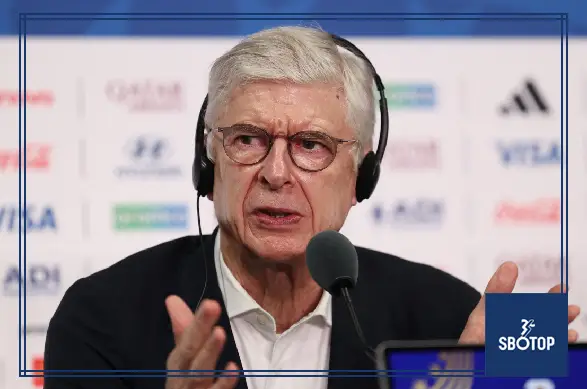
Arsène Wenger believes the mandatory hydration breaks used throughout the 2026 World Cup did not change match results, but FIFA has not yet decided whether the controversial pauses should remain part of future competitions.
The former Arsenal manager, now FIFA’s Chief of Global Football Development, said the organisation would conduct a detailed post-tournament review before reaching a conclusion. Every World Cup match included a three-minute stoppage midway through each half, regardless of the temperature, location, kickoff time or stadium conditions. The policy was intended to protect players and ensure all teams competed under the same rules.
The breaks quickly became one of the tournament’s most debated innovations.
Medical experts and some coaches supported the opportunity for players to drink, cool their bodies and recover during demanding summer conditions. Others argued that the pauses interrupted momentum, handed coaches an additional tactical timeout and divided football into four quarters.
Broadcasters also gained predictable windows in which advertisements could be shown, creating suspicion among supporters who believed commercial interests had influenced a policy officially presented as a player-welfare measure.
Wenger rejected the idea that the breaks had materially affected the competition. He said he had not observed evidence that they changed results or damaged the overall flow of matches. However, he acknowledged that not everyone enjoyed the interruptions and accepted that FIFA must listen to the people who watch football.
That review will need to answer a difficult question: Can FIFA protect players from extreme heat without unnecessarily changing the rhythm and identity of the sport?
A Rule Designed for an Unpredictable Tournament
The 2026 World Cup presented an unusual environmental challenge.
The competition was staged across the United States, Canada and Mexico, with venues separated by enormous geographical distances. Players encountered hot and humid conditions in some cities, cooler weather in others and climate-controlled environments inside covered stadiums.
FIFA decided against applying hydration breaks only when a specific temperature threshold was reached. Instead, it required the same stoppages in every match to maintain consistency.
The pauses generally occurred around the 22nd minute of each half, effectively dividing matches into four sections. That approach removed uncertainty for teams, officials and broadcasters. Coaches knew in advance that they would have two opportunities to gather their players, while medical staff could plan hydration and cooling strategies around fixed moments.
FIFA’s argument was based partly on fairness.
If one match received a break because conditions were slightly hotter while another did not, the teams in the first fixture would gain an additional tactical opportunity. Coaches could reorganise defensive structures, alter pressing instructions or address weaknesses without waiting for halftime.
By making the breaks universal, FIFA ensured that every team received the same formal opportunity.
The difficulty was that environmental conditions were not universal.
A match played under severe heat and humidity created an obvious medical reason for stopping. A night fixture in Canada or a game inside a covered, air-conditioned stadium did not always present the same risk. Players and supporters therefore questioned why identical treatment was necessary when the circumstances were completely different.
Wenger admitted that the breaks were medically valuable in many games but less popular in cooler or covered venues. FIFA’s review must now determine whether consistency is more important than flexibility.
The Health Argument Remains Powerful
Whatever criticism FIFA received, the player-safety case cannot be dismissed.
Elite football places significant physical demands on athletes. Players repeatedly sprint, change direction, jump, challenge for the ball and cover large distances over at least 90 minutes. Heat and humidity increase thermal strain because the body must work harder to regulate its temperature.
Sweating helps release heat, but it also causes fluid and electrolyte loss. When environmental conditions make evaporation less effective, the body’s internal temperature can continue rising even when a player is drinking regularly.
International sports-medicine guidance supports the use of cooling opportunities when athletes compete in severe heat. Consensus recommendations have highlighted the importance of heat acclimatisation, hydration, monitoring environmental conditions and providing scheduled opportunities for cooling during competition.
The issue became especially urgent after the 2025 Club World Cup in the United States, where high temperatures and oppressive humidity generated serious concerns among players, coaches and spectators. FIFA’s universal-break policy for 2026 was developed partly in response to that experience.
Some medical specialists argued that the World Cup’s three-minute pauses were not long enough. Douglas Casa of the Korey Stringer Institute said effective hydration and cooling would require at least five or six minutes, particularly when players needed more than a quick drink.
That criticism placed FIFA in an awkward position.
To traditionalists, three minutes felt too disruptive. To some heat-safety experts, the same three minutes were insufficient.
The organisation therefore faced pressure from opposite directions: shorten or remove the breaks to protect football’s flow, or extend them to make the health intervention more effective.
Players Did Not Speak with One Voice
Reaction from players was divided throughout the tournament.
Netherlands captain Virgil van Dijk supported hydration opportunities when conditions were genuinely hot but questioned their use in every match. He also criticised broadcasters cutting away to advertisements, suggesting that neutral viewers did not benefit from repeatedly leaving the live action.
Belgium midfielder Youri Tielemans recognised both sides of the argument. He noted that some host cities were not particularly hot, but also understood FIFA’s desire to treat every participant equally.
That tension appeared repeatedly in interviews.
Players wanted protection when conditions became dangerous, but many did not want unnecessary stoppages imposed during comfortable matches. A conditional system seemed more logical from a medical perspective, while the universal model appeared simpler from a competitive and operational perspective.
The experience of the tournament may also have varied by playing position.
Midfielders and full-backs covering large distances could benefit from a scheduled recovery period. Goalkeepers and central defenders might experience a different physical load. Substitutes, meanwhile, could enter after a break with tactical information that changed their role.
Individual tolerance to heat also differs. Players accustomed to competing in warm climates may respond differently from those based in cooler environments. Acclimatisation, fitness, body composition, recent workload and medical history can all influence how an athlete handles thermal stress.
A single rule can create equal timing, but it cannot create identical physical effects.
Coaches Discovered a Tactical Tool
The hydration pauses were officially introduced for welfare reasons, yet coaches immediately recognised their tactical value.
Belgium coach Rudi Garcia described them as coaching breaks as much as cooling breaks. Didier Deschamps also acknowledged that the stoppages allowed managers to communicate with players and adjust details before play resumed.
This changed the traditional structure of a football match.
Ordinarily, coaches can deliver detailed instructions before kickoff and at halftime. During play, communication is limited by crowd noise, distance and the speed of events. Tactical changes must often be communicated through brief gestures, shouted messages or substitutions.
A planned three-minute stoppage allows the entire team to gather around the technical staff. Coaches can use video information, clarify pressing triggers, change marking assignments or correct positioning.
For some managers, that represents a useful evolution. Modern football is already highly analytical, and teams regularly adjust their shape during matches. Giving coaches a short opportunity to explain those changes could improve tactical quality.
For critics, however, the pauses reduce the continuous problem-solving that makes football distinctive.
Players traditionally have to respond to shifting momentum while the game is moving. Captains and experienced teammates must recognise problems without waiting for direct intervention from the bench. A team enjoying a dominant spell can build pressure over several minutes, forcing an opponent to make decisions under stress.
A scheduled break can release that pressure.
Thomas Tuchel said the interruptions had a greater effect than expected and could break the moment of a match. Marcelo Bielsa was even more critical, arguing that dividing football into shorter segments damaged an essential part of the sport’s culture.
Their concern was not simply nostalgia. Momentum can influence tactical confidence, crowd energy and player decision-making. A team that is struggling may welcome the pause, while the side dominating possession may experience it as an unwanted interruption.
Can Anyone Prove the Breaks Changed Nothing
Wenger’s conclusion that hydration breaks did not alter results is understandable, but proving that claim is difficult.
There is no parallel version of the tournament in which the same matches were played without the pauses. FIFA cannot directly compare the two realities.
A team may have won 2-0 with hydration breaks and might also have won 2-0 without them. It might have won by a larger margin, conceded a goal or lost control of the match. None of those alternatives can be observed.
One frequently discussed example came during Curaçao’s group match against Germany. Curaçao equalised in the 21st minute, only for a hydration break to arrive shortly afterwards. Germany used the interruption to regroup before eventually winning 7-1.
That sequence does not prove that the break determined the result. Germany may have recovered regardless, and the eventual margin reflected a much larger difference than one short interruption.
Still, such moments illustrate why critics believe the breaks can influence matches.
A credible review should therefore examine more than final scores.
FIFA can study possession, shots, expected goals, pressing intensity and scoring patterns immediately before and after each pause. Analysts can compare whether teams under pressure improved after receiving tactical instructions or whether dominant sides became less effective following the restart.
The organisation should also examine physical data. Player-tracking information could reveal whether sprint frequency, high-intensity running and technical accuracy improved after the breaks. Medical records could show whether the policy reduced heat-related symptoms, cramps or emergency interventions.
Wenger may ultimately be correct that the breaks did not materially change the tournament. The strongest support for that conclusion, however, must come from evidence rather than observation alone.
Commercial Suspicion Damaged Public Trust
The commercial aspect became one of the largest sources of resentment.
Broadcasters were permitted to show advertisements shortly after each break began, provided they returned before play restarted. Some networks chose not to use the opportunity, instead continuing to show players receiving drinks and instructions. Others treated the pauses as regular commercial windows.
This distinction mattered to viewers.
Supporters watching the teams remain on screen could see the medical and tactical purpose of the stoppage. Those immediately shown advertisements were more likely to interpret the break as a commercial timeout imported from American sport.
FIFA President Gianni Infantino denied that revenue motivated the policy. He said FIFA’s commercial agreements had been completed before the breaks were introduced and that the governing body received no additional income from the advertising windows. According to Infantino, the decision was purely sporting and focused on heat, recovery and equal conditions.
That explanation did not eliminate suspicion because broadcasters clearly possessed a valuable new advertising opportunity.
The difference between FIFA earning additional money and its media partners benefiting commercially may not feel important to viewers. From their perspective, the game stopped and commercials appeared.
Future implementation will require greater transparency.
FIFA should clearly explain when advertisements may be shown, how much live footage viewers will miss and whether commercial considerations play any role in scheduling. It could also require broadcasters to keep the match visible through split-screen coverage, allowing audiences to watch coaching discussions and player recovery while advertisements are displayed elsewhere on screen.
Protecting trust is almost as important as protecting players. A safety policy loses credibility when supporters believe health language is being used to disguise commercial expansion.
Also Read: