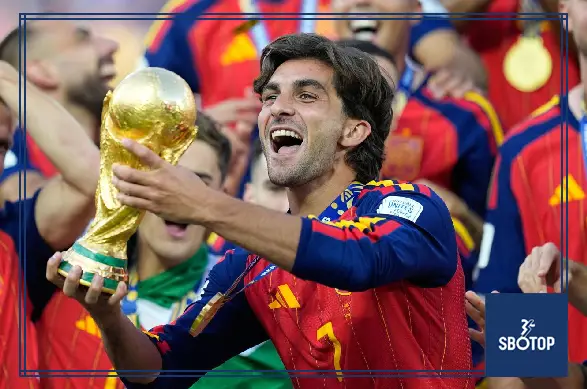
Spain are champions of the world once again. Sixteen years after Andrés Iniesta’s unforgettable strike in Johannesburg delivered the country’s first global title, Ferran Torres produced another extra-time moment of magic to defeat Argentina 1-0 and place La Roja back at the summit of international football.
The 2026 FIFA World Cup final at New York New Jersey Stadium was not a free-flowing classic filled with goals, but it became a powerful demonstration of Spain’s patience, technical control and collective belief. Argentina defended with determination, Emiliano Martínez delivered an extraordinary goalkeeping performance, and Lionel Messi searched for one last decisive contribution. Yet Spain refused to lose faith in their football. Their reward arrived in the 106th minute, when Torres attacked a loose ball inside the penalty area and drove a fierce left-footed finish beyond Martínez.
That single strike gave Spain their second men’s World Cup crown, following their historic triumph in 2010. It also completed an exceptional era under Luis de la Fuente, whose side added the world title to the European Championship they won in 2024. Spain imposed a clear identity, remained unbeaten, and conceded only one goal across eight matches.
A Final Filled With History
The occasion carried enormous emotional weight for both teams. Spain entered the final attempting to confirm their return as the dominant force in international football. Argentina arrived as defending champions, hoping to become the first nation since Brazil in 1962 to win consecutive World Cups.
Much of the attention naturally surrounded Messi. At 39, the Argentina captain was widely expected to be making his final World Cup appearance. Four years earlier, he had lifted the trophy in Qatar and completed the defining achievement of his career. In New Jersey, he had the opportunity to produce an even more remarkable ending by leading Argentina to another title.
Spain, however, were not interested in becoming supporting characters in Messi’s farewell story. They controlled possession, pressed intelligently and repeatedly forced Argentina deeper toward their own penalty area. Messi found little room between Spain’s midfield and defensive lines, while Argentina’s forwards were isolated for long periods.
Spain recorded the first 20 attempts of the match before Argentina finally created one in the second half of extra time. Argentina ended the game without a shot on target, while Martínez was required to make a World Cup final-record number of saves to keep his team alive.
Spain Take Control From the Opening Minutes
Spain established their rhythm almost immediately. Rodri dictated the tempo from midfield, offering a safe passing option whenever Argentina attempted to close down the ball. Fabián Ruiz moved intelligently between the lines, while the full-backs pushed forward to create width.
Lamine Yamal registered the first effort on target in the fifth minute, signalling Spain’s intention to attack rather than approach the occasion cautiously. Argentina remained disciplined and tried to interrupt Spain’s combinations with physical pressure, but they struggled to build sustained possession of their own.
Mikel Oyarzabal tested Martínez later in the first half, although his effort was directed too close to the goalkeeper. The pattern continued after the interval. Spain circulated the ball from side to side, waited for spaces to appear and then accelerated through Yamal, Pedro Porro and the advancing midfielders.
Argentina’s defensive organisation deserved respect. Nicolás Otamendi and his teammates protected the central areas, blocked shooting lanes and repeatedly cleared dangerous deliveries. Nevertheless, every clearance seemed to return the ball to Spain. La Roja’s counter-press prevented Argentina from escaping, and Messi was often forced to receive possession far from Unai Simón’s goal.
Emiliano Martínez Keeps Argentina Alive
Had Argentina found a way to win the final, Martínez would have been remembered as the central figure. The goalkeeper produced one of the finest individual displays of the tournament, denying Spain again and again as the pressure intensified.
In the 77th minute, Spain created another dangerous sequence, but efforts involving Pedro and Pau Cubarsí were stopped. During added time, Yamal curled a threatening attempt toward goal, only for Martínez to intervene once more. The save preserved Argentina’s hopes and forced the match into extra time.
Enzo Fernández’s Red Card Changes the Contest
Argentina’s task became even more difficult near the end of normal time. Enzo Fernández, already booked, received a second yellow card following a reckless challenge on Cubarsí in the 93rd minute.
The dismissal reduced Argentina to ten players just as fatigue was affecting both teams. Lionel Scaloni’s side responded by retreating deeper, sacrificing attacking ambition to protect the penalty area and reach a shootout.
Spain sensed the opportunity. De la Fuente introduced fresh energy from the bench, including Torres and Nico Williams. The substitutions gave La Roja greater speed, directness and movement against tired defenders.
Early in extra time, Williams appeared to have broken the deadlock, but the goal was disallowed because Mikel Merino had fouled Otamendi during the build-up. It was another painful setback for Spain and another reason for Argentina to believe the night might belong to them.
Ferran Torres Seizes His Moment
The decisive attack arrived seconds into the second period of extra time. Pedro Porro delivered a deep cross toward the far side of the penalty area. Williams met it and guided the ball back into a dangerous central position.
The ball bounced invitingly. Torres reacted first.
The forward surged toward it and struck with his left foot, sending a powerful effort beneath the crossbar before Martínez could set himself. After spending the entire evening denying Spain, the Argentina goalkeeper was finally beaten.
Torres sprinted toward the corner, overwhelmed by the magnitude of the moment. His teammates rushed after him from every direction. The substitutes poured from the bench, and Spain’s supporters erupted as they realised they had witnessed the goal that could win the World Cup.
It was Spain’s 20th attempt of the final and Torres’ first goal of the tournament. The timing made it priceless. He became the latest Spanish player to turn an extra-time World Cup final into a national memory, following the path created by Iniesta in 2010.
Torres’ contribution also represented the strength of Spain’s squad. He had started the match on the bench, as had Williams. Together, the two substitutes created the winning goal, demonstrating the importance of De la Fuente’s decisions and the depth available to the champions.
For Torres personally, the moment carried an additional sense of redemption. He had experienced near misses earlier in the tournament and faced criticism over his finishing. In the biggest match of all, he responded with the most important goal of his international career.
Argentina’s Final Push Falls Short
Argentina had little choice but to attack after falling behind. Even with ten players, they pushed bodies forward and attempted to create one final opening for Messi or one of the substitutes.
Spain briefly thought they had scored again when Torres found the net in the 114th minute, but the effort was ruled out for offside. That decision gave Argentina one last chance to force penalties.
Their best opportunity arrived in added time. Messi delivered a corner that eventually fell toward Giuliano Simeone, but the substitute sent his attempt over the crossbar. He immediately placed his hands on his head, aware that Argentina’s final opportunity had disappeared.
Moments later, the final whistle confirmed Spain as world champions. Their players collapsed, embraced and celebrated, while Argentina were left to process the end of their title defence. Messi walked away in tears after a match in which Spain’s organisation denied him the space required to shape the contest.
A Triumph Built on Collective Strength
Spain’s victory was not defined solely by Torres’ finish. It was the conclusion of a tournament built on tactical discipline, squad depth and shared responsibility.
Rodri provided leadership and control in midfield throughout the competition. Unai Simón operated behind the tournament’s strongest defence. Cubarsí emerged as one of the outstanding young players of the World Cup, while Yamal showed remarkable maturity on the sport’s biggest stage.
The contributions came from across the squad. Seven different players scored for Spain during the tournament, underlining their ability to succeed without depending on one superstar. Even in the final, the decisive action came from two substitutes.
Spain’s defensive performance was equally impressive. They conceded only once in eight matches, establishing a new benchmark for a World Cup-winning team. Their success was based not on passive defending but on controlling matches through possession, pressing and intelligent positioning. Opponents found it difficult to create chances because Spain rarely allowed them to settle with the ball.
This was the clearest expression of De la Fuente’s philosophy. Spain played as a connected unit. Every player understood where to move, when to press and how to support the teammate in possession. Their technical quality remained essential, but their unity transformed that talent into a championship team.
Luis de la Fuente’s Remarkable Achievement
De la Fuente’s role in Spain’s resurgence cannot be overstated. He inherited a talented group carrying enormous expectations and turned them into winners at both continental and global level.
Spain’s Euro 2024 triumph demonstrated that the team had rediscovered its confidence. The World Cup victory confirmed that their success was not temporary. They adapted to different opponents, managed difficult moments and maintained their identity under pressure.
The coach trusted young players, remained loyal to footballers who had faced criticism and used his substitutes effectively. Torres’ winning goal became the ultimate reward for that belief.
At 65, De la Fuente became the oldest coach to lead a team to the men’s World Cup title. More importantly, he created an environment in which players appeared willing to fight for one another. Spain’s celebrations reflected a group that viewed success as a collective achievement.
Spain Return to the Top of World Football
The victory elevated Spain into the group of nations that have won the men’s World Cup more than once. Their first title in 2010 represented the peak of a legendary generation built around Xavi, Iniesta, Iker Casillas and Sergio Busquets. The 2026 triumph belongs to a different group with its own style, leaders and emerging stars.
There are clear connections between the two victories. Both finals were goalless after 90 minutes. Both were decided by a Barcelona player in the second period of extra time. Both showcased Spain’s determination to remain faithful to possession-based football when the pressure became overwhelming.
However, the current team is not simply copying the past. It plays with greater vertical speed, uses direct wingers more frequently and presses with tremendous intensity. Yamal and Williams offer explosive width, while Rodri gives the side control and defensive security.
Spain also achieved a unique place in football history by holding the men’s and women’s World Cup titles at the same time, following the women’s national team’s triumph in 2023. It is a remarkable symbol of the country’s influence across the modern game.
Also Read: