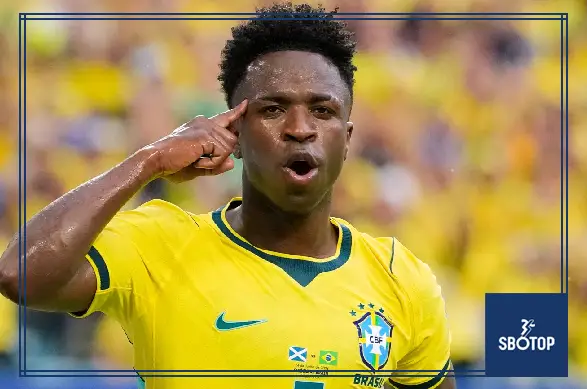
Arsenal are reportedly exploring the possibility of completing one of the most spectacular transfers in Premier League history by bringing Real Madrid forward Vinicius Junior to the Emirates Stadium.
The Brazil international has emerged as a potential option as Arsenal assess ways to strengthen the left side of their attack ahead of the new season. No formal offer has been announced, and reports indicate that there has not yet been official club-to-club contact. Nevertheless, Arsenal are understood to be examining whether a deal could become realistic if Vinicius decides against extending his Real Madrid contract.
Vinicius is entering the final year of his current agreement in Madrid, which is scheduled to expire in the summer of 2027. That contractual position has created uncertainty around one of world football’s most valuable attacking players.
Real Madrid remain interested in keeping him, while reports from Spain suggest that staying at the Santiago Bernabeu is still the player’s priority. However, discussions over salary, status and the direction of the club’s sporting project have not yet produced a publicly confirmed extension.
Arsenal’s interest therefore appears opportunistic rather than advanced. The Premier League champions are monitoring developments and considering whether circumstances could create an unexpected opening.
Any transfer would require an extraordinary financial commitment. Real Madrid would demand a substantial fee even with only one year remaining on the player’s contract, while Vinicius would expect wages reflecting his status as one of the world’s leading forwards.
Yet the fact that Arsenal are even considering such a move demonstrates the scale of their ambition. Signing Vinicius would not simply strengthen Mikel Arteta’s squad. It would change the profile of the club and send a powerful message throughout European football.
Arsenal Look for Greater Threat on the Left
Arsenal already possess one of Europe’s strongest squads, but the club continue to search for attacking improvements.
The right side of Arteta’s attack has often provided reliable creativity, direct running and goals. On the opposite flank, Arsenal have quality options, but the club appear interested in adding a forward capable of deciding the biggest matches through individual brilliance.
Vinicius fits that description.
He is naturally most dangerous from the left, where he can receive the ball close to the touchline before accelerating toward the penalty area. His speed forces defenders to retreat, while his close control allows him to change direction without losing momentum.
Unlike a conventional winger who remains outside the defensive block, Vinicius regularly moves into central areas. He can combine with a striker, attack the space between full-back and centre-back or make runs behind a high defensive line.
His arrival would give Arsenal a player capable of transforming a controlled possession sequence into a clear scoring chance within seconds.
Arteta’s team frequently face opponents who defend with large numbers behind the ball. Against those structures, careful passing is not always enough. Arsenal sometimes need an attacker who can eliminate a defender and create chaos without waiting for a perfect passing pattern to develop.
Vinicius would provide exactly that.
A Transfer That Would Transform Arsenal’s Attack
Signing Vinicius would potentially reshape Arsenal’s entire attacking structure.
Arteta could use him as a traditional left winger in a 4-3-3 formation, allowing him to isolate the opposition right-back. An overlapping full-back could then create two-against-one situations on the outside.
Alternatively, the full-back could move into midfield, leaving Vinicius with more space close to the touchline.
The Brazilian could also operate as a narrow forward. From there, he would make diagonal runs behind the defence while a central striker occupied the centre-backs.
His movement would provide Arsenal’s midfielders with another elite target for progressive passes. Martin Odegaard and the club’s deeper playmakers would have a forward capable of turning accurate distribution into immediate danger.
Vinicius would also create space for teammates.
Defenders rarely feel comfortable leaving him in a one-on-one situation. Opponents often send an additional player to cover the full-back, which creates openings elsewhere.
A midfielder could exploit the space outside the penalty area, while Arsenal’s striker would benefit from fewer defenders concentrating exclusively on the centre.
The Brazilian’s presence might therefore improve the output of the entire front line rather than simply adding his own goals and assists.
Vinicius Brings Elite-Level Experience
Arsenal are not considering an emerging prospect who may eventually become a world-class player. Vinicius has already influenced Champions League finals, major domestic matches and international tournaments.
He joined Real Madrid from Flamengo as a teenager and gradually developed from an exciting but inconsistent winger into one of the club’s most decisive attackers.
His speed was always obvious. The greatest improvement came in his composure and final decision-making.
Vinicius learned when to release the ball, when to continue dribbling and how to position himself inside the penalty area. That development turned him into a regular source of goals and assists.
He has also demonstrated the mentality required to perform under enormous scrutiny.
Real Madrid players are expected to win every competition. Poor performances receive immediate attention, while major European nights carry intense pressure.
Vinicius has repeatedly shown that he can handle those demands.
He was named FIFA’s Best Men’s Player in 2024 and finished as the runner-up in that year’s Ballon d’Or voting. He has also passed 100 goals for Real Madrid and established himself among the most productive Brazilian players in Champions League history.
Such experience would be valuable to an Arsenal side determined to maintain domestic dominance while pursuing the Champions League.
Why Real Madrid Might Consider a Sale
Real Madrid would not ordinarily want to lose a player of Vinicius’s quality. However, his contract situation may force the club to consider difficult options.
If no extension is agreed, the forward would be able to negotiate a pre-contract agreement with clubs outside Spain from January 2027.
Madrid would then risk losing an elite player without receiving a transfer fee the following summer.
That possibility strengthens the player’s negotiating position. It also means the club must decide whether to meet his demands, accept the risk of entering the final months of his contract or explore a sale during the current window.
Reports indicate that financial terms remain a major part of the discussion. Madrid are said to be willing to improve his salary significantly, but there has been disagreement over the complete package, including the possibility of a signing bonus.
The changing attacking structure at Madrid may also influence the conversation.
The arrival and central importance of Kylian Mbappe altered the hierarchy of the forward line. Vinicius remains highly influential, but both players are naturally dangerous when attacking from the left.
A successful team can accommodate multiple elite forwards, but role clarity is essential. Vinicius will want to understand how he fits into the next stage of Madrid’s project and whether he remains one of its central figures.
Spanish reporting nevertheless suggests that the Brazilian’s preference is still to renew and continue with Real Madrid. Arsenal’s opportunity may therefore depend on negotiations deteriorating rather than simply presenting an attractive offer.
The Financial Challenge for Arsenal
Even if Madrid became willing to negotiate, Arsenal would face a complicated financial operation.
Vinicius would command a major transfer fee. His salary would also place him among the highest-paid players in the Premier League.
The club would need to assess how such a contract would affect its wage structure.
Elite signings can improve a team, but they can also create internal pressure. Existing players may seek improved terms if one arrival earns substantially more than the rest of the squad.
Arsenal would have to ensure that the sporting benefits justified the financial consequences.
There may also be competition from other wealthy clubs. Only a limited number of teams can afford the transfer fee and wages associated with Vinicius, but those that can are among the most powerful in the world.
Saudi Arabian interest has previously been reported, while other Premier League clubs have monitored the player’s contract position.
Arsenal would therefore need more than financial strength. They would have to convince Vinicius that the Emirates offers the right sporting environment.
The club could present an attractive case.
Arsenal are competing for the biggest trophies, play in London and have a coach known for improving attacking players. Vinicius would also have the chance to become the central superstar of an ambitious team rather than one of several global names in Madrid.
Arteta Could Offer a Central Role
One of Arsenal’s strongest arguments could be the role Vinicius would receive.
At Real Madrid, he shares attacking responsibility with Mbappe, Jude Bellingham and other elite players. At Arsenal, he could become the defining figure on the left side and one of the principal faces of the club.
Arteta could build attacking patterns specifically around his strengths.
The Brazilian would receive freedom to attack defenders, exchange positions and move into central scoring areas.
Arsenal’s structure could also protect him from excessive defensive responsibilities.
Arteta expects every player to contribute without the ball, but the team’s organised press may allow Vinicius to use his energy more efficiently than in a disjointed defensive system.
He would still need to learn detailed pressing triggers and positional instructions. However, his speed makes him capable of closing defenders quickly when the collective structure is working.
The challenge would be balancing freedom and discipline.
Vinicius is most dangerous when allowed to express himself. Arteta, meanwhile, demands precise positioning and control.
The manager would need to preserve the Brazilian’s spontaneity without weakening Arsenal’s tactical organisation.
How Vinicius Could Fit with Arsenal’s Striker
The success of the transfer would partly depend on the striker operating beside Vinicius.
The Brazilian has often been most effective when playing with a forward who understands how to create space for him.
A striker who stays central can occupy defenders and leave a channel for Vinicius to attack. A more mobile number nine can rotate with him, dragging defenders away from their positions.
Arsenal would need to establish those relationships quickly.
Vinicius could provide low crosses and cutbacks after reaching the byline. He could also move into scoring positions when attacks develop from the right.
His off-ball movement has improved considerably during his time in Madrid. He no longer waits exclusively for the ball at his feet.
That variety would make Arsenal’s attack harder to predict.
Opponents could not simply block the passing route into midfield and expect the winger to remain outside. Vinicius would attack behind them, move across the defensive line and create opportunities from transitions.
Premier League Defenders Would Face a New Problem
The Premier League contains athletic and tactically intelligent defenders, but Vinicius would still present a unique challenge.
His acceleration is difficult to contain because he can reach maximum speed over a short distance.
A defender who moves too close risks being beaten by the first touch. A defender who leaves too much space allows Vinicius to gather speed and attack the penalty area.
Teams would probably defend him collectively.
The opposition winger might track Arsenal’s full-back, while a midfielder moved across to protect the right-back. That would reduce space around Vinicius but create opportunities elsewhere.
Arsenal would need to exploit those adjustments.
Quick switches of play could punish teams that concentrate too heavily on one side. Odegaard and the right winger could receive more space when opponents shift toward Vinicius.
His impact would therefore extend beyond individual duels.
Even when he did not receive the ball, the fear created by his speed could alter the positioning of the entire defensive block.
Arsenal Must Consider the Risks
As exciting as the possibility may be, the transfer would involve significant risk.
The financial commitment would be enormous. Arsenal could potentially use the same resources to strengthen several positions rather than signing one superstar.
Vinicius would also arrive with intense expectations.
Anything below immediate excellence might be treated as a disappointment because of his reputation and salary.
Adapting to English football can take time. The physical schedule, winter conditions and frequency of high-intensity matches would provide new challenges.
Arsenal would also need to assess personality and dressing-room balance.
Vinicius plays with visible emotion. That passion often drives his performances, but it can also draw him into confrontations with opponents and officials.
The Brazilian has endured disgraceful racist abuse during his career and has frequently been forced to compete in hostile environments. His emotional reactions cannot be separated from that context.
Arsenal would need to provide strong institutional support while helping him remain focused during difficult moments.
Also Read: