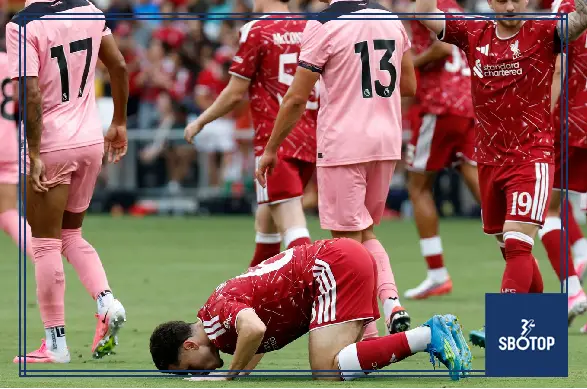
Andoni Iraola made a winning start as Liverpool head coach as the Reds defeated Sunderland 4–2 in an entertaining preseason encounter at GEODIS Park in Nashville.
Liverpool were forced to recover from a difficult spell in which Sunderland turned a one-goal deficit into a 2–1 lead. Iraola’s side responded with three unanswered goals in the second half, combining moments of individual quality with the direct, aggressive attacking football that supporters hope will define the new era.
Kieran Morrison opened the scoring for Liverpool before Enzo Le Fée equalised for Sunderland. Timur Tutierov then gave the Black Cats the lead shortly after half-time, raising the possibility that Iraola’s first match would end in defeat.
Dominik Szoboszlai changed the direction of the contest with an outstanding long-range strike. Federico Chiesa later restored Liverpool’s advantage before Lewis Koumas completed the scoring in the closing minutes.
The result provided Iraola with a positive beginning after he officially succeeded Arne Slot as Liverpool head coach in June 2026. Although the match was only a preseason friendly, it offered an early look at the intensity, vertical attacking and willingness to use young players that could shape the Reds’ new identity.
The victory was tempered by an injury to Joe Gomez, who was forced off inside the opening 10 minutes. With Liverpool already facing concerns over their defensive depth, the experienced defender’s condition became one of the most important issues to emerge from the game.
Morrison Delivers the First Goal of Iraola’s Reign
Liverpool began with an energetic side that mixed experienced first-team players with emerging academy talent. Several senior internationals remained unavailable after their World Cup involvement, giving younger members of the squad an important opportunity to impress the new coach.
Morrison took full advantage.
The young attacker opened the scoring in the 12th minute, becoming the first player to score for Liverpool under Iraola. Harvey Elliott helped create the opportunity before Morrison produced a composed finish across the goalkeeper.
The goal represented exactly the type of moment young players hope to deliver during preseason. Morrison did not merely participate in a high-profile friendly; he made a decisive contribution and demonstrated that he could remain calm in the final third.
Preseason is often described as a period for fitness and tactical development, but it can also reshape a player’s position within the squad. A youngster who enters the summer on the edge of senior consideration can suddenly force his way into the manager’s thinking through a series of confident performances.
Morrison’s goal provided an ideal start. He moved intelligently into space, timed his run and finished without hesitation.
For Iraola, it was also encouraging to see one of Liverpool’s academy players respond to the freedom and responsibility of a first-team role. The coach has inherited a club with a strong history of developing young talent, and the Nashville friendly suggested that pathway will remain open.
Gomez Injury Creates an Early Concern
Liverpool’s positive opening was interrupted by Gomez’s injury. The defender was unable to continue after fewer than 10 minutes and was replaced by 18-year-old Mor Talla Ndiaye. That change left Liverpool with an extremely inexperienced central defensive pairing, as Ndiaye joined fellow teenager Ifeanyi Ndukwe.
The situation immediately altered the test facing Iraola’s team.
Rather than playing behind an established defensive unit, Liverpool’s midfield and forwards had to support two young centre-backs learning to manage Sunderland’s senior attackers.
Iraola later described the injury as the most disappointing part of the evening. The exact seriousness was not immediately clear, but Gomez’s withdrawal highlighted Liverpool’s limited margin for further defensive problems.
Preseason injuries are especially frustrating because players are still building fitness. Clubs want to increase intensity gradually, but friendly matches inevitably include physical challenges and sudden movements that can expose players to setbacks.
Gomez’s versatility makes him particularly valuable. He can operate at centre-back or full-back and offers experience in a squad undergoing significant transition.
Liverpool will hope his removal was precautionary rather than evidence of a long absence.
The younger defenders nevertheless gained useful experience. Sunderland tested their positioning, communication and ability to defend space behind the line. Mistakes were inevitable, but those situations may accelerate their development.
Le Fée Brings Sunderland Level
Liverpool’s early control did not prevent Sunderland from responding.
The Black Cats began to find more space between Liverpool’s midfield and defence, particularly when the Reds pushed several players forward. Le Fée took advantage in the 28th minute, scoring to make it 1–1.
The goal was a reminder that Iraola’s attacking approach can carry risk.
His teams are known for pressing aggressively and moving the ball forward quickly. When the pressure succeeds, opponents can be trapped close to their own goal. When it is broken, however, space may appear behind the first line.
Sunderland showed enough composure to exploit those openings.
Le Fée’s equaliser also gave the match a more competitive edge. Liverpool could no longer treat the contest as a comfortable opening exercise. Their young defenders were placed under pressure, while the midfield needed to improve its control of transitions.
The response was not immediate. Sunderland remained dangerous and entered the interval with increasing confidence.
For Iraola, that difficult spell may ultimately have been more useful than an easy victory. Preseason should expose weaknesses while there is still time to correct them.
Tutierov Turns the Game Around
Sunderland completed the turnaround early in the second half.
Tutierov scored in the 49th minute, giving his team a 2–1 advantage and placing Liverpool in an unfamiliar position under their new coach.
The goal came before Iraola’s players had fully established their second-half rhythm. It demonstrated the importance of concentration immediately after the restart, particularly when substitutions and tactical adjustments have changed the shape of the match.
Liverpool’s defending again lacked stability. The inexperienced back line struggled to manage Sunderland’s movement, while the midfield did not prevent the attack from developing.
A preseason defeat would not have carried serious consequences, but the manner of Liverpool’s response still mattered.
The new coach wanted to see whether his team could maintain belief, increase the intensity and solve problems within the game.
Liverpool did not panic. Instead, they became more direct, pushed Sunderland backwards and began creating shooting opportunities from central areas.
That reaction was one of the most promising aspects of the evening.
Szoboszlai Changes the Mood with a Spectacular Goal
Szoboszlai produced the match’s outstanding moment in the 56th minute.
The Hungary international received possession well outside the penalty area and unleashed a powerful strike that flew beyond the goalkeeper.
It was a goal of exceptional quality and exactly the type of individual intervention that can transform a match.
Liverpool had been searching for a route back into the contest. Sunderland’s defensive shape was becoming increasingly compact, and the Reds had not consistently created clear opportunities inside the area.
Szoboszlai solved the problem from distance.
His ability to strike the ball powerfully has always been one of his greatest qualities. The challenge has been finding positions from which that weapon can be used regularly.
Iraola’s system may give him more opportunities to arrive in central attacking spaces. If Liverpool press high and recover possession quickly, Szoboszlai can receive the ball before the opposition defence has settled.
The goal also carried psychological importance.
Sunderland had begun to believe they could protect their lead. Liverpool suddenly had momentum again, and the pace of the game shifted.
Szoboszlai later created Liverpool’s fourth goal, completing an influential second-half performance.
Chiesa Makes His Case
Federico Chiesa restored Liverpool’s lead in the 72nd minute.
Calvin Ramsay supplied the assist, and Chiesa completed the move to make it 3–2.
The goal was significant for a player whose immediate future has attracted attention. Preseason offers Chiesa an opportunity to convince Iraola that he can become an important part of the new Liverpool attack.
The Italian forward brings speed, directness and the ability to play across the front line. At his best, he attacks defenders without hesitation and creates danger through movement rather than waiting for the game to come to him.
His finish against Sunderland demonstrated his instinct for arriving in scoring positions.
Liverpool’s attacking options are evolving, and the departure of established figures has created openings. Chiesa must now show that he can remain fit, perform consistently and adapt to Iraola’s high-intensity demands.
The new coach expects his forwards to contribute to the press as well as the attack. Chiesa has the athletic qualities to do that, but his positioning and timing will need to align with the rest of the team.
A goal in Iraola’s first game could provide an important confidence boost.
Koumas Completes the Victory
Koumas added Liverpool’s fourth goal in the 85th minute.
Szoboszlai created the opportunity, and the young forward applied the finish to end Sunderland’s hopes of another comeback.
Like Morrison, Koumas used the friendly to strengthen his case for further senior involvement.
Young forwards often enter preseason facing uncertainty. They may remain with the first team, leave on loan or return to academy football. Their performances during summer matches can heavily influence that decision.
Koumas showed energy, confidence and awareness after entering the contest.
His goal also reflected Liverpool’s improved control during the final stages. After falling behind, they scored three times without reply and finished the match with far greater authority.
The scoreline perhaps made the victory appear more comfortable than it had been. Sunderland had caused genuine problems and led early in the second half.
Nevertheless, Liverpool’s ability to finish strongly was encouraging.
Early Signs of Iraola’s Tactical Identity
One match cannot provide a complete understanding of Iraola’s Liverpool, especially when numerous senior players are still absent.
Even so, several familiar elements of his coaching style were visible.
Liverpool attempted to press high, recover the ball quickly and attack before Sunderland could organise their defensive structure.
The approach was energetic rather than cautious.
Iraola did not appear interested in using his first game simply to circulate possession safely. He wanted Liverpool to play forward, commit players and create pressure around Sunderland’s penalty area.
That philosophy produced exciting attacking moments, but it also left the Reds vulnerable when the press was bypassed.
The balance between aggression and control will become one of the central themes of Iraola’s first season.
Liverpool supporters generally expect proactive football. They want the team to press, attack and impose itself on opponents.
However, the Premier League will punish structural weaknesses far more severely than a preseason opponent.
Iraola must ensure that the midfield protects the defence and that the back line knows when to step forward or retreat.
The Sunderland match offered a useful starting point rather than a finished tactical product.
Iraola himself acknowledged that Liverpool lacked freshness after an intense period of training, describing the performance as something from which the team could build and improve.
Young Players Embrace Their Opportunity
The number of academy players involved was one of the evening’s most notable features.
Liverpool were without several established internationals, creating opportunities for Morrison, Koumas, Ndiaye, Ndukwe and other emerging players.
Morrison and Koumas scored. Ndiaye and Ndukwe were tested in central defence. Trey Nyoni and James McConnell also received valuable minutes as Liverpool attempted to maintain energy in midfield.
Preseason results are often quickly forgotten, but the developmental value of these matches can be considerable.
Young players learn what senior football demands physically and tactically. They experience playing in front of a crowd, responding to setbacks and following instructions in an unfamiliar environment.
They also show the manager how they react when the match becomes difficult.
Liverpool fell behind, yet the young players did not disappear. They remained involved and contributed to the comeback.
That resilience will please Iraola.
Not every academy player will secure a permanent first-team role this season. Some may need loan moves to gain consistent football.
However, the Nashville performance confirmed that Liverpool still possess a group of players capable of supporting the senior squad.
Also Read: