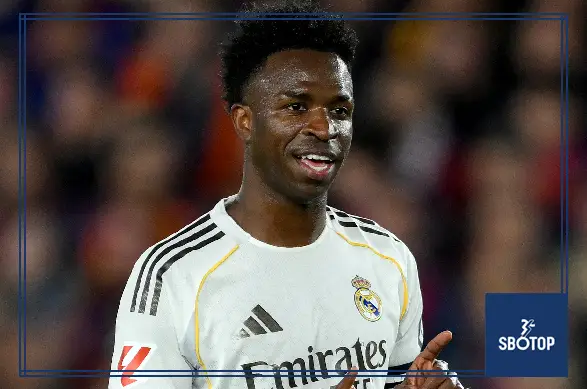
Arsenal are reportedly exploring an extraordinary move for Real Madrid forward Vinicius Junior as uncertainty continues to surround the Brazilian international’s future at the Santiago Bernabéu.
The Premier League champions have made preliminary enquiries about the feasibility of signing the 26-year-old, who has entered the final year of his Real Madrid contract. No formal offer has been submitted, and Arsenal have not yet opened official negotiations with the Spanish club, but their interest represents a significant statement of ambition.
Vinicius remains one of the most dangerous attackers in world football. His pace, close control, movement and experience in decisive Champions League matches make him an obvious target for any club seeking elite quality on the left wing.
Arsenal’s interest appears to be opportunistic. Real Madrid still want to renew the forward’s contract, and Spanish reports suggest that both parties are expected to hold further discussions before the new club season begins. However, those negotiations have not yet produced a publicly confirmed agreement.
Should talks remain unresolved, Madrid would face an uncomfortable decision. They could keep Vinicius for the final year of his contract and risk losing him without a transfer fee in 2027, or they could consider a major offer during the current window.
Arsenal are monitoring that uncertainty closely.
Their priority is not simply to add another attacking option. They are assessing whether a rare opening could allow them to recruit a global superstar capable of transforming their attack and elevating the club’s profile throughout Europe.
At this stage, the possibility remains complicated and expensive. Vinicius would command a substantial transfer fee despite his contract situation, while his wage expectations could force Arsenal to reconsider their existing salary structure. Nevertheless, the fact that the Gunners are studying the deal demonstrates the confidence created by their recent success.
Arsenal Look Beyond Ordinary Reinforcements
Arsenal’s recruitment strategy has changed considerably in recent years. The club previously focused heavily on younger players who could develop under Mikel Arteta. That approach helped create a competitive, technically accomplished squad with the potential to challenge for major trophies over several seasons.
After establishing themselves among Europe’s strongest teams, Arsenal can now consider a different category of signing.
Vinicius would not arrive as a talented prospect who might eventually become world-class. He is already an established Champions League winner, Brazil international and one of the most recognisable attacking players in the sport.
Signing him would represent a shift from long-term squad construction toward immediate dominance.
Arsenal already possess quality across the pitch, but their attack can still become predictable when opponents defend deeply. Much of their creativity has historically come from structured passing combinations, coordinated movement and the influence of their right-sided players.
Against organised defensive blocks, those qualities are not always enough.
A player capable of beating defenders individually can change the entire nature of an attack. Vinicius does not need a perfect passing sequence to create danger. He can receive possession near the touchline, accelerate beyond an opponent and force the defensive structure to collapse.
That type of ability is extremely difficult to coach and equally difficult to defend.
Arsenal’s interest therefore reflects a desire to add individual unpredictability to an already sophisticated collective system.
Why Vinicius Would Transform Arsenal’s Left Side
Vinicius is naturally most effective from the left wing, where he can attack defenders with his right foot and move diagonally toward goal.
His first few steps are explosive. A defender who stands too close risks being beaten immediately, while one who retreats gives him time to gather speed.
This creates a problem that often requires more than one player to solve.
Opponents frequently move a midfielder or winger across to protect the right-back. That additional cover may reduce Vinicius’ space, but it also creates openings elsewhere.
At Arsenal, those openings could be exploited by attacking midfielders, overlapping full-backs and the central striker.
If two defenders move toward Vinicius, space may appear near the edge of the penalty area. If the opposition remains narrow to protect the centre, Arsenal can isolate him one against one.
His presence would therefore influence the entire attacking shape even when he did not receive the ball.
Vinicius has also developed into a more complete goalscorer.
During the early stages of his Real Madrid career, his speed and dribbling were obvious, but his final decisions were inconsistent. He sometimes rushed shots, selected the wrong pass or moved into crowded areas.
Experience changed his game.
He learned to slow down at decisive moments, attack the correct spaces and combine more effectively with central forwards. That development turned him from an entertaining winger into one of Real Madrid’s most productive players.
Arsenal would be recruiting the mature version of Vinicius rather than the raw teenager who first arrived in Spain.
Arteta’s Tactical Challenge
The possibility is exciting, but Arteta would still need to integrate Vinicius carefully.
Arsenal’s system depends on positional discipline. Players are expected to occupy specific areas during the build-up, understand pressing triggers and react collectively when possession is lost.
Vinicius performs best when given freedom.
He likes to move inside, exchange positions and attack situations instinctively. Excessive restriction could reduce the spontaneous quality that makes him so dangerous.
Arteta would therefore need to find a balance between structure and expression.
The most logical solution would be to create stable support around the Brazilian while allowing him greater freedom in the final third.
A left-sided midfielder could remain close enough to offer short passing combinations, while the full-back adjusted his position according to Vinicius’ movement.
When the winger stayed wide, the full-back might move into midfield. When Vinicius drifted centrally, the defender could overlap and maintain width.
Those rotations could make Arsenal extremely difficult to contain.
Vinicius would also need to adapt to Arsenal’s defensive expectations. Arteta demands intense work without the ball, particularly from his wide players.
The Brazilian has the speed to press effectively, but the timing and positioning of that pressure would require detailed coaching.
If he embraced those responsibilities, Arsenal could gain an attacker who contributes to their collective intensity without losing his individual brilliance.
Real Madrid’s Contract Dilemma
Real Madrid confirmed in 2023 that Vinicius had extended his contract until June 2027. He is now entering the final season of that agreement, creating urgency around the next round of negotiations.
The club’s preference is believed to be a renewal.
Vinicius has played a central role in Madrid’s recent success, scoring in major European matches and developing into one of the principal faces of the team.
Allowing him to leave would represent a major sporting and commercial loss.
However, contract negotiations involving elite players are rarely simple. Salary, signing bonuses, image rights and status within the squad can all become important.
Reports have suggested that Vinicius’ representatives are seeking a financial package that reflects his position among the world’s leading forwards. Madrid must decide how far they are willing to adjust their existing wage structure.
The presence of Kylian Mbappé adds another layer.
Both players are naturally dangerous from the left, even though they can operate in other positions. Real Madrid must define how the attack will be structured and whether Vinicius continues to feel central to the club’s project.
Spanish reports have indicated that Madrid and Vinicius planned to meet in late July to continue renewal discussions. Those reports also suggested that both parties remained optimistic about finding an agreement.
Until that agreement is signed, Arsenal will continue watching.
Why Madrid Could Consider a Sale
Selling Vinicius would initially appear unthinkable, but the contractual risk cannot be ignored.
From January 2027, the forward would be permitted to discuss a pre-contract agreement with clubs outside Spain if no extension had been completed.
Madrid could then lose a highly valuable player without receiving a fee.
Elite clubs generally try to avoid that situation. Even when they want to retain a player, they must consider a sale if contract talks reach a genuine deadlock.
Arsenal’s enquiry may therefore be designed to establish what Madrid would require before making a final decision.
The Spanish club would still demand a major fee. Vinicius’ contract reduces their leverage, but it does not remove his sporting value.
Reports have also linked Real Madrid with RB Leipzig winger Yan Diomandé. Madrid’s pursuit of another left-sided attacker has increased speculation that they may be preparing for significant changes, although interest in Diomandé does not automatically mean Vinicius will leave.
Major clubs often recruit young forwards before they become essential, and Madrid may simply be strengthening their depth.
Nevertheless, the timing has encouraged Arsenal to investigate.
The Financial Scale of the Operation
A transfer would require one of the largest financial commitments in Arsenal’s history.
The fee alone could exceed anything the club have previously paid. Although Madrid’s negotiating position is weakened by the contract, they would not allow Vinicius to leave cheaply.
His salary would be equally important.
Reports around the renewal talks have linked the player with demands that would place him among the highest-paid footballers in Europe. Arsenal would have to decide whether to break or significantly stretch their wage structure.
That decision would affect the entire squad.
When one player earns considerably more than his teammates, other leading performers may seek improved contracts. Arsenal must consider not only the cost of Vinicius’ deal but also its wider consequences.
There are also financial-regulation requirements.
The club must ensure that any transfer, signing bonus and salary can be accommodated without restricting future recruitment.
Arsenal may need to sell players before completing such an operation. Departures could generate transfer income and create room within the wage budget.
The deal would therefore be more complicated than submitting one spectacular offer.
It would require careful planning across several departments and confidence that Vinicius represents the final piece of a championship-winning attack.
Why Arsenal Could Appeal to Vinicius
Real Madrid remain one of the most prestigious clubs in world football, so Arsenal would need to offer more than money.
The sporting project would be central.
Arsenal can present a young, competitive squad capable of challenging for the Premier League and Champions League. Vinicius would join a team approaching its peak rather than one undergoing a complete rebuild.
He could also become the defining attacking figure at the Emirates.
At Madrid, attention is shared among Mbappé, Jude Bellingham and several other global stars. At Arsenal, Vinicius would immediately become one of the central faces of the project.
Arteta could build the left side of the attack around his qualities.
The opportunity to play in the Premier League may also appeal to him. England offers intense competition, enormous global exposure and the chance to test himself against a different style of football.
London could provide commercial opportunities without reducing the sporting level of his career.
Arsenal would need to convince him that leaving Madrid is not a step backward.
Their recent success makes that argument more credible than it would have been several years ago.
Also Read: