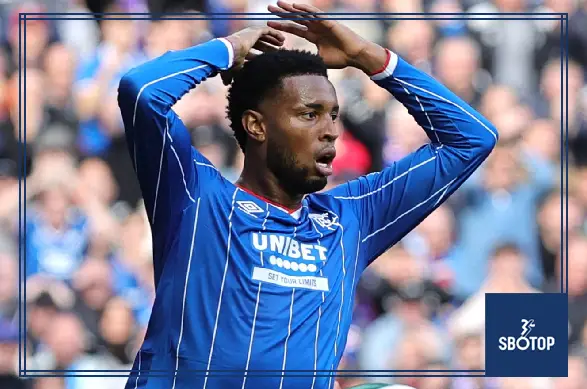
Rangers have suffered a major setback at a particularly difficult stage of the season after confirming that striker Youssef Chermiti has sustained an anterior cruciate ligament injury. The Portuguese forward was forced off during the defeat to Hibernian and will now spend a significant period away from competitive football.
The injury represents a serious blow for both Chermiti and Rangers. The 22-year-old had established himself as an important attacking option after an impressive campaign last season, while the club had also been dealing with considerable interest in his services from elsewhere.
Rangers confirmed following medical assessment that Chermiti had suffered ACL damage during the Scottish Premiership match against Hibernian. The club did not provide a specific recovery timeline, instead stating that the striker would be out of action for a “significant period of time.”
For a player at the beginning of his career, the injury creates an unwanted interruption to the momentum he had built. For Rangers, meanwhile, the timing could hardly be more challenging, with the club preparing for a demanding schedule and still working to shape its squad under manager Derek McInnes.
A Painful Moment Against Hibernian
Chermiti’s injury occurred during Rangers‘ home defeat to Hibernian at Ibrox.
The striker went down in the first half after colliding with the advertising boards. He required medical attention before being taken from the pitch on a stretcher, later leaving the stadium wearing a protective boot and knee brace.
The incident immediately raised concerns about the seriousness of the injury.
Before being forced off, Chermiti had shown signs of being a threat to the Hibernian defence. McInnes later indicated that the striker had looked lively and had been making purposeful movements to create gaps.
His early departure therefore affected Rangers not only physically but also tactically.
The team lost one of its main attacking outlets at a time when it was already searching for consistency. The defeat added further frustration, while the subsequent diagnosis turned an already difficult afternoon into a much more significant setback.
Rangers Confirm the ACL Diagnosis
Following further assessment, Rangers confirmed the extent of Youssef Chermiti injury.
The club announced that the striker had suffered an ACL injury and would be unavailable for a significant period. Rangers also expressed their support for the player as he began the recovery process.
An ACL injury is among the most challenging setbacks a footballer can experience because rehabilitation is typically measured in months rather than weeks.
Although Rangers have not publicly provided a definitive return date, the wording surrounding the injury makes it clear that Chermiti faces an extended absence.
For the player, the immediate focus will now shift from scoring goals and competing for selection to rehabilitation, recovery and gradually rebuilding his physical condition.
A Major Setback After an Impressive Season
The injury is particularly unfortunate because Chermiti had been developing into an important player for Rangers.
After joining the Glasgow club from Everton, the Portuguese forward produced a strong first campaign. He scored 15 goals across the Scottish Premiership and contributed five assists in all competitions last season.
His numbers demonstrated his growing influence.
Chermiti was not simply a player who occasionally found the net. He became a significant part of Rangers’ attacking structure and regularly posed a threat around the penalty area.
His ability to make runs behind defenders, occupy central positions and create shooting opportunities made him an increasingly valuable option.
That progress had also attracted attention beyond Scotland.
The combination of his age, potential and performances had increased his value in the transfer market.
Now, however, his development has been temporarily interrupted.
The Timing Makes the Injury Even More Difficult
One of the most unfortunate aspects of the situation is when the injury happened.
Rangers had reportedly rejected a significant approach from Galatasaray for Chermiti shortly before the Hibernian match. Reports indicated that the Turkish club had made a major bid for the striker, but Rangers decided that the offer did not meet their valuation.
The injury therefore arrived at a particularly dramatic moment.
Only hours earlier, Chermiti had been at the centre of transfer speculation.
After the injury, the immediate conversation changed completely.
Instead of discussing a possible move, the focus became his health and recovery.
For Chermiti personally, that change must be difficult. He had reached a point where his performances were attracting serious interest, only to suffer a major injury that will now keep him away from the pitch for a prolonged period.
McInnes Loses an Important Attacking Option
The setback is equally significant for Derek McInnes.
The Rangers manager is still attempting to establish his preferred style and build a competitive squad. Losing an important striker so early in the campaign reduces his options at a critical time.
McInnes had already highlighted Chermiti’s potential before the injury.
After the Hibernian match, the manager expressed disappointment that the striker had been forced to leave the game, noting that he had looked bright and was making useful movements.
That assessment underlines what Rangers are losing.
Chermiti offered more than goals.
His movement could create spaces for teammates. His presence could occupy central defenders. His ability to stretch the defensive line could change the way opponents approached Rangers.
Replacing all of those qualities will not necessarily be straightforward.
Rangers Must Now Consider Their Options
Chermiti’s injury inevitably creates questions about Rangers’ attacking depth.
With the striker unavailable for a substantial period, the club may need to consider whether another forward should be brought in.
Reports have indicated that Rangers are already assessing options in the transfer market following the injury.
The timing is important because the transfer window is approaching its closing stages.
Recruiting a replacement is not simply about finding someone who can score goals.
Rangers need a player who can adapt quickly, understand the demands of the club and contribute to a team that is still undergoing changes.
A new striker would also have to deal with the pressure of arriving at a major Scottish club where expectations are high.
Lawrence Shankland Faces Greater Responsibility
One player likely to receive greater attention as a result of Chermiti’s absence is Lawrence Shankland.
The forward arrived from Hearts with a strong reputation as a goalscorer and will now have an even greater opportunity to become a central figure in Rangers’ attack.
Shankland’s responsibility will not necessarily mean he must replicate Chermiti’s style.
Instead, Rangers may need to adjust their attacking approach depending on the characteristics of the available forwards.
The coaching staff could experiment with different formations or attacking combinations.
That flexibility could become particularly important during the period Chermiti is unavailable.
The Challenge of Replacing Goals
The most obvious concern is Chermiti’s goal production.
Fifteen league goals is a substantial contribution.
Replacing that output cannot be guaranteed simply by giving additional minutes to another player.
Goals often come from the collective structure of a team.
The midfield must create chances. Wide players must deliver quality balls. Full-backs must provide support. Strikers must make intelligent movements.
Therefore, Rangers may need to compensate collectively rather than expecting one player to replace everything Chermiti offered.
More goals may need to come from midfield.
Wingers could be asked to attack the penalty area more frequently.
Set pieces could become even more important.
The Psychological Challenge for Chermiti
While the tactical implications for Rangers are significant, the personal impact on Chermiti should not be overlooked.
An ACL injury can be psychologically demanding.
Footballers spend most of their lives training and competing. Suddenly being removed from that environment can be extremely difficult.
There is also the uncertainty surrounding rehabilitation.
Progress is often measured gradually.
Some days may feel encouraging, while others may be frustrating.
Patience becomes essential.
Chermiti will need to focus on each stage of recovery rather than becoming consumed by the question of when he will return.
Rehabilitation Will Be a Long Process
The recovery journey from an ACL injury involves multiple stages.
The early phase generally focuses on controlling swelling, restoring movement and preparing the knee for further rehabilitation.
Later stages involve rebuilding strength and stability.
Eventually, the player must gradually return to football-specific movements, including running, changing direction and high-intensity actions.
The final stages involve regaining confidence and demonstrating that the body can handle the demands of competitive football.
For Chermiti, every step will matter.
The goal will not simply be to return quickly.
The priority must be returning properly and safely.
Support from Rangers Will Be Important
Chermiti will need strong support throughout the process.
That support can come from Rangers’ medical team, coaching staff, teammates and supporters.
Football clubs play an important role in helping injured players remain connected to the squad.
Even when a player cannot train with the team, maintaining a sense of belonging can be valuable.
Chermiti will remain part of Rangers’ wider plans even while he is unavailable.
The club’s public message of support is therefore significant.
A Different Kind of Test
For a young player, an extended injury can become a major test of character.
Chermiti has already shown that he can handle pressure on the pitch.
Now he must demonstrate patience away from it.
Rehabilitation requires discipline.
There are no shortcuts.
The player must complete exercises repeatedly, follow medical advice and accept that progress can sometimes be slower than expected.
Those qualities will be essential if Chermiti is to return at his best.
Rangers Also Face a Mental Test
The injury is not only a test for Chermiti.
It is also a challenge for Rangers as a team.
Players may feel disappointed after seeing a teammate suffer such a serious setback.
The squad must now channel that disappointment into motivation.
A strong dressing room can respond positively to adversity.
Players can dedicate performances to their injured teammate while continuing to work toward the club’s objectives.
That collective mentality could become important as the season develops.
The Importance of Squad Depth
Chermiti’s injury highlights the importance of having sufficient depth.
A long season inevitably brings injuries, suspensions and periods of poor form.
A club with multiple quality options is better positioned to deal with those setbacks.
Rangers now have to evaluate whether their existing squad is capable of handling Chermiti’s absence.
If not, recruitment may become necessary.
But there is another solution as well: existing players can step forward.
Young forwards could receive more opportunities.
Players who have previously played wider positions may be moved centrally.
Tactical adjustments could also help compensate.
Opportunity for Other Players
Every injury creates an unwanted opportunity for someone else.
For Rangers’ attacking players, Chermiti’s absence could open the door to increased responsibility.
Players who had previously been competing for substitute appearances may now find themselves starting.
That can be valuable for squad development.
However, increased opportunity also comes with increased expectations.
Players must be ready to handle greater pressure.
If someone can establish themselves during Chermiti’s absence, Rangers could emerge from the situation with greater attacking depth than before.
The Broader Impact on Rangers’ Season
The timing of the injury means Rangers cannot afford to lose momentum.
The club is dealing with several early-season challenges under McInnes, and Chermiti’s absence adds another complication.
The manager now has to balance immediate results with longer-term squad development.
European fixtures, domestic competition and cup matches can create a demanding schedule.
Rotation will therefore become important.
Players need to remain physically ready and mentally focused.
The absence of one key attacker can affect how the manager distributes minutes across the squad.
Chermiti’s Previous Development Offers Encouragement
Despite the seriousness of the injury, Chermiti’s development before the setback provides reason for optimism.
His 15 league goals last season showed that he was capable of performing consistently at Rangers.
He also produced five assists across all competitions, demonstrating that his contribution extended beyond finishing.
His performances helped establish him as a valuable young forward.
That progress does not disappear because of one injury.
If he completes his rehabilitation successfully, he can use the experience as another chapter in his development.
Returning Stronger Will Be the Objective
The biggest goal for Chermiti will eventually be to return to competitive football.
But there should be no unnecessary rush.
The body needs time to recover.
The player also needs to rebuild confidence.
Returning from an ACL injury is not simply about proving that the knee is physically ready.
The player must trust the injured leg again.
Football involves explosive movements, sharp changes of direction and physical challenges.
Confidence will be essential.
A Long Road But Not the End
For Chermiti, this injury represents a setback rather than the end of his progress.
At 22, he has plenty of time to continue developing.
The experience may be difficult, but many players have successfully returned from serious knee injuries and resumed their careers.
What matters now is the process.
Every rehabilitation session will contribute to his eventual return.
Every small improvement should be viewed as progress.
Also Read: